Iran's supreme leader presides over funeral for president and others killed in helicopter crash
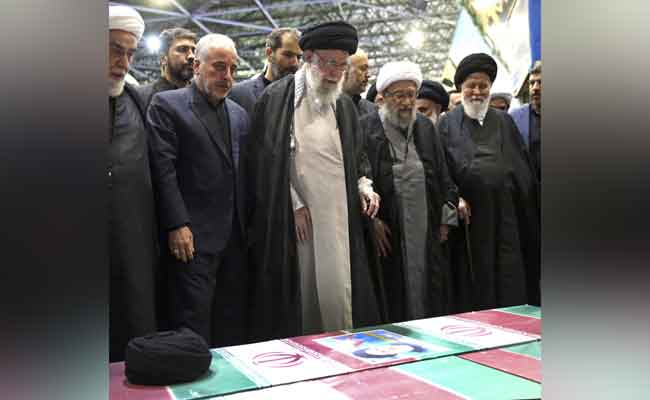
Dubai (AP): Iran's supreme leader presided over a funeral Wednesday for the country's late president, foreign minister and others killed in a helicopter crash, as tens of thousands later followed a procession of their caskets through the capital, Tehran.
Ayatollah Ali Khamenei held the service at Tehran University, the caskets of the dead draped in Iranian flags with their pictures on them. On the late President Ebrahim Raisi's coffin sat a black turban — signifying him as a direct descendent of Islam's Prophet Muhammad.
“Oh Allah, we didn't see anything but good from him,” Khamenei said in the standard prayer for the dead in Arabic, the language of Islam's holy book, the Quran. He soon left and the crowd inside rushed to the front, reaching out to touch the coffins. Iran's acting president, Mohammad Mokhber, stood nearby and openly wept during the service.
People then carried the coffins out on their shoulders, with chants outside of "Death to America!" They loaded them onto a semitruck trailer for a procession through downtown Tehran to Azadi, or “Freedom,” Square, where Raisi gave speeches in the past. People threw scarves and other items up for attendants on the truck to touch to the coffins for a blessing.
In attendance were top leaders of Iran's paramilitary Revolutionary Guard, one of the country's major power centres. Also on hand was Ismail Haniyeh of Hamas, Before the funeral, Haniyeh spoke and an emcee led the crowd in the chant: “Death to Israel!”
“I come in the name of the Palestinian people, in the name of the resistance factions of Gaza ... to express our condolences,” Haniyeh told those gathered.
He also recounted meeting Raisi in Tehran during Ramadan, the holy Muslim fasting month, and heard the president say the Palestinian issue remains the key one of the Muslim world.
The Muslim world “must fulfil their obligations to the Palestinians to liberate their land," Haniyeh said, recounting Raisi's words. He also described Raisi calling the October 7 attack that sparked the war, which saw 1,200 people killed and 250 others taken hostage, an “earthquake in the heart of the Zionist entity.” The war since has seen 35,000 Palestinians killed in the Gaza Strip and hundreds of others in the West Bank in Israeli operations.
Also expected to attend services in Tehran were Pakistan's Prime Minister Shehbaz Sharif and a delegation from the Taliban of Afghanistan, including their Foreign Minister Amir Khan Mutaqqi. Iraq's Prime Minister Mohammed Shia al-Sudani also flew in for the ceremony, along with Armenian Prime Minister Nikol Pashinyan.
Even Egyptian Foreign Minister Sameh Shoukry travelled to Tehran, despite diplomatic relations between the countries being severed after the 1979 revolution. Egypt and Iran have recently discussed reestablishing ties.
But notably, none of Iran's living past presidents — other than Khamenei — could be seen in state television footage of the prayers. They include reformist Mohammad Khatami, hard-liner Mahmoud Ahmadinejad and relative moderate Hassan Rouhani — all individuals who maintain some political cachet within Iran's tightly controlled political system.
Authorities offered no explanation for their absence from the event, which comes weeks ahead of a planned June 28 presidential election. As of now, there's no clear favourite for the position among Iran's political elite — particularly no one who is a Shiite cleric, like Raisi.
Iran's theocracy declared five days of mourning over Sunday's crash, encouraging people to attend the public mourning sessions. Typically, government employees and schoolchildren attend such events en masse, while others take part out of patriotism, curiosity or to witness historic events.
For Iran's Shiite theocracy, mass demonstrations have been crucial to demonstrating the legitimacy of their leadership since millions thronged the streets of Tehran to welcome Grand Ayatollah Ruhollah Khomeini in 1979 during the Islamic Revolution, and also attended his funeral 10 years later.
An estimated 1 million turned out in 2020 for processions for the late Revolutionary Guard Gen. Qassem Soleimani, who was slain in a US drone strike in Baghdad. In that ceremony, Khamenei openly wept over Soleimani's casket alongside Raisi. On Wednesday, Khamenei appeared composed, though he later hugged family members of the dead on his way out.
Whether Raisi, Foreign Minister Hossein Amirabdollahian and others draw the same crowd remains in question, particularly as Raisi died in a helicopter crash, won his office in the lowest-turnout presidential election in the country's history and presided over sweeping crackdowns on all dissent.
Prosecutors already have warned people over showing any public signs of celebrating his death and a heavy security force presence has been seen on the streets of Tehran since the crash.
Raisi, 63, had been discussed as a possible successor for Iran's supreme leader, the 85-year-old Khamenei. The only other person suggested was Khamenei's 55-year-old son, Mojtaba. However, concerns have been raised over the position going to a family member, particularly after the revolution overthrew the hereditary Pahlavi monarchy of the shah.
Meanwhile, an Iranian official offered a new account of Sunday's crash, further fuelling the theory bad weather led to it. Gholamhossein Esmaili, who travelled in one of the two other helicopters in Raisi's entourage, told state TV that weather had been fine when the aircraft took off. But Raisi's helicopter disappeared into heavy clouds and the others couldn't reach the aircraft by radio, forcing them to land at a nearby copper mine.
Neither Amirabdollahian or a bodyguard on board responded to calls, but Tabriz Friday prayer leader Mohammad Ali Ale-Hashem somehow answered two mobile phone calls, Esmaili said. It wasn't clear why Iran then couldn't track the phone's signal.
“When we found the location of the accident, the conditions of the bodies indicated that Ayatollah Raisi and other companions had died instantly but Ale-Hashem ... (died) after several hours,” he said.
Let the Truth be known. If you read VB and like VB, please be a VB Supporter and Help us deliver the Truth to one and all.
BCI urges CJI to take action against Andhra HC judge for sending young lawyer to 24-hour custody
New Delhi (PTI): The Bar Council of India on Wednesday sought the urgent intervention of Chief Justice of India Surya Kant following a "deeply disturbing" incident where a judge of the Andhra Pradesh High Court reportedly sent a young advocate to
24-hour judicial custody over a procedural lapse.
The Bar Council of India (BCI) Chairperson and senior advocate Manan Kumar Mishra, in a formal representation, termed the conduct of Justice Tarlada Rajasekhar Rao "grossly inappropriate" and "damaging to the confidence of the Bar".
“I most respectfully request your Lordship to kindly take immediate institutional cognizance of the matter and call for the video recording of the proceedings, the order passed, and the surrounding circumstances.
“I further request that appropriate administrative action may kindly be considered, including withdrawal of judicial work from the learned Judge pending review, his immediate transfer to some far off High Court, and his nomination for appropriate judicial training/orientation on court management, judicial temperament, Bar-Bench relations, and proportional exercise of contempt/judicial authority,” Mishra wrote.
This representation is made to preserve the “dignity, moral authority and public confidence of the judiciary”, he said, adding, “Judges command the highest respect not by fear, but by fairness, patience, restraint and constitutional humility”.
The communication urged the CJI to intervene at the earliest to ensure that the faith of Bar, particularly young advocates, in the protective and corrective role of the judiciary is restored.
The controversy stems from proceedings on May 5.
According to the BCI, a video circulating online shows Justice Rao rebuking a young advocate who was unable to produce a specific order copy during a hearing.
The letter said that despite the advocate "repeatedly seeking pardon and mercy" and claiming he was in physical pain, the judge remained "unmoved".
The judge allegedly told the lawyer, "now you will learn," and mocked his experience before directing the Registrar and police personnel to take him into custody for 24 hours.
The BCI chairperson said that the judge’s actions lacked proportionality and fairness.
"The dignity of the court is not enhanced when a lawyer is made to beg for grace in open court and is still sent to custody for a procedural lapse," the letter said.
"A young lawyer... is an officer of the Court, still learning, still growing, and entitled to correction without humiliation," it added.
The bar body said that such actions create a "chilling effect" on the legal fraternity, particularly among junior members, and undermine the mutual respect required between the Bench and the Bar.