Iraqi protesters defy curfew as violence leaves 31 dead
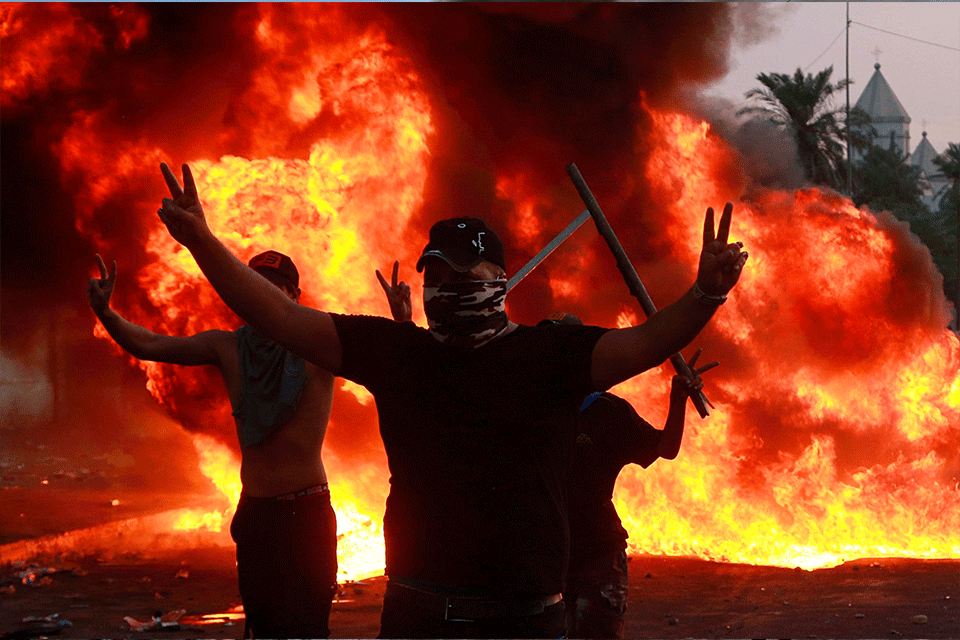
Baghdad: Anti-government demonstrators defied an around-the-clock curfew in Baghdad and other cities Thursday as Iraqi security forces used live ammunition and tear gas during a third day of unrest that has left 31 people dead, most of them protesters.
Authorities cut internet access in much of Iraq since late Wednesday in a desperate move to curb the rallies. By Thursday afternoon, the curfew was extended to three other southern provinces.
The spontaneous rallies have been spurred mostly by youths wanting jobs, improved services such as electricity and water, and an end to endemic corruption in the oil-rich country. Most of the demonstrators were peaceful; many had their faces covered with masks or Iraqi flags.
The streets of Baghdad were littered with tear gas canisters and empty bullet casings. Smoke from burned tires rose above the streets as protesters tried to prevent security forces from advancing. The forces spread barbed wires and armoured vehicles to block their path.
Even with a curfew, we are not turning back, shouted protester Abu Qassim.
The unrest is the most serious challenge for Prime Minister Adel Abdul-Mahdi's year-old government, which also has been caught in the middle of increasing US-Iran tensions in the region.
Iraq is allied with both countries and hosts thousands of US troops, as well as powerful paramilitary forces allied with Iran.
Middle East expert Jennifer Cafarella, with the Washington-based Institute for the Study of War, said the immediate and widespread use of force against protesters in multiple provinces demonstrates that the security forces are overwhelmed by the volume and rate of spread of the rallies.
There were indications that the regional tension is at play. Some Baghdad demonstrators blamed Iranian-backed groups within the security forces for the violence.
Media affiliated with the Iranian-backed groups have pointed fingers at the United States and Saudi Arabia for the unrest. Cafarella said that indicates the potential for escalation between protesters and these forces.
One protester in Baghdad held up an empty casing to journalists, screaming: Look! These are Iranian bullets!
In the last three days, at least 20 protesters and one policeman were killed in four provinces. On Thursday, the first death was reported in Baghdad where one protester was killed as the demonstrators pushed their way toward Tahrir Square in the city centre.
The square has been off-limits since Wednesday night just before the curfew.
Soon after, protesters overpowered a soldier in his armoured vehicle, setting it on fire and warning other security forces to stay away from the square. The protesters then marched toward the square. There were also fires set to parts of government buildings in the southern provinces of Najaf and Dhiqar.
At least three protesters were shot and killed Thursday in Zaafaraniya, a southern Baghdad neighborhood, according to police and a medial official.
Explosions were heard before dawn inside Baghdad's heavily fortified Green Zone, home to government offices and foreign embassies. The US-led coalition said an investigation was underway into the attack, adding that no coalition forces or assets were hit.
An Iraqi security official said two mortar shells hit the Green Zone, falling on an open space and not causing any injuries. The official spoke on condition of anonymity in line with regulations.
In the latest deaths, at least six protesters were shot and killed Thursday in the city of Nasiriyah, about 320 kilometers (200 miles) south of Baghdad, a medical official told The Associated Press. Nasiriyah has seen the most violence since the protests began Tuesday.
The mostly leaderless protests have been concentrated in Baghdad and in predominantly Shiite areas of southern Iraq, bringing out jobless youths and university graduates who are suffering under an economy reeling from graft and mismanagement.
I came here to seize back my rights, said Ahmed Abdul-Sattar, a protester in his early 20s. I can't get a government job or find any other job. It is a corrupt government and we came here to take our rights.
Two demonstrators were killed Tuesday and at least 17 deaths were reported Wednesday, including a policeman, in rallies in Nasiriyah, Kut, and Amara, according to security officials.
The coalition urged all sides to reduce tensions and reject violence.
Iraq's state news agency said Parliament Speaker Mohammed al-Halbusi invited representatives of the protesters to parliament to discuss their demands. Iraqi state TV broadcast numbers for the office of the prime minister in an outreach to the seemingly leaderless protests.
Iraq's Foreign Ministry summoned Iran Ambassador Iraj Masjedi to denounce his threat that Tehran would retaliate to a US attack anywhere in the world, including in Iraq.
A ministry statement said Iraqi official Abdul-Karim Hashem told him that American troops are in Iraq at the request of the Iraqi government and that Iraq will not accept becoming an arena for international conflicts.
Iran urged its citizens to postpone pilgrimages to Shiite holy sites in Iraq amid the turmoil. Iran's Foreign Ministry expressed hope the Iraqi government, political parties and groups would help calm the disturbances that it said were being exploited by foreign elements.
Baghdad's main streets were largely deserted Thursday morning, except for Iraqi army vehicles. Some side roads were blocked with barbed wire.
Let the Truth be known. If you read VB and like VB, please be a VB Supporter and Help us deliver the Truth to one and all.
AIITA welcomes Karnataka’s ban on obscene songs in school events
Bhatkal: The Karnataka unit of the All India Ideal Teachers Association (AIITA) has welcomed the Karnataka government’s decision to strictly ban school children from dancing to obscene songs during educational and cultural programmes in government, aided, and private schools across the state.
AIITA Karnataka State President M. R. Manvi congratulated the government for taking what he termed an important step to preserve the sanctity of education.
“Such decisions to safeguard the dignity of school children and uphold the values of education are the need of the hour. This rule should not be limited to government schools alone but must be strictly implemented in all private educational institutions as well,” he said.
He further urged the government to address other concerns within school programmes.
“The government should not only prohibit obscene dances in the name of school anniversaries, but also ensure that plays and dialogues that incite religious hatred are avoided. Schools should be centres of harmony, not platforms for spreading hatred,” he added.
According to a recent circular issued by the Department of School Education and Literacy, obscene dances are adversely affecting the mental health and moral values of students.
In this regard, schools have been advised to use songs that promote nationalism, positive thinking, the greatness of Kannada culture, and value-based traditions instead of inappropriate content during programmes.
The circular also emphasises that students should be dressed in decent attire.
AIITA also backed the department’s warning that disciplinary action would be taken against head teachers if such guidelines are violated. The association has further demanded that district Deputy Directors of Public Instruction strictly monitor the implementation of these rules.