Israel begins administering 4th vaccine dose
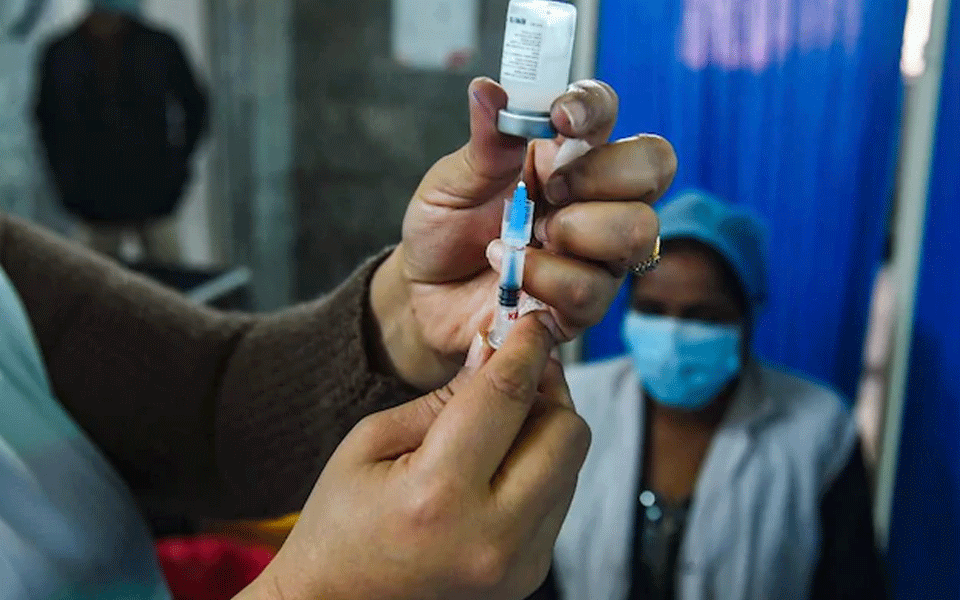
Jerusalem (AP): Israel has begun delivering a fourth vaccine dose for people most vulnerable to coronavirus, becoming one of the first countries to do so as it prepares for a wave of infections driven by the omicron variant.
Israel, which led a world beating vaccination program in 2020, will administer a fourth dose of the vaccine to individuals with weakened immune systems along with elderly residents and employees in care homes.
The rollout of the fourth dose began at Israel's Sheba Medical Center Friday morning and was administered to heart and lung transplant patients.
The country is currently experiencing a new wave of infections fueled by the transmissible omicron variant. There were 4,085 new cases recorded on Thursday, the highest daily count of infections Israel has seen since late September.
In response, Israel introduced new restrictions late Thursday in a bid to curb rising infection rates ahead of new year's eve celebrations. These include a Green Pass, given to fully vaccinated individuals or those who have recently recovered from coronavirus, for outdoor events of more than 100 people and mandatory mask-wearing in outdoor events of more than 50 people.
Israel, a country of 9.3 million people, has reported 8,243 deaths from the coronavirus since the start of the pandemic. Most of its population more than 6.5 million people has received at least one dose of the Pfizer/BioNTech vaccine, and more than 4.2 million Israelis have received two doses and a booster. (AP)
Let the Truth be known. If you read VB and like VB, please be a VB Supporter and Help us deliver the Truth to one and all.
Vartha Bharati–Sankalp predictions align closely with Karnataka bypoll results
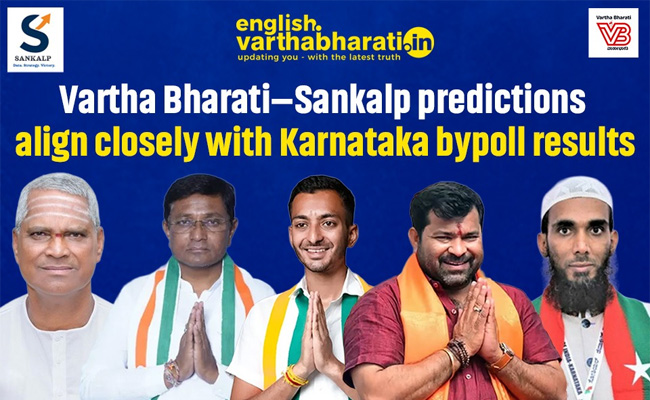
Bengaluru: The Vartha Bharati–Sankalp election analysis has shown a high level of accuracy in predicting the outcome of the recent Karnataka Assembly by-elections held in May 2026, correctly calling winners in both constituencies and closely estimating vote share trends.
The by-elections were held in Bagalkot and Davanagere South, drawing significant political attention as both seats were seen as key tests for the ruling Congress and opposition BJP.
According to the analysis, Vartha Bharati–Sankalp had made three major projections ahead of the results the winning party, vote share percentages, and margin of victory.
In both constituencies, the platform accurately predicted that the Congress would emerge victorious. The outcome matched the projections, with Congress candidates winning in Bagalkot and Davanagere South.
In terms of vote share, the predictions were largely in line with the final results. In Bagalkot, the BJP’s vote share was forecast in the range of 40 to 46 per cent, while the actual figure stood at 42.9 per cent. The Congress vote share, however, exceeded expectations, with the party securing 55.4 per cent against a projected range of 43 to 48 per cent.
The margin of victory in Bagalkot turned out to be significantly higher than anticipated. While the projection had placed the margin between 2,000 and 3,500 votes, the final margin was around 22,332 votes.
In Davanagere South, the predictions also remained largely accurate. The Congress vote share was projected between 43 and 51 per cent, and the final figure stood at 43.9 per cent. The BJP was expected to secure between 42 and 50 per cent but ended with 40.3 per cent.
The analysis had also identified the role of SDPI as a potential spoiler in the constituency. While its vote share was estimated around 6 per cent, the party eventually secured around 12 per cent of the vote.
The margin of victory in Davanagere South was predicted to be between 1,500 and 2,600 votes. The actual margin was higher at around 5,708 votes, though the contest remained relatively close as anticipated.
Overall, the performance of Vartha Bharati–Sankalp stood out for correctly identifying the winning parties in both seats and maintaining close accuracy in vote share estimates, with only limited deviations in specific cases.