Israel, Egypt held secret meeting over Gaza in May: Report
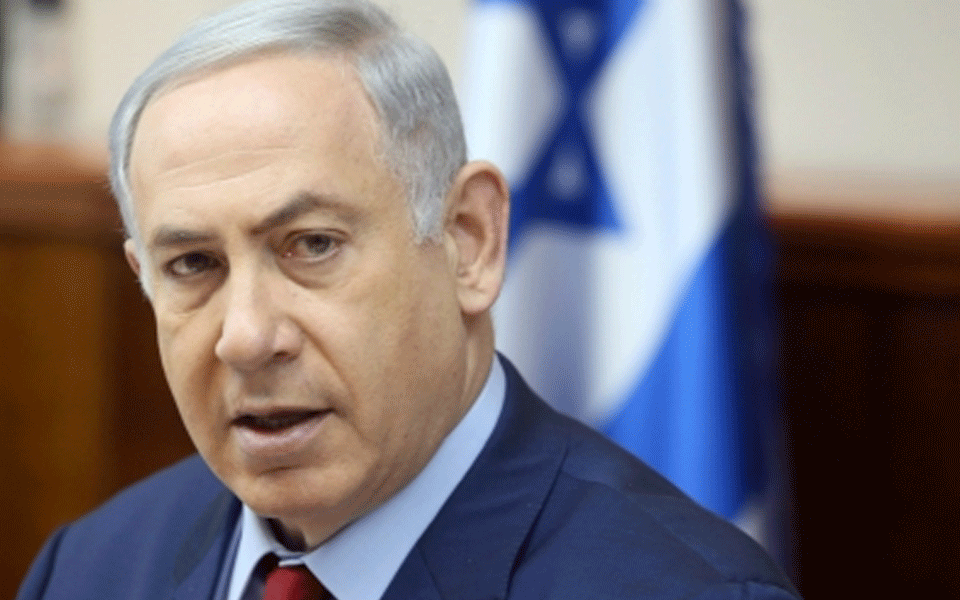
Jerusalem, Aug 14: Israeli Prime Minister Benjamin Netanyahu held a secret meeting with Egyptian President Abdel-Fattah al-Sisi in Cairo in May over the issue of the Gaza Strip, a media report said on Monday.
The Hebrew-language Channel 10 TV news reported Monday that the Israeli Prime Minister's Office was not immediately available for comments, but quoted anonymous US officials as saying that Netanyahu and a few of his advisors took a flight to Cairo on May 22 to meet with Sisi.
The meeting focused on Egypt's efforts to advance a diplomatic solution to the situation in Gaza, which includes the reinstatement of the Palestinian National Authority's role in Hamas-run Gaza and a cease-fire between Israel and Hamas, Xinhua quoted the report as saying.
In return, Israel and Egypt would significantly ease their 11-year crippling blockade imposed on the Palestinian enclave to enable its rehabilitation.
The two leaders also discussed the new US peace plan that the White House has been working to advance for the Israeli-Palestinian conflict.
The latest severe escalation of fighting between Israel and Gaza came last week, as Israel struck hundreds of sites in Gaza, killing three, while Gaza militants launched about 200 rockets toward southern Israel without causing casualties.
Egypt and the US have been key players in the efforts to achieve a cease-fire agreement between Israel and Hamas.
Sisi and Netanyahu held their first official meeting in New York in September 2017, when they discussed possible ways to restart the long-stalled peace talks between Israel and the Palestinians.
Let the Truth be known. If you read VB and like VB, please be a VB Supporter and Help us deliver the Truth to one and all.
Tribals, Scheduled Castes preserved India's identity and soul despite foreign invasions: Bhagwat
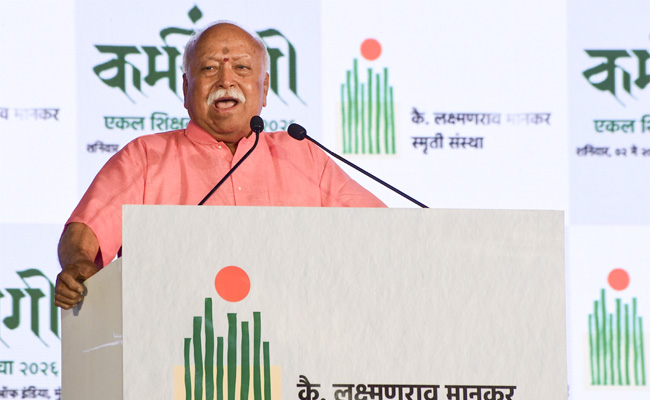
Mumbai (PTI): RSS chief Mohan Bhagwat has said that despite foreign invasions and hardships, tribal communities and Scheduled Castes preserved the country's identity and soul, stressing the need to integrate them into the mainstream development process.
He was speaking on Saturday at the Karmayogi awards ceremony in Mumbai, where Union Road Transport and Highways Minister Nitin Gadkari was also present.
"Human life is defined by giving back to the world, as we are all part of one great family. A person works and spends for the betterment of society, not as a favour, but out of duty. In serving others, we foster our own development. By helping others to thrive, we elevate ourselves and grow as human beings. This principle is the core value of this Indian land, commonly known as a Hindu society," Bhagwat said.
"This is the society's enduring ethos, which has survived for thousands of years. For various reasons, partly because of our indifference and partly because of foreign invasion, those who preserved this ethos paid a heavy price," he said.
The foreign invaders found that this ethos, this value system of the society is its soul and the key to keeping it alive. So they ensured that those who tried to preserve this soul would be uprooted and face extreme hardships, the Rashtriya Swayamsevak Sangh (RSS) chief noted.
But despite foreign invasions and hardships, tribal communities and Scheduled Castes preserved the country's identity and its soul, he said.
"Despite such adversities, the country's core identity remained intact among tribal communities and those belonging to SC and ST groups," he said, emphasising the need to integrate them into the mainstream development process while ensuring they receive equal access to services and facilities.
Referring to global developments, Bhagwat said the present world is "stumbling forward" and struggling to maintain balance, and asserted that India could emerge as a stabilising force.
The country must not only safeguard its own interests but also extend support to the world, he said.
"The world should get to see that the country is not only solving its own misery and sorrow but also helping the world to address similar issues," he said.
The RSS chief stressed that service to society is not a favour but a duty that contributes to one's own development.
Helping others grow also elevates individuals and strengthens the collective fabric of society, he said.
The so-called educated and developed sections have, over time, distanced themselves from these communities, Bhagwat pointed out, and called for the need to bridge this gap.
The identities preserved by these communities represent the true identity of Indian society, he said and underlined that without identity, existence itself is at risk.