Israel election: Exit polls show Netanyahu behind main rival Gantz
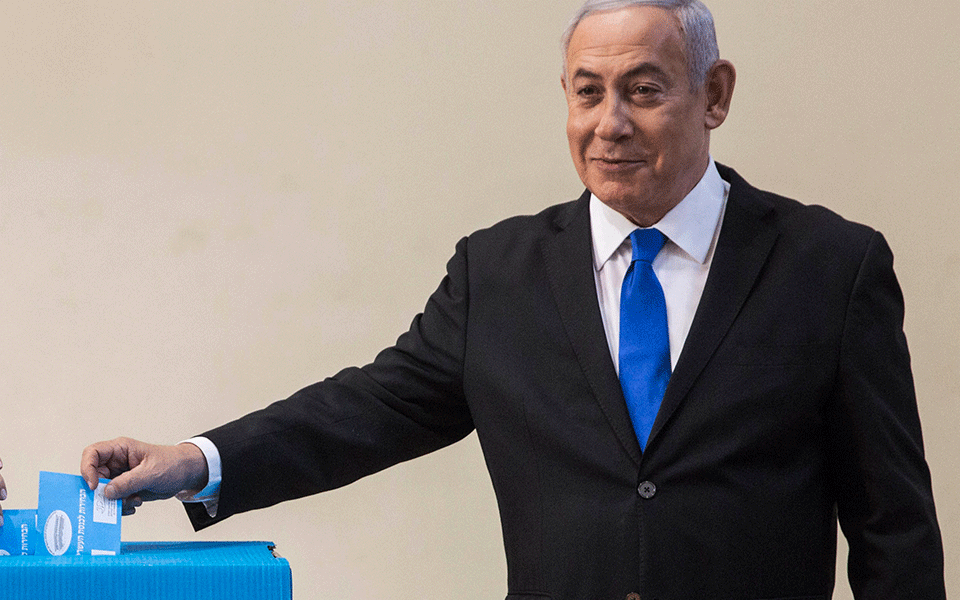
Jerusalem: Has the Benjamin Netanyahu era ended in Israel? If the exit polls results are to be believed, the country's longest serving Prime Minister will fall short of securing a parliamentary majority and is set to suffer a setback in his quest for a record fifth term in office.
If the exit polls do not go horribly wrong, then there are no clear winners as well.
The right-wing bloc led by Netanyahu is projected to win between 55-57 seats, but his main challenger Benny Gantz's Blue and White party also does not have the possibility of reaching the magical figure of 61 in a 120-member Knesset (Israeli Parliament), making the possibility of a unity government the most likely one.
The Central Elections Commission said that 69.4 per cent of the eligible voters cast ballots in Israel's unprecedented repeat elections on Tuesday, a slightly larger number than those that took part in April's vote.
Avigdor Lieberman, who has earlier served as Foreign and Defence Minister in Netanyahu led government's, has emerged the kingmaker as per the exit polls. His Yisrael Beteinu party is expected to get between 8 and 10 seats and the ultra-nationalist leader has made it clear that he will back a unity government with or without his party's inclusion.
In an address to his party workers after the polls closed at 10 PM (local time) on Wednesday, Lieberman said that his party would stick to its stand and only support a unity government given that the country faces "an emergency situation both politically and economically".
Yisrael Beteinu had recommended Netanyahu's name to the President for Prime Minister after the April 9 polls, but refused to join a coalition government under him on the question of draft exemption for ultra-orthodox Jews.
The Israeli Prime Minister could not muster a coalition of 61 members without Yisrael Beteinu, leading to an unprecedented repeat polls on Tuesday. Ultra-orthodox Jews backed parties, Shas and United Torah Judaism, were Netanyahu's important coalition partners.
Gantz has also been careful in his post-election address, shying away from declaring victory and has called for unity and national healing.
Netanyahu took to the ruling Likud party stage late on Wednesday, vowing to create a "strong Zionist government" and thwart the formation of a "dangerous anti-Zionist" government.
"We will protect this country," he asserted.
He started by saying, "As you see, I am hoarse", drawing cheers from the crowd, "and as you know, it's better to lose your voice than to lose the country".
"I said the election was hard. That's not the word ....We faced a campaign that was so tilted against us by the biased media, so against us," he said.
"We're still waiting for the results. But one thing is clear, the State of Israel is at a historic turning point. We are facing immense opportunities, and immense challenges... including the existential threat from Iran," Netanyahu emphasised.
He praised the soaring Israeli economy and flourishing diplomatic relations, mentioned US President Donald Trump's expected peace plan and stressed that Israel needs "a strong government, a stable government, a Zionist government, a government that is committed to Israel as the homeland of the Jewish people".
There cannot be a government that relies on the anti-Zionist Arab parties, he said adding, "parties that praise and glorify blood-thirsty terrorists who kill our soldiers, our citizens, our children".
Both Netanyahu and Gantz started reaching out to prospective coalition partners soon after the polls ended.
The big winner of the repeat polls seem to be the Arab population-backed Joint Unity List which is expected to win between 10 and 12 seats with the voter turnout in the Arab sector registering a significant increase from April 9 polls.
A little less than 50 per cent of the eligible Arab voters had participated in the previous elections, but with unity forged between various Arab factions, it soared by almost 13 per cent this time, Election Commission sources said.
With apparent no clear winner and counting moving slowly and significant trends likely to come around Wednesday afternoon, focus has shifted towards President Reuven Rivlin who has vowed to prevent yet another polls by looking at all the possibilities to put a government together.
"President Reuven (Ruvi) Rivlin will meet representatives of the parties elected to the Knesset for a round of consultations after he receives a clear picture of the results, and as soon as possible," his media adviser said in a statement.
"The President will do so in full coordination with the chairman of the Central Elections Committee, and once he has heard the position of all the factions he will take all considerations into account," the statement said.
The president will be guided by the need to form a government in Israel as quickly as possible and to implement the will of the people as expressed in the results of the election, as well as the need to avoid a third general election, it said.
"Accordingly, the President will allocate the role of forming a government after consultation and discussion with representatives of the factions and the leaders of the relevant parties, the statement said.
Meanwhile, Senior Palestinian official Saeb Ereka has said that he hopes the next government "will focus on how to make peace".
Let the Truth be known. If you read VB and like VB, please be a VB Supporter and Help us deliver the Truth to one and all.
AIITA welcomes Karnataka’s ban on obscene songs in school events
Bhatkal: The Karnataka unit of the All India Ideal Teachers Association (AIITA) has welcomed the Karnataka government’s decision to strictly ban school children from dancing to obscene songs during educational and cultural programmes in government, aided, and private schools across the state.
AIITA Karnataka State President M. R. Manvi congratulated the government for taking what he termed an important step to preserve the sanctity of education.
“Such decisions to safeguard the dignity of school children and uphold the values of education are the need of the hour. This rule should not be limited to government schools alone but must be strictly implemented in all private educational institutions as well,” he said.
He further urged the government to address other concerns within school programmes.
“The government should not only prohibit obscene dances in the name of school anniversaries, but also ensure that plays and dialogues that incite religious hatred are avoided. Schools should be centres of harmony, not platforms for spreading hatred,” he added.
According to a recent circular issued by the Department of School Education and Literacy, obscene dances are adversely affecting the mental health and moral values of students.
In this regard, schools have been advised to use songs that promote nationalism, positive thinking, the greatness of Kannada culture, and value-based traditions instead of inappropriate content during programmes.
The circular also emphasises that students should be dressed in decent attire.
AIITA also backed the department’s warning that disciplinary action would be taken against head teachers if such guidelines are violated. The association has further demanded that district Deputy Directors of Public Instruction strictly monitor the implementation of these rules.