Israel expands ground operation in Gaza and bombs Hamas tunnels after knocking out communications
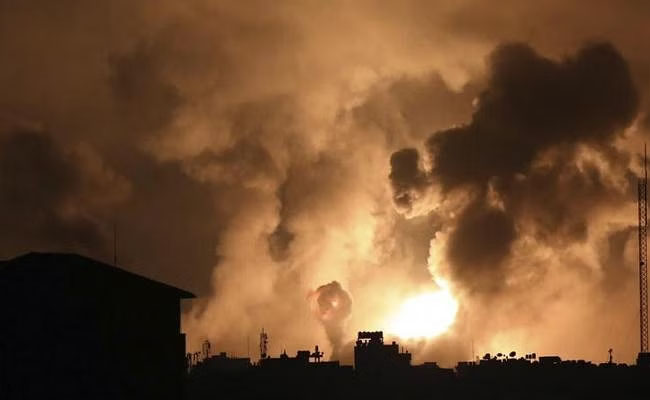
Jerusalem(AP): Israel on Saturday expanded its ground operation in Gaza with infantry and armoured vehicles backed by massive strikes from the air and sea, including the bombing of Hamas tunnels a key target in its campaign to crush the territory's ruling group after its bloody incursion in Israel three weeks ago.
The bombardment, described by Gaza residents as the most intense of the war, also knocked out most communications in Gaza.
This largely cut off the besieged enclave's 2.3 million people from the world, while enabling the Israeli military to control the narrative in a new stage of fighting.
The military released grainy images Saturday showing tank columns moving slowly in open areas of Gaza, many apparently near the border, and said warplanes bombed dozens of Hamas tunnels and underground bunkers.
"The forces are still on the ground and are continuing the war," said the army spokesman, Rear Adm. Daniel Hagari, indicating that the next stage has begun in what is expected to evolve into an all-out ground offensive in northern Gaza.
Early in the war, Israel had already amassed hundreds of thousands of troops along the border.
Until now, troops had conducted brief nightly ground incursions before returning to Israel.
The Palestinian death toll in Gaza on Saturday rose to just over 7,700 people since October 7, with 377 deaths reported since late Friday, according to the territory's Health Ministry.
A majority of those killed have been women and minors, the ministry said.
Ministry spokesman Ashraf al-Qidra told reporters that the disruption of communications has "totally paralysed" the health network.
Residents had no way of calling ambulances, and emergency teams were chasing the sounds of artillery barrages and airstrikes to search for people in need.
Some civilians were using their bare hands to pull injured people from the rubble and loading them into personal cars or donkey carts to rush them to the hospital.
In a video posted by local media, Palestinians were sprinting down a ravaged street with a wounded man covered in the dust of a building's collapse while he winced, eyes clenched shut, on a stretcher.
"Ambulance! Ambulance!" the men shouted as they shoved the stretcher into the back of a pick-up truck and shouted at the driver, "Go! Go!"
Other residents traveled by foot or car to check on their relatives and friends. "The bombs were everywhere, the building was shaking," said Hind al-Khudary, a journalist in central Gaza and one of a few people with cell phone service. "We can't reach anyone or contact anyone. I do not know where my family is."
Israel says its strikes target Hamas fighters and infrastructure and that the militants operate from among civilians, putting them in danger.
Across Gaza, terrified civilians were huddling in homes and shelters with food and water supplies running out.
Electricity was knocked out by Israel in the early stages of the war.
More than 1.4 million people have fled their homes, nearly half crowding into UN schools and shelters.
Aid workers say the trickle of aid Israel has allowed to enter from Egypt the past week is a tiny fraction of what is needed.
Gaza hospitals have been scrounging for fuel to run emergency generators that power incubators and other life-saving equipment.
The UN agency for Palestinian refugees, which runs an extensive network of shelters and schools for nearly half the displaced Gaza residents, has lost contact with most of its staff, spokeswoman Juliette Touma said Saturday.
She said that coordinating aid efforts was now "extremely challenging."
The intensified air and ground campaign also raised new concerns about dozens of hostages dragged into Gaza on October 7. On Saturday, hundreds of relatives of hostages gathered in a square in downtown Tel Aviv, demanding to meet with Prime Minister Benjamin Netanyahu and Defence Minister Yoav Gallat.
Some in the group demanded that Israel push for the release of all hostages before proceeding with the campaign against Hamas.
Protesters wore shirts emblazoned with the faces of their missing relatives under the word "kidnapped" and the words "Bring them back."
The families "feel like they're they're left behind and no one is really caring about them," said Miki Haimovitz, a former lawmaker and spokeswoman for the group. "No one is talking to them. No one is explaining what's going on."
Gallant later said he would meet with the families Sunday.
In Cairo, Egyptian President Abdel Fattah el-Sissi said his government was working to de-escalate the conflict through its talks with the warring parties to release prisoners and hostages. He didn't provide further details.
Hagari, the army spokesman, said the confirmed number of hostages was 229, after four were released in recent days through mediation by Qatar and Egypt.
He dismissed media reports about a possible cease-fire deal in exchange for the release of hostages, saying Hamas was engaged in a "cynical exploitation" of the anxieties of relatives of hostages.
More than 1,400 people were slain in Israel during Hamas' Oct. 7 attack, according to the Israeli government. Among those killed were at least 311 soldiers, according to the military.
Palestinian militants have fired thousands of rockets into Israel over the past three weeks.
The overall number of deaths in Gaza and Israel far exceeds the combined toll of all four previous Israel-Hamas wars, estimated at around 4,000.
Gallant said Friday that Israel expects a long and difficult ground offensive into Gaza soon.
It "will take a long time" to dismantle Hamas' vast network of tunnels, he said, adding that he expects a lengthy phase of lower-intensity fighting as Israel destroys "pockets of resistance."
His comments pointed to a potentially gruelling and open-ended new phase of the war after three weeks of relentless bombardment.
Israel has said it aims to crush Hamas' rule in Gaza and its ability to threaten Israel. But how Hamas' defeat will be measured and an invasion's endgame remain unclear.
Israel says it does not intend to rule the tiny territory but not who it expects to govern even as Gallant suggested a long-term insurgency could ensue.
In Washington, the Pentagon said US Defence Secretary Lloyd Austin spoke with Gallant on Friday and "underscored the importance of protecting civilians during the Israel Defence Forces' operations and focusing on the urgency of humanitarian aid delivery for civilians in Gaza."
The Pentagon said Austin also brought up "the need for Hamas to release all of the hostages."
The conflict has threatened to ignite a wider war across the region. Arab nations including US allies and ones that have reached peace deals or normalised ties with Israel have raised increasing alarm over a potential ground invasion, likely to bring even higher casualties amid urban fighting. (AP)
Let the Truth be known. If you read VB and like VB, please be a VB Supporter and Help us deliver the Truth to one and all.
India, Vietnam elevate ties to enhanced comprehensive strategic partnership; set USD 25 bn
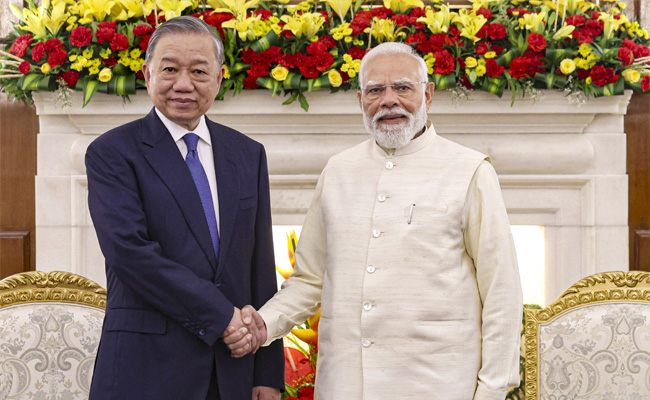
New Delhi (PTI): India and Vietnam on Wednesday elevated their ties to an enhanced comprehensive strategic partnership and set a USD 25 billion annual trade target by 2030 as Prime Minister Narendra Modi and Vietnamese President To Lam held talks focusing on expanding bilateral ties in areas of trade, defence, and critical minerals in the face of increasing geopolitical upheavals.
Following the Modi-Lam meeting, the two sides signed as many as 13 agreements which will provide for deeper two ways engagements in a range of areas including digital payments, rare earth minerals, pharmaceuticals, education, banking and culture.
Modi and Lam also deliberated on the situation in the Indo-Pacific amid China's increasing assertiveness in the region, and agreed to continue to contribute to the rule-of-law, peace, stability, and prosperity.
It is understood that China's growing military muscle-flexing in the South China Sea also figured in the delegation-level talks between the two sides.
Elected as president earlier this month, Lam began his first state visit to India on Tuesday, leading a high-level delegation for a three-day trip.
ALSO READ: Explosives used in blast outside Punjab Frontier BSF HQ in Jalandhar: Punjab Police
"A decade ago, Vietnam became India's first comprehensive strategic partner in ASEAN (Association of Southeast Asian Nations) . Since then, our relations have made rapid and comprehensive progress," Modi said in his media statement.
"Building on this strong foundation, today we are elevating our relations to the level of Enhanced Comprehensive Strategic Partnership. We will now advance our partnership to even higher goals," he said.
"Our cooperation will reach new levels in every area ' culture, connectivity, and capacity building, as well as security, sustainability, and supply chain resilience," Modi added.
He noted that the bilateral trade between India and Vietnam has doubled in the last decade to reach USD 16 billion and that the target now is to increase it to USD 25 billion by 2030.
Modi also cited a plethora of agreements signed between the two countries to emphasis that the economic engagement is expected to witness a significant upswing going forward.
"The MoU between our drug authorities will now increase access to Indian medicines in Vietnam. Exports of Indian agricultural, fisheries, and animal products to Vietnam are also set to become easier. Very soon, Vietnam will taste India's grapes and pomegranates," he said.
The two sides also agreed to update the India-ASEAN trade agreement by the end of this year.
"This will provide a new impetus to trade and investment between India and all ASEAN countries. New initiatives in critical minerals, rare earths, and energy cooperation will ensure the economic security and supply chain resilience of both countries," Modi said.
"To boost financial connectivity, we have today decided to enhance cooperation between our central banks. India's UPI and Vietnam's fast payment systems will soon be linked. Furthermore, we are strengthening state-to-state and city-to-city cooperation between the two countries," he noted.
Modi said India is grateful to Vietnam for its strong condemnation of the Pahalgam terrorist attack and standing with India in its fight against terrorism.
"In this era of global turmoil and economic challenges, thanks to their talent, good governance, and economic reforms, India and Vietnam are emerging as the world's fastest-growing economies," he said.
"Now, through our enhanced strategic partnership, we will support each other's rapid growth. As the Buddha's teachings say, 'If you light a lamp for someone else, it also illuminates your own path'," Modi said.
He also described Vietnam a a key pillar of India's Act East Policy and Vision Ocean.
"In the Indo-Pacific region as well, we share a common outlook. Through our strengthening defence and security cooperation, we will continue to contribute to the rule-of-law, peace, stability, and prosperity," he said.
The prime minister said India will broaden its relations with ASEAN with Vietnam's cooperation.
In his remarks, Lam said both sides agreed to deepen political trust and elevate security cooperation.
Last year, the two sides inked a pact to set up a framework for submarine search, rescue and support mechanism. They also signed a letter of intent (LoI) to strengthen bilateral defence industry collaboration.