Israel forms unity government as war intensifies
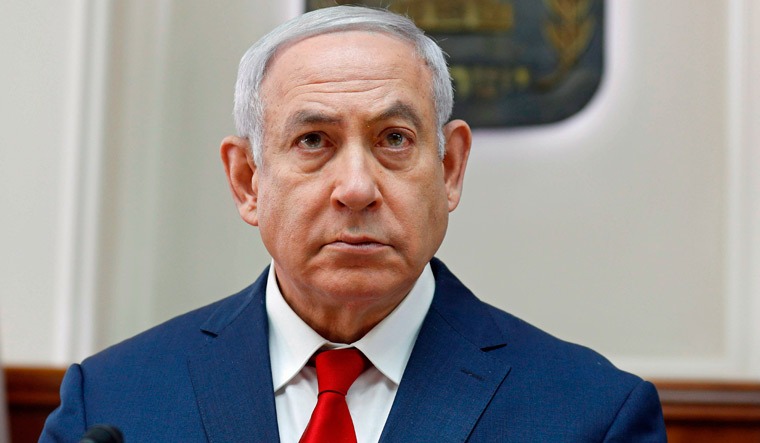
Jerusalem (PTI): Israeli Prime Minister Benjamin Netanyahu and a top opposition leader on Wednesday reached a deal to form a war-time unity government to oversee the operations against Hamas amid escalating violence in the region that has so far claimed the lives of more than 2,200 people.
Benny Gantz, the leader of the National Unity party, who had earlier indicated that he was willing to unconditionally join an emergency unity government to boost Israel's war efforts released what he said was a joint statement with Netanyahu.
Gantz, who served as a Defence Minister and also Chief of Staff of the Israel Defence Forces (IDF) in the past, said that they would form a five-member "war-management" Cabinet, which will consist of Netanyahu, current Defence Minister Yoav Gallant, two other top officials serving as "observers" and himself as members.
The statement stressed that the government would not pass any legislation or decisions that are not connected to the war as long as the fighting continues.
Main opposition leader Yair Lapid was also invited to join the new Cabinet but he did not respond to the offer so far.
The move received support from unexpected quarters in Israeli politics which looked divided into two wide factions not long ago on the question of the judicial overhaul initiative of the government.
The judicial overhaul initiative interpreted by many as an effort to undermine the authority of the judiciary led to massive protests across the country for 39 consecutive weeks and there was one planned also on the day the war started.
Right-wing extremist leader, National Security Minister Itamar Ben Gvir, who was seen as one of the only members of the government dragging his feet on establishing a unity coalition, wrote on platform X shortly after the announcement that he "welcomes unity, now we need to win."
Justice Minister Yariv Levin, the architect of the judicial overhaul initiative, also welcomed the move saying the agreement "is the right and necessary thing to do from here, we work together."
"The State of Israel has a unity government," wrote Economy Minister Nir Barkat.
"At a time like this we must join forces, give support to IDF soldiers and work as one until there is a complete victory of the State of Israel over its enemy," he emphasised.
Israel, which mobilised 360,000 reservists, has vowed an unprecedented offensive against Hamas, which rules the Gaza Strip, after its fighters broke through the border fence and stormed into the country's south through air, land and sea on October 7.
On the fifth day, the Israeli military said more than 1,200 people, including 155 soldiers, had been killed in Israel while in Gaza, 950 people had been killed, including 260 children and 230 women, according to authorities there.
Hamas is holding an estimated 150 Israelis hostages. The group continued to fire rockets at Israel, including a heavy barrage at the southern town of Ashkelon.
Israel's defence minister on Monday stopped entry of food, water, fuel and medicine into Gaza, which is home to 2.3 million Palestinians.
Let the Truth be known. If you read VB and like VB, please be a VB Supporter and Help us deliver the Truth to one and all.
4 workers die after being buried under coal slurry in Jharkhand's Dhanbad

Dhanbad (Jharkhand) (PTI): At least four workers died after being buried under coal slurry in Jharkhand's Dhanbad district on Saturday, a police official said.
The incident took place at Moonidih coal washery in the command area of Bharat Coking Coal Limited (BCCL).
"Bodies of all four workers were dug out of debris during a rescue operation," Putki police station in-charge Waqar Hussain told PTI.
The incident took place when coal slurry was being loaded into trucks by workers, during which a large chunk of slurry fell and trapped several workers underneath, officials said.
The deceased have been identified as Manik Bauri, Dinesh Bauri, Deepak Bauri, and Hemlal Gope.
Meanwhile, the family members of the deceased and local villagers placed the bodies in front of the washery gate and began a protest.
They demanded compensation, jobs for dependents and action against those responsible for the incident.
Police and administration officials are trying to pacify the protesters, an official said.