Israel hits Iranian nuclear research facility, says it's preparing for possibly long campaign
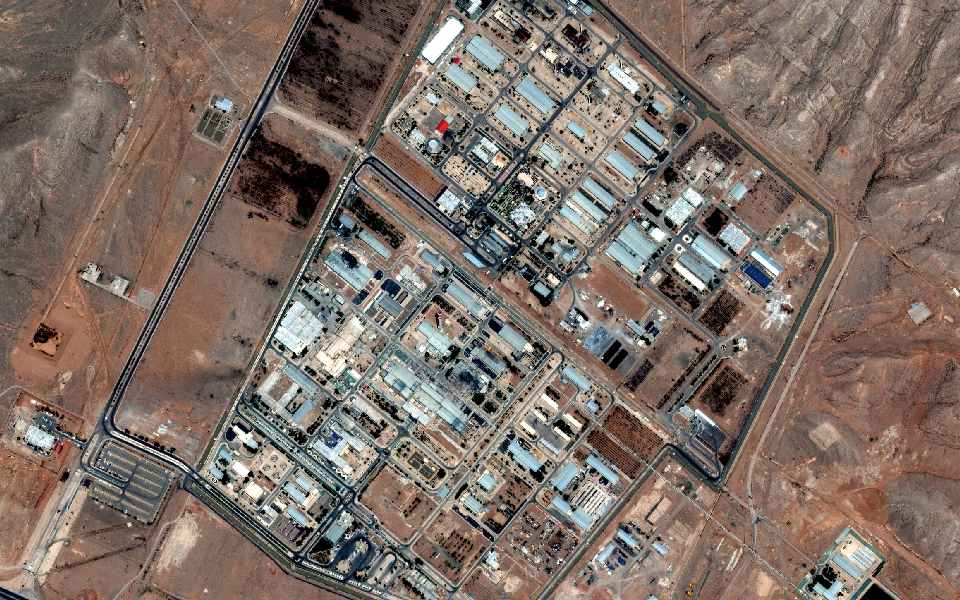
Tel Aviv, Jun 21 (AP): Israel's military said on Saturday it struck an Iranian nuclear research facility overnight and killed three senior Iranian commanders in targeted attacks, while emphasising it was preparing for the possibility that the war could turn into a lengthy campaign.
Early Saturday, smoke could be seen rising from an area near a mountain in Isfahan, where a local official said Israel had attacked the nuclear research facility in two waves.
The target was two centrifuge production sites, and the attacks came on top of strikes on other centrifuge production sites elsewhere in recent days, according to an Israeli military official speaking on condition of anonymity under army guidelines to brief reporters.
It was the second attack on Isfahan, which was hit in the first 24 hours of the war as part of Israel's goal to destroy the Iranian nuclear program.
Akbar Salehi, Isfahan province's deputy governor for security affairs, confirmed the Israeli strikes had caused damage to the facility but said there had been no human casualties.
Iran launched a new wave of drones and missiles at Israel but there were no immediate reports of significant damage, and the Israeli official called it a “small barrage” that was largely intercepted by Israel's defences.
The official said part of the reason that Iran's overnight attack had been relatively small was that the military had been targeting its launchers, and estimates it has now taken out more than 50 per cent of them.
“We've been able to take out a large amount of their launchers, creating a bottleneck — we're making it harder for them to fire toward Israel,” he said. “Having said all that, I want to say the Iranian regime obviously still has capabilities.”
Israel's Magen David Adom rescue service said Saturday an Iranian drone hit a two-story building in northern Israel, but there were no casualties.
Later, the Israeli military's chief spokesman, Brig. Gen. Effie Defrin, said the army had been told by Chief of Staff Lt. Gen. Eyal Zamir to be prepared for a “prolonged campaign” to destroy its targets, including nuclear sites, enrichment facilities and missile infrastructure.
“We are deepening our strikes night after night and we have amazing achievements,” he said. “We will continue until the threat is removed.”
Talks in Switzerland fail to produce a breakthrough
Talks in Geneva on Friday failed to produce a breakthrough. European officials expressed hope for future discussions, and Iranian Foreign Minister Abbas Araghchi said he was open to further dialogue while emphasising that Tehran had no interest in negotiating with the US while Israel continued attacking.
“Iran is ready to consider diplomacy once again and once aggression is stopped and the aggressor is held accountable for the crimes committed,” he told reporters.
No date was set for the next round of talks.
Iran warns against US military involvement
US President Donald Trump is weighing active US military involvement in the conflict, which Araghchi said Saturday “would be very unfortunate”.
“I think that it would be very, very dangerous for everyone,” he said in Istanbul, speaking on the sidelines of a meeting of the Organisation of Islamic Cooperation.
The war between Israel and Iran erupted June 13, with Israeli airstrikes targeting nuclear and military sites, top generals and nuclear scientists. At least 722 people, including 285 civilians, have been killed in Iran and more than 2,500 wounded, according to a Washington-based Iranian human rights group.
Iran has retaliated by firing more than 450 missiles and 1,000 drones at Israel, according to Israeli army estimates. Most have been shot down by Israel's multi-tiered air defences, but at least 24 people in Israel have been killed and hundreds wounded.
Israeli Prime Minister Benjamin Netanyahu has said Israel's military operation in Iran would continue “for as long as it takes” to eliminate what he called the existential threat of Iran's nuclear program and arsenal of ballistic missiles.
But Netanyahu's goal could be out of reach without US help. Barring a commando raid or even a nuclear strike, Iran's underground Fordo uranium enrichment facility is considered to be out of reach to all but America's “bunker-buster” bombs. Trump said he would put off deciding whether to join Israel's air campaign against Iran for up to two weeks.
Israel continues targeted attacks on Iranian military commanders
In Israel's opening attack, it killed three of Iran's top military leaders: one who oversaw the entire armed forces, Gen. Mohammad Bagheri; one who led the paramilitary Revolutionary Guard, Gen. Hossein Salami; and the head of the Guard's ballistic missile programme, Gen. Amir Ali Hajizadeh.
The targeted killings of senior commanders continued, with Israel's defence minister saying Saturday that the military had killed a commander in Iran's paramilitary Revolutionary Guard who financed and armed Hamas in preparation for the October 7, 2023, attack on Israel that sparked the 20-month long war in Gaza.
Israel said Saeed Izadi was commander of the Palestine Corps for the Iranian Quds Force, an elite arm of the Guard that conducts military and intelligence operations outside Iran, and that he was killed in an apartment in the city of Qom.
Iranian officials did not immediately confirm the death, but the Qom governor's office did say there had been an attack on a four-story apartment building and local media reported two people had been killed.
Israel also said it had killed the commander of the Quds Force's weapons transfer unit, who it said was responsible for providing weapons to Hezbollah and Hamas. Behnam Shahriyari was killed in his car while travelling in western Iran, the military said.
A commander of Iran's drone force was also killed overnight, the Israeli official who briefed reporters said.
Iran threatens head of UN nuclear watchdog
On Friday, the head of the UN nuclear watchdog warned at an emergency meeting of the UN Security Council against attacks on Iran's nuclear reactors, particularly its only commercial nuclear power plant in the southern city of Bushehr.
“I want to make it absolutely and completely clear: In case of an attack on the Bushehr nuclear power plant, a direct hit would result in a very high release of radioactivity to the environment,” said Rafael Grossi, head of the International Atomic Energy Agency.
“This is the nuclear site in Iran where the consequences could be most serious.”
Israel has not targeted Iran's nuclear reactors, instead focusing its strikes on the main uranium enrichment facility at Natanz, centrifuge workshops near Tehran, laboratories in Isfahan and the country's Arak heavy water reactor southwest of the capital.
Iran previously agreed to limit its uranium enrichment and allow international inspectors access to its nuclear sites under a 2015 deal with the US, France, China, Russia, Britain and Germany in exchange for sanctions relief. But after Trump pulled the US unilaterally out of the deal during his first term, Iran began enriching uranium up to 60 per cent — a short, technical step away from weapons-grade levels of 90 per cent — and restricting access to its nuclear facilities.
Iran has long maintained its nuclear programme is for peaceful purposes, but it is the only non-nuclear-weapon state to enrich uranium up to 60 per cent.
Israel is widely believed to be the only Middle Eastern country with a nuclear weapons programme but has never acknowledged it.
Leaders in Iran have blamed Grossi's statements about the status of Iran's nuclear programme for prompting Israel's attack.
On Saturday, a senior adviser for Iran's Supreme Leader Ali Khamanei, Ali Larijani, said in a brief social media post without elaboration that Iran would make Grossi “pay” once the war with Israel is over.
Iran acknowledges detaining a German cyclist
Iran also acknowledged for the first time that it detained a German cyclist on spying allegations, likely an effort by Tehran to pressure Germany — one of the countries that has been involved in the diplomatic talks.
The semiofficial Mehr news agency published footage of the unidentified man's arrest. It said he was detained in Markazi province, home to Iran's Arak heavy water reactor.
The German news agency dpa reported the arrest took place last year. Germany's Foreign Ministry refused to comment.
Let the Truth be known. If you read VB and like VB, please be a VB Supporter and Help us deliver the Truth to one and all.
Two injuries, one DNF, a DQ as India end messy World Relays campaign

Gaborone (Botswana) (PTI): Amoj Jacob and Ragul Kumar got injured during the men's 4x400m and 4x100 races respectively as India ended their World Athletics Relays campaign in disappointment on the second day of competitions here on Sunday.
The Indian camp had high hopes of making the 2027 World Championships in the men's 4x400m relay but the team did not finish (DNF) the race as Jacob suffered cramps and pulled out of the race after taking the baton from the first leg runner Dharamveer Choudhary. Rajesh Ramesh and Vishal TK were to run in the third and fourth legs.
Those teams which could not qualify for the 2027 Beijing World Championships by reaching the final round of each of the six relay events on Saturday were given another chance in the second qualification round on Sunday.
The top two teams in each of the two heats (in all six relay events) booked the Beijing ticket on Sunday.
India will now have to try and qualify for the World Championships through the Top Lists of the World Athletics, which is a long and tedious process.
In the men's 4x100m race, third leg runner Ragul Kumar fell down the track after failing to hand over the baton inside the exchange zone to fourth leg runner Gurindervir Singh, which clearly showed the lack of coordination among the runners.
Harsh Santosh Raut and Animesh Kujur ran the first two legs.
The Indian quartet was disqualified and Kumar was seen being taken away from the Field of Play with the help of the volunteers.
It was a comedy of errors in the case of the women's 4x100m race, which saw the baton being dropped during an exchange between first leg runner Tamanna and second runner Nithya Gandhe, though the Indians finished the race in 53.09 seconds.
Gandhe started running quite a distance, but after realising that the baton was not in her hand, she turned and ran back to pick it up.
The only silver-lining for the Indian contingent was the national record time in the mixed 4x100m relay race, though the quartet of Ragul Kumar, Nithya Gandhe, Animesh Kujur and Sneha SS finished sixth in heat number two with a time of 41.35 seconds, bettering the previous national mark of 42.30 seconds set in March in Chandigarh.
The mixed 4x400m relay quartet of Theerthesh P Shetty, Kumari Saloni, Nihal William and Rashdeep Kaur ended at fifth in heat number one with a time of 3 minutes and 19.40 seconds.
On Saturday, all the five Indian relay teams had failed to make it to the respective final rounds and thus missed out on the 2027 World Championships berths.