Israel intensifies its assault on southern Gaza, causing renewed concern about civilian deaths
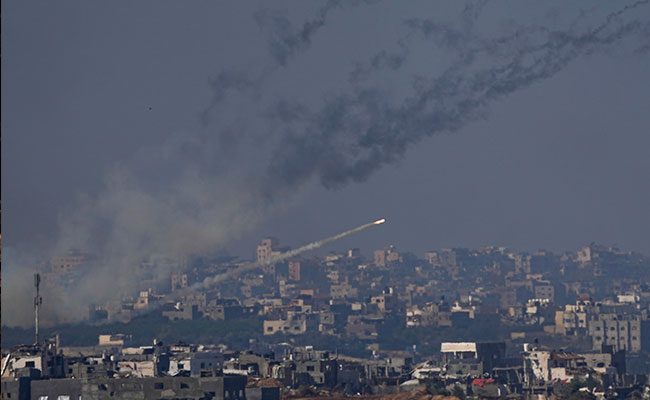
Khan Younis (Gaza Strip) (AP): Israel pounded targets in the southern Gaza Strip on Saturday, intensifying a renewed offensive that followed a weeklong truce with Hamas and giving rise to renewed concerns about civilian casualties.
At least 178 Palestinians have been killed since the fighting resumed Friday morning, even as the United States urged ally Israel to do everything possible to protect civilians.
"This is going to be very important going forward," Secretary of State Antony Blinken said Friday after meetings with Arab foreign ministers in Dubai, wrapping up his third Middle East tour since the war started. "It's something we're going to be looking at very closely."
Israel's attacks Saturday were focused on the Khan Younis area in southern Gaza, where the military dropped leaflets the day before warning residents to leave.
As of late Friday, however, there had been no reports of large numbers of people leaving, according to the United Nations.
"There is no place to go," lamented Emad Hajar, who fled with his wife and three children from the northern town of Beit Lahia a month ago to seek refuge in Khan Younis.
"They expelled us from the north, and now they are pushing us to leave the south."
Some 2 million people - almost Gaza's entire population - are crammed into the territory's south, where Israel urged people to relocate at the war's start and has since vowed to extend its ground assault. Unable to go into north Gaza or neighbouring Egypt, their only escape is to move around within the 220-square-kilometre (85-square-mile) area.
In response to US calls to protect civilians, the Israeli military released an online map, but it has done more to confuse than to help.
It divides the Gaza Strip into hundreds of numbered, haphazardly drawn parcels, sometimes across roads or blocks, and asks residents to learn the number of their location in case of an eventual evacuation.
"The publication does not specify where people should evacuate to," the UN office for coordinating humanitarian issues in the Palestinian territory noted in its daily report. "It is unclear how those residing in Gaza would access the map without electricity and amid recurrent telecommunications cuts."
Egypt has expressed concerns the renewed offensive could cause Palestinians to try and cross into its territory. In a statement late Friday, the Egyptian Foreign Ministry said the forced transfer of Palestinians "is a red line".
US Vice President Kamala Harris, who was in Dubai on Saturday for the COP28 climate conference, was expected to outline proposals with regional leaders to "put Palestinian voices at the centre" of planning the next steps for the Gaza Strip after the conflict, according to the White House. US President Joe Biden's administration has been emphasising the need for an eventual two-state solution, with Israel and a Palestinian state coexisting.
Let the Truth be known. If you read VB and like VB, please be a VB Supporter and Help us deliver the Truth to one and all.
Caste census will form basis for future policy decision, says CM Siddaramaiah
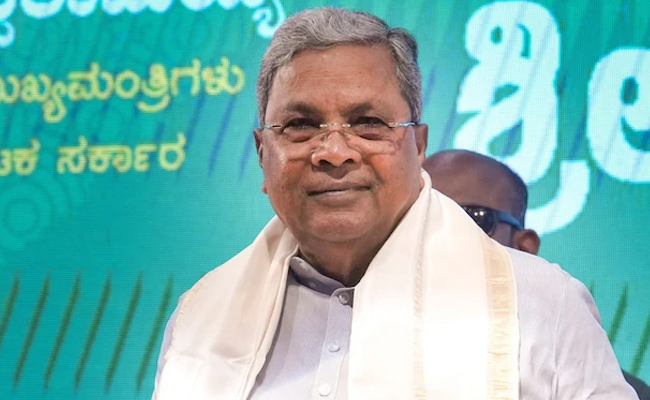
Mysuru (Karnataka) (PTI): Karnataka Chief Minister Siddaramaiah on Wednesday said that the ongoing caste census would form the basis for future policy decisions, asserting that the exercise was crucial to advancing social justice in the state.
Addressing a gathering at the Siddarameshwara Jayanti celebrations here, he said caste enumeration was being carried out for the first time since 1931 and would be followed by deliberations once the report is submitted.
"At present, a caste census (Jaati Sameekshe) is underway. After the report comes, we will discuss it and take necessary decisions," Siddaramaiah said.
He underlined the government’s commitment to equality, stating, "We are committed to social justice. No one should face injustice. Even if not 100 per cent, we will strive to ensure 99 per cent justice."
Referring to measures aimed at addressing intra-caste disparities, the chief minister said the government had already implemented internal reservation based on revised classifications.
"We have gone beyond the Nagamohan Das report and implemented internal reservation… now it has been revised to 5.25 per cent, 5.25 per cent, and 4.5 per cent. This has been approved by the Cabinet," he said.
Siddaramaiah said the broader objective was to ensure equitable distribution of resources and opportunities, while reiterating that policy interventions would be guided by constitutional principles.
"Our objective is equal share and equal life for all," he said.
He also emphasised the role of education in eliminating inequalities, particularly among marginalised communities, and said empowerment was essential to dismantle entrenched caste hierarchies.
"Only when people gain such empowerment can caste divisions be eradicated. Education is essential for this," he added.
The CM said the government would examine demands raised by various communities and take decisions based on feasibility, while ensuring that benefits reached all sections without discrimination.