Israel strike in Gaza destroys building with AP, other media
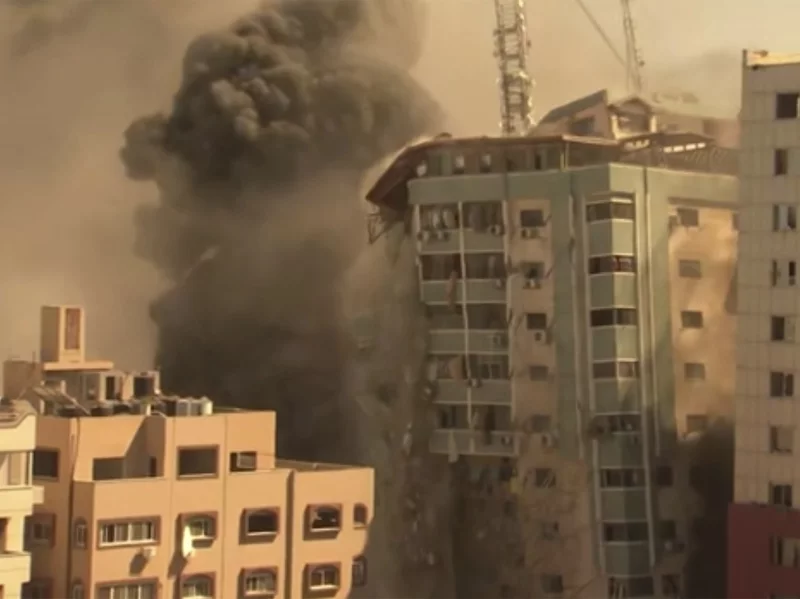
Gaza City, May 15: An Israeli airstrike destroyed a high-rise building in Gaza City that housed offices of The Associated Press and other media outlets on Saturday, the latest step by the military to silence reporting from the territory amid its battle with the militant group Hamas.
The strike came nearly an hour after the military ordered people to evacuate the building, which also housed Al-Jazeera, other offices and residential apartments. The strike brought the entire 12-story building down, collapsing with a gigantic cloud of dust. There was no immediate explanation for why it was attacked.
The strike came hours after another Israeli air raid on a densely populated refugee camp in Gaza City killed at least 10 Palestinians from an extended family, mostly children, in the deadliest single strike of the current conflict. Both sides pressed for an advantage as cease-fire efforts gathered strength.
The latest outburst of violence began in Jerusalem and has spread across the region, with Jewish-Arab clashes and rioting in mixed cities of Israel. There were also widespread Palestinian protests Friday in the occupied West Bank, where Israeli forces shot and killed 11 people.
The spiraling violence has raised fears of a new Palestinian intifada, or uprising at a time when there have been no peace talks in years. Palestinians on Saturday were marking Nakba (Catastrophe) Day, when they commemorate the estimated 700,000 people who were expelled from or fled their homes in what was now Israel during the 1948 war surrounding its creation. That raised the possibility of even more unrest.
U.S. diplomat Hady Amr arrived Friday as part of Washington's efforts to de-escalate the conflict, and the U.N. Security Council was set to meet Sunday. But Israel turned down an Egyptian proposal for a one-year truce that Hamas rulers had accepted, an Egyptian official said Friday on condition of anonymity to discuss the negotiations.
Since Monday night, Hamas has fired hundreds of rockets into Israel, which has pounded the Gaza Strip with strikes. In Gaza, at least 139 people have been killed, including 39 children and 22 women; in Israel, eight people have been killed, including the death Saturday of a man killed by a rocket that hit in Ramat Gan, a suburb of Tel Aviv.
The strike on the building housing media offices came in the afternoon, after the building's owner received a call from the Israeli military warning that it would be hit. AP's staff and others in the building evacuated immediately.
Al-Jazeera, the news network funded by Qatar's government, broadcast the airstrikes live as the building collapsed.
This channel will not be silence. Al-Jazeera will not be silenced, an on-air anchorwoman said, her voice thick with emotion. We can guarantee you that right now.
Earlier Saturday, an airstrike hit a three-story house in Gaza City's Shati refugee camp, killing eight children and two women from an extended family.
Mohammed Hadidi told reporters his wife and five children had gone to celebrate the Eid al-Fitr holiday with relatives. She and three of the children, aged 6 to 14, were killed, while an 11-year-old is missing. Only his 5-month-old son Omar is known to have survived.
Children's toys and a Monopoly board game could be seen among the rubble, as well as plates of uneaten food from the holiday gathering.
There was no warning, said Jamal Al-Naji, a neighbor living in the same building. You filmed people eating and then you bombed them? he said, addressing Israel. Why are you confronting us? Go and confront the strong people!
The Israeli military did not immediately respond to a request for comment. Hamas said it fired a salvo of rockets at southern Israel in response to the airstrike.
A furious Israeli barrage early Friday killed a family of six in their house and sent thousands fleeing to U.N.-run shelters. The military said the operation involved 160 warplanes dropping some 80 tons of explosives over the course of 40 minutes and succeeded in destroying a vast tunnel network used by Hamas.
Lt. Col. Jonathan Conricus, a military spokesman, said the military aims to minimize collateral damage in striking military targets. But measures it takes in other strikes, such as warning shots to get civilians to leave, were not feasible this time.
Israeli media said the military believed dozens of militants were killed inside the tunnels. The Hamas and Islamic Jihad militant groups have confirmed 20 deaths in their ranks, but the military said the real number is far higher.
Gaza's infrastructure, already in widespread disrepair because of an Israeli-Egyptian blockade imposed after Hamas seized power in 2007, showed signs of breaking down further, compounding residents' misery. The territory's sole power plant is at risk of running out of fuel in the coming days.
The U.N. said Gazans are already enduring daily power cuts of 8-12 hours and at least 230,000 have limited access to tap water. The impoverished and densely populated territory is home to 2 million Palestinians, most of them the descendants of refugees from what is now Israel.
The conflict has reverberated widely. Israeli cities with mixed Arab and Jewish populations have seen nightly violence, with mobs from each community fighting in the streets and trashing each other's property.
Late on Friday, someone threw a firebomb at an Arab family's home in the Ajami neighborhood of Tel Aviv, striking two children.
Let the Truth be known. If you read VB and like VB, please be a VB Supporter and Help us deliver the Truth to one and all.
Fire at mass marriage event attended by Dy CM Shivakumar, nobody affected
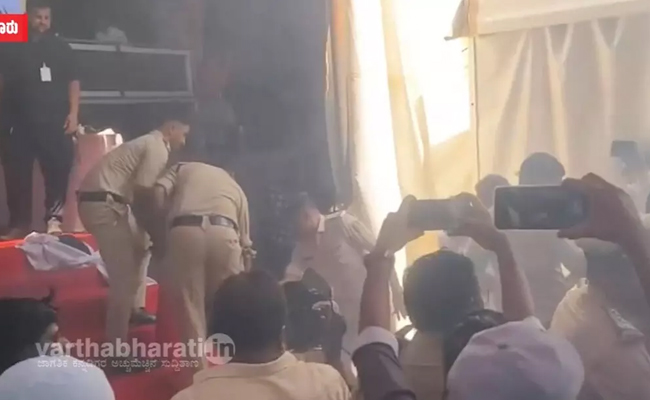
Raichur (Karnataka) (PTI): Fire broke out near the stage of the mass marriage event that was attended by Deputy Chief Minister D K Shivakumar here, police said on Sunday.
Nobody was affected, and the fire was immediately put out, they said.
The fire was noticed shortly after Shivakumar and other dignitaries left the stage, and Forest Minister Eshwaran Khandre was speaking to the media at the venue in Sindhanur, officials said.
According to officials, wires, speakers, and cloth materials near the stage caught fire, allegedly due to a short circuit.
Police personnel present at the spot quickly swung into action and extinguished the fire.
The programme was halted for some time and resumed later, they said.
Several ministers, legislators and political leaders from the region, and actor Sudeep had attended the event.