Israel strikes in and around Gaza's second largest city in an already bloody new phase of the war
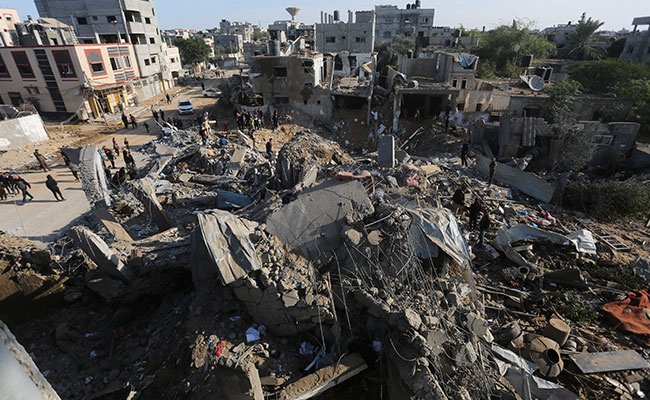
Khan Younis (Gaza Strip) (AP): Israel intensified its bombardment in and around Gaza's second largest city early Tuesday, as ambulances and private cars came racing into a local hospital carrying people wounded in a bloody new phase of the war in Gaza.
Under U.S. pressure to prevent further mass casualties, Israel says it is being more precise as it widens its offensive into southern Gaza after obliterating much of the north. Aerial bombardment and the ground offensive have already driven three-fourths of the territory's 2.3 million people from their homes.
At the Nasser Hospital in Khan Younis, ambulances brought dozens of wounded people in throughout the night. At one point, a car pulled up and man emerged carrying a young boy in a bloody shirt and whose hand had been blown off.
"Where is the Red Cross? where is the United Nations?" a woman screamed outside the emergency department. "My children, since 10 p.m., are still under the rubble."
Satellite photos taken Sunday showed tanks and troops massing outside Khan Younis, the latest target of the offensive, which was home to more than 400,000 people before the war.
Israel has ordered people out of nearly two dozen neighbourhoods instead of the entire region, as it did in the north. But with most of Gaza's population already packed into the south, cramming U.N. shelters and family homes, there are few places left to go. Israel has barred people who fled the north earlier in the war from returning.
Palestinians say that as Israel continues to strike across the besieged territory, there are no areas where they feel safe, and many fear that if they leave their homes they will never be allowed to return.
The Health Ministry in Gaza said the death toll in the territory since Oct. 7 has surpassed 15,890 people 70% of them women and children with more than 42,000 wounded, hundreds have been killed or wounded since the cease-fire's end, and many still are trapped under rubble.
Let the Truth be known. If you read VB and like VB, please be a VB Supporter and Help us deliver the Truth to one and all.
Caste census will form basis for future policy decision, says CM Siddaramaiah
Mysuru (Karnataka) (PTI): Karnataka Chief Minister Siddaramaiah on Wednesday said that the ongoing caste census would form the basis for future policy decisions, asserting that the exercise was crucial to advancing social justice in the state.
Addressing a gathering at the Siddarameshwara Jayanti celebrations here, he said caste enumeration was being carried out for the first time since 1931 and would be followed by deliberations once the report is submitted.
"At present, a caste census (Jaati Sameekshe) is underway. After the report comes, we will discuss it and take necessary decisions," Siddaramaiah said.
He underlined the government’s commitment to equality, stating, "We are committed to social justice. No one should face injustice. Even if not 100 per cent, we will strive to ensure 99 per cent justice."
Referring to measures aimed at addressing intra-caste disparities, the chief minister said the government had already implemented internal reservation based on revised classifications.
"We have gone beyond the Nagamohan Das report and implemented internal reservation… now it has been revised to 5.25 per cent, 5.25 per cent, and 4.5 per cent. This has been approved by the Cabinet," he said.
Siddaramaiah said the broader objective was to ensure equitable distribution of resources and opportunities, while reiterating that policy interventions would be guided by constitutional principles.
"Our objective is equal share and equal life for all," he said.
He also emphasised the role of education in eliminating inequalities, particularly among marginalised communities, and said empowerment was essential to dismantle entrenched caste hierarchies.
"Only when people gain such empowerment can caste divisions be eradicated. Education is essential for this," he added.
The CM said the government would examine demands raised by various communities and take decisions based on feasibility, while ensuring that benefits reached all sections without discrimination.