Israeli army tells Palestinians to evacuate parts of Gaza's Rafah ahead of an expected assault
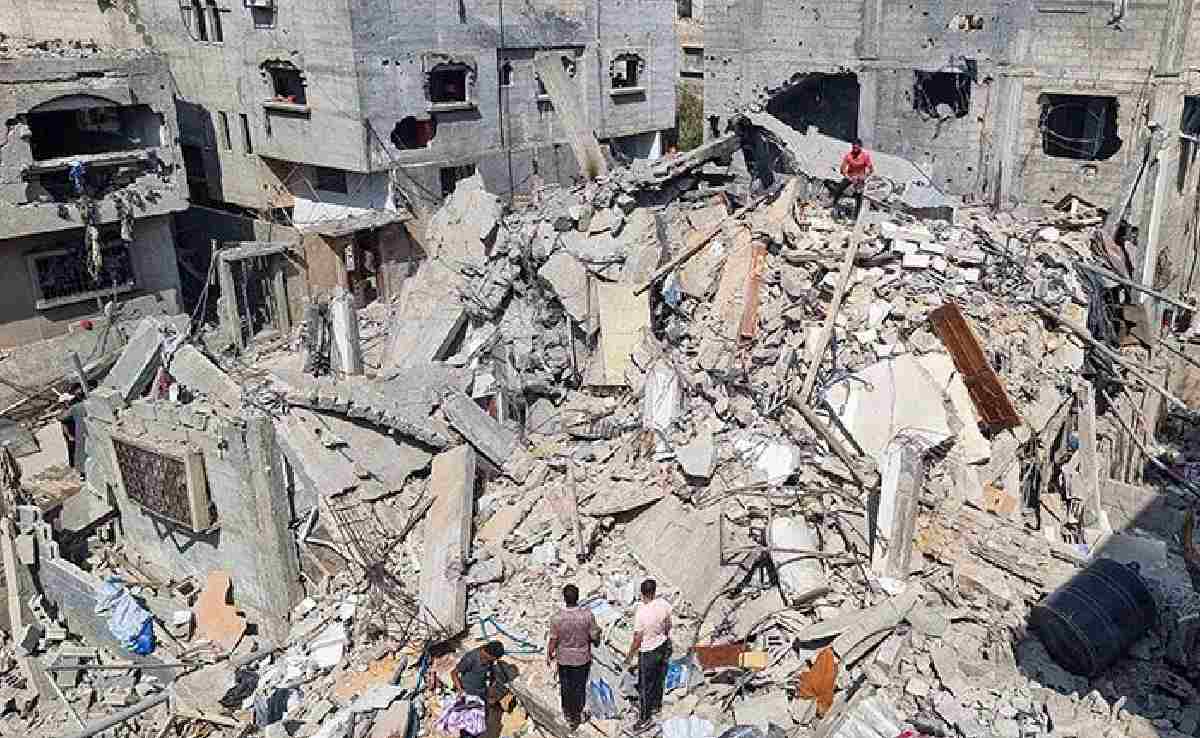
Jerusalem, May 6: The Israeli army ordered some 100,000 Palestinians on Monday to begin evacuating from the southern city of Rafah, signalling that a long-promised ground invasion there could be imminent and further complicating efforts to broker a cease-fire in Gaza.
The looming operation in the city — where more than 1 million Palestinians are sheltering and a high number of deaths is feared — has raised global alarm and Israeli's closest allies have warned against it. On Monday, the United Nations agency serving Palestinian refugees said it would not comply with the evacuation order.
Israel has described Rafah as the last significant Hamas stronghold after some seven months of war, and has repeatedly said the invasion is necessary to defeat the Hamas group, which unleashed the current conflict with an attack on Israel on October 7.
But Hamas and key mediator Qatar have warned that invading Rafah — along the border with Egypt — could derail efforts by international mediators to broker a cease-fire.
Lt. Col. Nadav Shoshani, an army spokesman, said some 100,000 people were being ordered to move to a nearby Israel-declared humanitarian zone called Muwasi — a makeshift camp of tents where along the coast hundreds of thousands of Palestinians have sought safety and live in squalid conditions.
Shoshani said Israel was preparing a “limited scope operation” and would not say whether this was the beginning of a broader invasion of the city. Israel never formally announced the launch of its current ground invasion in Gaza.
Smoke could be seen rising from Rafah Monday afternoon, although the cause was unclear.
Tensions escalated Sunday when Hamas fired rockets at Israeli troops positioned on the border with Gaza near Israel's main crossing for delivering badly needed humanitarian aid, killing four soldiers. Israel shuttered the crossing — but Shoshani said it would not affect how much aid enters Gaza as others are working.
He would not say whether the upcoming operation was a response to that attack. Meanwhile, Israeli airstrikes on Rafah killed 22 people, including children and two infants, according to a hospital.
Shoshani said Israel published a map of the evacuation area, and that orders were being issued through air-dropped leaflets, text messages and radio broadcasts. He said Israel has expanded humanitarian aid into Muwasi, including field hospitals, tents, food and water.
Israel's army said on the social media platform X that it would act with “extreme force” against militants, and urged the population to evacuate immediately for their safety.
Jan Egeland, secretary-general of the Norwegian Refugee Council, condemned the “forced, unlawful” evacuation order and the idea that people should go to Muwasi.
“The area is already overstretched and devoid of vital services,” Egeland said.
About 1.4 million Palestinians — more than half of Gaza's population — are jammed into Rafah and its surroundings. Most of them fled their homes elsewhere in the territory to escape Israel's onslaught and now face another wrenching move or the danger of staying under a new assault.
They live in densely packed tent camps, overflowing U.N. shelters or crowded apartments, and are dependent on international aid for food, with sanitation systems and medical facilities infrastructure crippled.
Palestinians in Rafah said people gathered to discuss their options after receiving the flyers.
“So many people here are displaced and now they have to move again, but no one will stay here it's not safe,” Nidal Alzaanin told The Associated Press by phone.
A father of five, Alzaanin works for an international aid group and fled to Rafah from Beit Hanoun in the north at the start of the war. He said people are concerned since Palestinians have said they were fired at during previous evacuations. Israel denies shooting at civilians.
Alzaanin said he has packed his documents and bags but will wait 24 hours to see what others do before relocating. He said he has a friend in Khan Younis whom he hopes can pitch a tent for his family.
The U.N. agency that has helped millions of Palestinians in Gaza and the West Bank for decades, known as UNRWA, warned Monday of devastating consequences of a Rafah offensive, including more civilian suffering and deaths. Juliette Touma, communications director for the agency, which has thousands of employees in the city, said it has not evacuated and has no plans to do so.
Egypt's Rafah crossing, a main transfer point for aid going into Gaza, lies in the evacuation zone. The crossing remained open on Monday after the Israeli order.
The war was sparked by an unprecedented Oct. 7 raid into southern Israel in which Hamas and other groups killed around 1,200 people, mostly civilians, and abducted around 250 hostages.
The ensuing conflict has killed more than 34,000 Palestinians, according to local health officials. The tally does not distinguish between civilians and combatants, but officials say at least two-thirds of the dead are children and women. It has left a swath of destruction in Gaza, and around 80% of the territory's population has fled to other parts of the besieged coastal enclave.
Recently, pressure to end the war has grown. Even as the U.S., Egypt and Qatar have pushed for a cease-fire agreement, Israeli Prime Minister Benjamin Netanyahu repeated last week that the military would move on the city regardless of whether a truce-for-hostages deal is struck.
A Hamas official told The Associated Press that Israel is trying to pressure the group into making concessions on the cease-fire, but that it won't change its demands. Hamas wants a full end to the war, withdrawal of Israeli troops from Gaza and the eventual reconstruction of the strip in exchange for the Israeli hostages held by the group.
In Rafah, people received flyers Monday morning in Arabic detailing which neighborhood blocks needed to leave and said that aid services would be provided in other cities.
“The IDF is about to operate with force against the terror organizations in the area you currently reside,” the army said in its evacuation order to residents. “Anyone in the area puts themselves and their family members in danger.”
But some people say they're too tired and fed up of months of devastation to flee again.
Sahar Abu Nahel fled to Rafah with 20 members of her family.
“Where am I going to go? I have no money or anything. I am seriously tired as are (my) children," she said wiping tears from her cheeks. “Maybe its more honourable for us to die. We are being humiliated.”
Let the Truth be known. If you read VB and like VB, please be a VB Supporter and Help us deliver the Truth to one and all.
'Last rites' of INDIA bloc: BJP on Cong-DMK fallout in Tamil Nadu
New Delhi (PTI): The BJP on Wednesday took a swipe at the Congress for extending support to Vijay's TVK in forming the government in Tamil Nadu and breaking away from its long term ally DMK, saying the party has a history of "betraying" its allies.
The saffron party also attacked the opposition INDIA bloc, claiming the alliance is "falling apart like a pack of cards" and lacks any common ideology or vision.
The Tamil Nadu Congress has decided to support TVK leader Vijay in forming a secular government in the state, sources said.
The decision to support the TVK was taken at an urgent meeting of the Political Affairs Committee (PAC) of Tamil Nadu Congress late on Tuesday night.
Reacting to the development, BJP national spokesperson Shehzad Poonawalla claimed the INDIA alliance had effectively come to an end after the declaration of assembly election results on May 4.
"There is nobody whom the Congress has not deceived. Imagine what they will do to the Samajwadi Party if they have done this to the DMK," he wrote in a post on X.
Calling it the "last rites" of the INDIA bloc, Poonawalla, in a video post, said, "It has become a Bharat free of the DMK, TMC and the Left, and now Congress has dumped the DMK for the TVK."
The BJP spokesperson alleged that the opposition bloc was formed solely out of political compulsions and personal ambitions.
"The INDI alliance never had any mission or vision. It was only about ambition for position, corruption, commission and obsession against Modi ji that they came together. But now it is all falling apart like a pack of cards," he said.
Questioning the unity of the opposition parties, Poonawalla said the alliance was absent in several states during the election.
"Where was the INDI alliance in Bengal, in Kerala, in Gujarat, in Punjab, in Delhi, in Haryana, in Karnataka? There is no INDI alliance," he said.
The DMK on Wednesday described the Congress move to extend support to TVK as a "backstab" by its long-time national ally.
Speaking to PTI videos, DMK spokesperson Saravanan Anadurai said, "The Congress party has decided to ally with the TVK, pledging their support to the party. I think they have backstabbed... They have backstabbed the people of Tamil Nadu. They've backstabbed the mandate given by the people of Tamil Nadu."
He said that the decision came even before the electoral process had fully concluded.
"Even before the ink on the returning officer's signature on the victory certificate dried up, they've chosen to go ahead with an alliance," he said.
Vijay's TVK won 108 seats in the 234-member Tamil Nadu Assembly, falling short of the halfway mark. He needs the support of 10 MLAs to form a government with a simple majority. The results were declared only on Monday.
The Congress has won five seats, while the Pattali Makkal Katchi (PMK) has bagged four seats. The CPI and CPI-M have two seats each. The outgoing ruling party, Dravida Munnetra Kazhagam (DMK), has won 59 seats while the All India Anna Dravida Munnetra Kazhagam (AIADMK) has won 47 seats.
The Bharatiya Janata Party (BJP) has won only one seat, and so have the Desiya Murpokku Dravida Kazhagam (DMDK) and the Amma Makkal Munnettra Kazagam (AMMK), while the VCK has won two seats.
The Congress had fought the assembly polls in a pre-poll alliance with the DMK, while the BJP had a tie-up with the AIADMK.