Israeli fire kills at least 18 in Gaza, US envoy visits hostage family protest
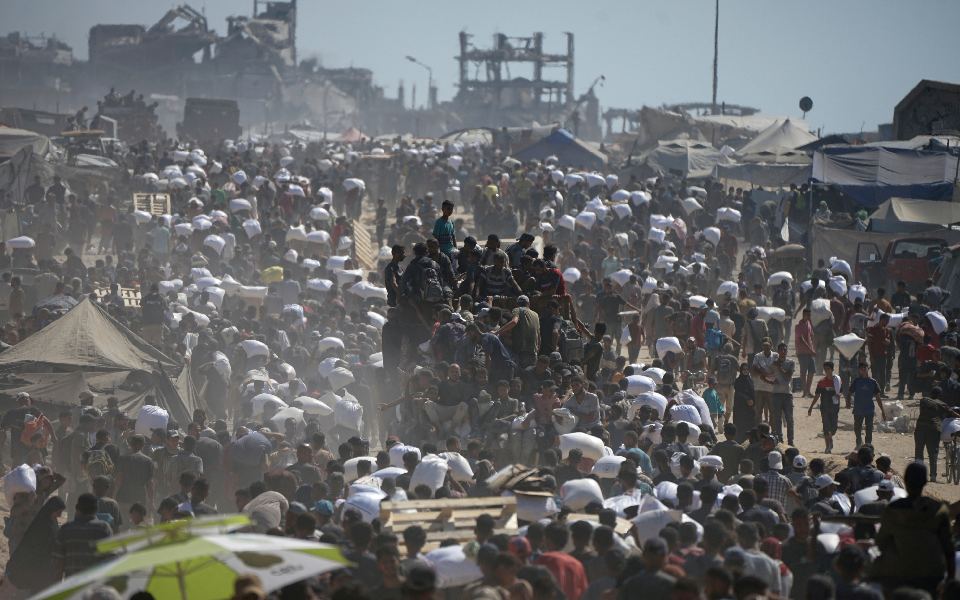
Deir al-Balah(Gaza Strip), Aug 2 (AP): Hospitals in Gaza reported the killing of more than a dozen people, eight of them food-seekers, by Israeli fire on Saturday as Palestinians endured severe risks searching for food amid airdrops and restrictions on overland aid delivery.
Near a Gaza Humanitarian Foundation distribution site, Yahia Youssef, who had come to seek aid Saturday morning, described a panicked scene now grimly familiar. After helping carry out three people wounded by gunshots, he said he looked around and saw others lying on the ground bleeding.
“It's the same daily episode,” Youssef said.
In response to questions about several eyewitness accounts of violence at the northernmost of the Israeli-backed American contractor's four facilities, GHF said “nothing (happened) at or near our sites.”
The episode came a day after US officials visited one site and US Ambassador to Israel Mike Huckabee called the distribution “an incredible feat.” International outrage has mounted as the group's efforts to deliver aid to hunger-stricken Gaza have been marred by violence and controversy.
“We weren't close to them (the troops) and there was no threat,” Abed Salah, a man in his 30s who was among the crowds close to the GHF site near Netzarim corridor, said. “I escaped death miraculously.”
The danger facing aid seekers in Gaza has compounded what international hunger experts this week called a “worst-case scenario of famine” in the besieged enclave. Israel's nearly 22-month military offensive against Hamas has shattered security in the territory of some 2 million Palestinians and made it nearly impossible to deliver food safely to starving people.
Seven Palestinians died of malnutrition-related causes in the Gaza Strip over the past 24 hours, the territory's health ministry said on Saturday.
They include a child, it said in a statement, bringing total deaths among children from causes related to malnutrition in Gaza to 93 since the war began. The ministry said 76 adults in Gaza have died of malnutrition-related causes since late June, when it started counting deaths among adults.
From May 27 to July 31, 859 people were killed near GHF sites, according to a United Nations report published Thursday. Hundreds more have been killed along the routes of food convoys.
GHF says its armed contractors have only used pepper spray or fired warning shots to prevent deadly crowding. Israel 's military has said it has only fired warning shots at people who approach its forces, though on Friday said it was working to make the routes under its control safer. Israel and GHF have said that the toll has been exaggerated.
Health officials reported that Israeli airstrikes and gunfire killed at least 18 Palestinians on Saturday, including three transported from the vicinity of a distribution site to a central Gaza hospital along with 36 others who were wounded.
Officials said 10 of Saturday's casualties were killed by strikes in central and southern Gaza. Nasser Hospital said it received the bodies of five people killed in two separate strikes on tents sheltering displaced people. The dead include two brothers and a relative, who were killed when a strike hit their tent close to a main thoroughfare in Khan Younis.
The health ministry's ambulance and emergency service said an Israeli strike hit a family house between the towns of Zawaida and Deir al-Balah, killing two parents and their three children.
Another strike hit a tent close to the gate of a closed prison where the displaced have sheltered in Khan Younis, killing a mother and her daughter, they said.
The hospital said Israeli forces killed five other Palestinians who were among crowds awaiting aid near the newly constructed Morag corridor in Rafah and between Rafah and Khan Younis.
Israel's military did not immediately respond to questions about the strikes or gunfire near the aid sites. Its top general, meanwhile, warned Saturday that “combat will continue without rest” if hostages weren't freed. Lt Gen Eyal Zamir said Israel's military would adapt to “place Hamas under increasing pressure.”
Hostage families push Israel to cut deal
In Tel Aviv, families of hostages protested and urged Israel's government to push harder for the release of their loved ones, including those shown in footage released by fighter groups earlier this week.
US President Donald Trump's special envoy Steve Witkoff joined them, a week after quitting ceasefire talks, blaming Hamas's intransigence and pledging to find other ways to free hostages and make Gaza safe.
Of the 251 hostages who were abducted by Hamas-led group, around 20 are believed to be alive in Gaza. Hamas and Islamic Jihad, the second-largest fighter group in Gaza, released separate videos of individual hostages this week, triggering outrage among hostage families and Israeli society.
Israeli media hasn't broadcast the videos, calling them propaganda, but the family of 21-year-old Rom Braslavski allowed the release of a photograph showing him visibly emaciated in an unknown location. Tami Braslavski, his mother, blamed top Israeli officials and demanded they meet with her.
"They broke my child, I want him home now,” Braslavski told Ynet on Thursday. “Look at him: Thin, limp, crying. All his bones are out.”
Protesters called on Israel's government to make a deal to end the war, imploring them to "stop this nightmare and bring them out of the tunnels”
“Do the right thing and just do it now,” said Lior Chorev, chief strategy officer of the Hostages and Missing Families Forum.
Airdrops expand despite limited impact
Alongside Israel, several European countries announced plans this week to join the Jordan-led coalition orchestrating airdropping parcels, though most acknowledge the strategy remains deeply inadequate.
“If there is political will to allow airdrops - which are highly costly, insufficient & inefficient, there should be similar political will to open the road crossings,” Philippe Lazzarini, the head of the UN agency for Palestinian refugees, wrote on X on Saturday. “Let's go back to what works & let us do our job.”
The war in Gaza began when Hamas attacked southern Israel on Oct 7, 2023, killing around 1,200 people, mostly civilians. Israel's retaliatory offensive has killed more than 60,000 Palestinians, according to Gaza's Health Ministry, which doesn't distinguish between fighters and civilians and operates under the Hamas government. The UN and other international organizations see it as the most reliable source of data on casualties.
Let the Truth be known. If you read VB and like VB, please be a VB Supporter and Help us deliver the Truth to one and all.
Double-decker electric bus gutted in fire at Kurla BEST depot

Mumbai (PTI): An empty double-decker electric bus was gutted in a fire during servicing at a BEST depot in Mumbai's Kurla area on Sunday, officials said, adding that nobody was injured.
The blaze broke out inside the Kurla BEST bus depot near Kanakia Building at 4.14 pm, according to preliminary information from the Mumbai Fire Brigade.
The parked bus was unoccupied at the time of the incident.
Fire brigade personnel rushed to the spot and brought the blaze under control. The exact cause of the fire was yet to be ascertained, they said.
No injuries were reported in the incident, officials added.
The Brihanmumbai Electricity Supply and Transport (BEST) Undertaking has hired 50 electric double-decker buses from Switch Mobility in its fleet of around 2,700 buses.