Israeli police and Palestinians clash at al-Aqsa mosque, over 300 hurt

Jerusalem, May 10: Israeli police firing tear gas, stun grenades and rubber bullets clashed with stone-throwing Palestinians at a flashpoint Jerusalem holy site on Monday, the latest in a series of confrontations that threatened to push the contested city toward wider conflict.
In an apparent attempt to avoid further confrontation, Israeli authorities changed the planned route of a march by ultranationalist Jews through the Muslim Quarter of the Old City. The marchers were ordered to avoid the area and sent on a different route circumventing the Muslim Quarter on their way to the Western Wall, the holiest site where Jews can pray.
But tensions remained high after Monday morning's violence.
More than a dozen tear gas canisters and stun grenades landed in the Al-Aqsa Mosque, one of Islam's holiest sites, as police and protesters faced off inside the walled compound that surrounds it. Smoke rose in front of the mosque and the iconic golden-domed shrine on the site, and rocks littered the nearby plaza. Inside one area of the compound, shoes and debris lay scattered over ornate carpets.
More than 305 Palestinians were hurt, including 228 who went to hospitals and clinics for treatment, according to the Palestinian Red Crescent. Seven of the injured were in serious condition. Police said 21 officers were hurt, including three who were hospitalized. Israeli paramedics said seven Israeli civilians were also hurt.
The confrontation was the latest after weeks of mounting tensions between Palestinians and Israeli troops in the Old City of Jerusalem, the emotional center of their conflict. There have been almost nightly clashes during the Muslim holy month of Ramadan, already a time of heightened religious sensitivities.
Most recently, the tensions have been fuelled by the planned eviction of dozens of Palestinians from the Sheikh Jarrah neighbourhood of east Jerusalem where Israeli settlers have waged a lengthy legal battle to take over properties. Monday was expected to be particularly tense since Israelis mark it as Jerusalem Day to celebrate their capture of east Jerusalem in the 1967 Mideast war.
On Monday, two anti-Arab members of Israel's parliament, surrounded by an entourage and police, pushed through a line of protesters in the Sheikh Jarrah neighbourhood. Several Arab members of parliament were among those trying to stop Betzalel Smotrich and Itamar Ben Gvir, amid shouting and jostling.
At one point during the scrum, the protesters pounded on the sides of a dumpster, and one man yelled at Smotrich in Arabic, Get out of here, you dog!
Smotrich and Ben Gvir eventually got to the other side of a police barricade and entered a house already inhabited by settlers.
Over the past few days, hundreds of Palestinians and several dozen police officers have been hurt in clashes in and around the Old City, including the sacred compound, which is known to Jews as the Temple Mount and to Muslims as the Noble Sanctuary. The compound which has been the trigger for rounds of Israel-Palestinian violence in the past, is Islam's third-holiest site and considered Judaism's holiest.
Early Monday morning, protesters had barricaded gates to the walled compound with wooden boards and scrap metal. Sometime after 7:00 am, clashes erupted, with those inside throwing stones at police deployed outside. Police entered the compound, firing tear gas, rubber-coated steel pellets and stun grenades.
At some point during the morning about 400 people, both young protesters and older worshippers, were inside the carpeted Al-Aqsa Mosque. Police fired tear gas and stun grenades into the mosque.
Police said protesters hurled stones at officers and onto an adjoining roadway near the Western Wall, where thousands of Israeli Jews had gathered to pray.
After several days of Jerusalem confrontations, Israel has come under growing international criticism for its heavy-handed actions at the site, particularly during Ramadan.
The UN Security Council scheduled closed consultations on the situation Monday.
Late Sunday, US National Security Adviser Jake Sullivan spoke to his Israeli counterpart, Meir Ben-Shabbat. A White House statement said Sullivan called on Israel to pursue appropriate measures to ensure calm and expressed the US' serious concerns about the ongoing violence and planned evictions.
Prime Minister Benjamin Netanyahu pushed back against the criticism Monday, saying Israel is determined to ensure the rights of worship for all and that this requires from time to time stand up and stand strong as Israeli police and our security forces are doing now.
Ofir Gendelman, a spokesman for Netanyahu, claimed in a tweet that extremist Palestinians planned well in advance to carry out riots at the holy site, sharing photos of mounds of stones and wooden barricades inside the compound.
Ayman Odeh, a leading Arab politician in Israel, blamed the violence on Israel's discriminatory policies toward the Palestinians and said it had provoked the violence. Wherever you find occupation, you will find resistance, he said at a news conference in Sheikh Jarrah.
In other violence, Palestinian protesters hurled rocks at an Israeli vehicle driving just outside the Old City walls. The driver later told public broadcaster Kan that his windows were smashed by stones and pepper spray shot into the car. CCTV footage released by the police showed a crowd surrounding the car and pelting it with rocks when it swerved off the road and into a stone barrier and a bystander.
Police said two passengers were injured.
Let the Truth be known. If you read VB and like VB, please be a VB Supporter and Help us deliver the Truth to one and all.
India-bound LPG tanker clears Hormuz
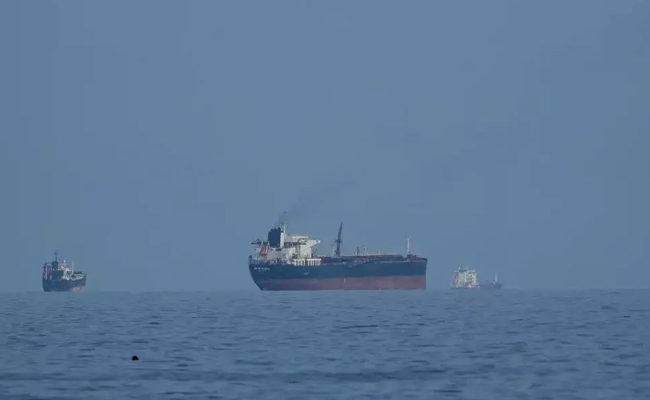
New Delhi (PTI): A tanker carrying liquefied petroleum gas (LPG) for India has sailed out of the Strait of Hormuz and is now headed towards the country, an official statement said on Sunday.
The Marshall Islands-flagged LPG carrier MT Sarv Shakti, loaded with 46,313 tonnes of LPG and staffed by 20 crew, including 18 Indians, cleared the key shipping chokepoint on May 2 and is expected to reach Visakhapatnam on May 13, it said.
The cargo -- enough to meet half a days requirement of the country -- will partly tide over supply constraints being faced since the start of the West Asia conflict more than two months back.
Ship-tracking data showed its position in Oman Gulf on Sunday evening.
The very large gas carrier has previously made runs between the Persian Gulf and Indian ports, has been chartered by state-owned Indian Oil Corporation (IOC).
Sarv Shakti is the first India-linked tanker to cross the war zone since a weeks-old US blockade of ships tied to Iran began, pushing transits through Hormuz back down to almost zero.
There are as many as 14 Indian flagged or India-owned vessels still stranded on the west side of the Strait of Hormuz.
The statement said no incident involving Indian-flagged vessels has been reported in the past 24 hours. The Ministry of Ports, Shipping and Waterways is working closely with the Ministry of External Affairs, Indian missions and maritime stakeholders to ensure crew welfare and uninterrupted operations.
The Directorate General of Shipping (DG Shipping) control room has handled 8,373 calls and more than 17,965 emails since activation, including 38 calls and 127 emails in the last 24 hours.
India has also facilitated the repatriation of more than 2,953 seafarers so far, including 31 in the past day from across the Gulf region.
Port operations across the country remain normal with no congestion reported, the statement added.