Israeli president asks Opposition leader to form govt after Netanyahu fails to form coalition
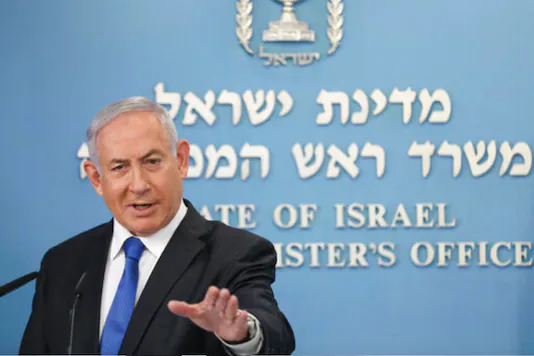
Jerusalem, May 5: Israeli President Reuven Rivlin on Wednesday tasked Opposition leader Yair Lapid to form a new government, after beleaguered Prime Minister Benjamin Netanyahu failed to meet a midnight deadline of forming a coalition.
President Rivlin's announcement on live television gave opposition a chance to end the lengthy rule of Prime Minister Netanyahu, who is at the helm of politics since 2009 - becoming Israel's longest-serving premier.
Lapid, 57, a veteran journalist and politician, now has four weeks to build a coalition.
Netanyahu, 71, who is facing trial on a series of graft charges, was earlier tasked by President Rivlin to put together a government on April 6 following inconclusive polls, the fourth in the last two years.
President Rivlin's spokesman in a statement said: "Shortly before midnight, Netanyahu informed the President's Residence that he was unable to form a government and so returned the mandate to the president."
Rivlin on Wednesday contacted the parties represented in the Knesset (Israel's unicameral parliament) on the continuation of the process of forming a government.
He met with Yesh Atid party's chairman Lapid, and right-wing Yamina party's chairman Naftali Bennett at the President's Residence. At his request, the rest of the party leaders submitted their recommendations for the second mandate. Lapid received recommendations from 56 lawmakers and Bennett from only his party's seven.
"From the number of recommendations, it is clear that Yair Lapid could form a government that has the confidence of the Knesset, despite there being many difficulties," Rivlin said.
"I have just spoken to Yair Lapid and informed him that I am entrusting him with forming a government," he said.
Netanyahu's Likud party emerged as the single largest party in the 120-member Parliament but failed to muster the necessary 61-member support to form a government. Likud had won 30 seats in the general election in March.
While tasking Netanyahu with the responsibility of forming the government, Rivlin had said that he was doing so reluctantly and also mentioned his "moral dilemma" given the court proceedings and lack of enough support for the Likud leader.
Netanyahu has denied any wrongdoing.
Gideon Sa'ar, a former member of Netanyahu's Likud party who broke away to launch the New Hope party before the March 23 elections, had recommended Lapid to be tasked with forming the next government.
In the previous round of consultations with Rivlin last month, Sa'ar's six-member party didn't back anyone as premier.
Additionally, the majority of the Joint List alliance of predominantly Arab parties also chose to back Lapid this time around, saying it preferred him to any of the other options.
The additional support boosted Lapid's bloc of backers from 45 to 56 lawmakers, including Yesh Atid, Blue and White, Labor, Meretz and Yisrael Beytenu. His Yesh Atid party had emerged as the second largest party in the March 23 election with 17 seats.
The Blue and White party, headed by Defence Minister Benny Gantz also recommended that Lapid be granted the Presidential mandate to form a government, a spokesperson for the party said.
Rivlin gave Netanyahu the first chance to form a coalition after 52 members of parliament endorsed him as Prime Minister last month, compared to 45 for Lapid and a mere seven for Bennett.
Netanyahu failed to persuade Bennett to join him in a power-sharing agreement that would have seen the pair take turns as prime minister.
Bennett had dismissed the offer, saying even with his support Netanyahu could not muster a majority.
Likud blamed Bennett for foiling Netanyahu's chances by refusing to commit to a right-wing government, which would certainly have led to the formation of a government joined by additional members of parliament."
Though the right-wing bloc in the Israeli political spectrum has repeatedly garnered the majority seats in all the four elections, a lot of determined "friends turned foes" of Netanyahu have prevented a majority for him in the 120-member house.
Bennett, who in the past has served as Defence Minister in Netanyahu's government, on Wednesday called on all political parties to join a "broad emergency government" in order to avoid a fifth election.
"The truth is simple, Netanyahu failed to form a right-wing," Bennett said in a statement.
He said that he "left no stone unturned" in order to form a right-wing government, including last-minute efforts on Tuesday night to leave the door open for such a government, but that Netanyahu slammed it shut".
He also called on all right-wing parties to join a "broad emergency government," which, he said, would "not be easy for anyone" and "not necessarily a natural government" but was the only alternative to a fifth election.
If such a government does get formed, it would mark the end of Netanyahu's uninterrupted reign at the helm of affairs since 2009.
Netanyahu is Israel's longest-serving leader, having led five governments since 1996. The last, which saw him share power with the then-main Opposition party to help tackle the coronavirus pandemic, collapsed in December, triggering the latest elections.
Until any new government is agreed and sworn into office, Netanyahu remains Israel's Prime Minister.
Let the Truth be known. If you read VB and like VB, please be a VB Supporter and Help us deliver the Truth to one and all.
Double-decker electric bus gutted in fire at Kurla BEST depot
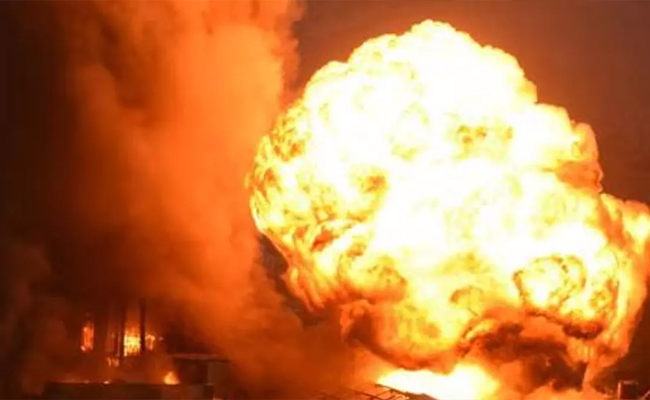
Mumbai (PTI): An empty double-decker electric bus was gutted in a fire during servicing at a BEST depot in Mumbai's Kurla area on Sunday, officials said, adding that nobody was injured.
The blaze broke out inside the Kurla BEST bus depot near Kanakia Building at 4.14 pm, according to preliminary information from the Mumbai Fire Brigade.
The parked bus was unoccupied at the time of the incident.
Fire brigade personnel rushed to the spot and brought the blaze under control. The exact cause of the fire was yet to be ascertained, they said.
No injuries were reported in the incident, officials added.
The Brihanmumbai Electricity Supply and Transport (BEST) Undertaking has hired 50 electric double-decker buses from Switch Mobility in its fleet of around 2,700 buses.