Israeli military rep says expanding ground operation in Gaza after knocking out communications
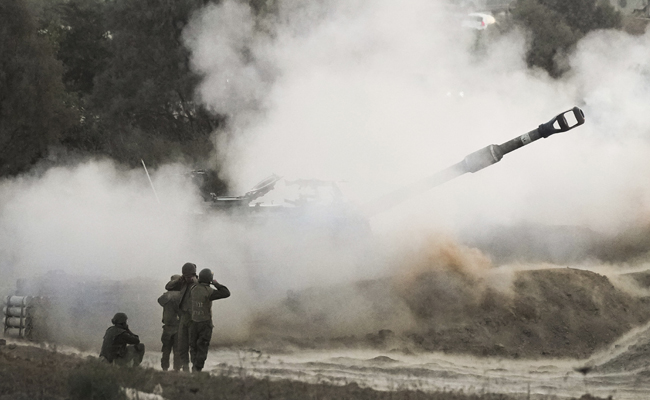
Jerusalem (AP): Israel is expanding its ground operation in Gaza with infantry and armoured vehicles backed by "massive" strikes from the air and sea, the Israeli military spokesman said Saturday.
Rear Adm. Daniel Hagari said that "the forces are still on the ground and are continuing the war."
Previously, troops had conducted brief nightly ground incursions before returning to Israel.
Earlier Saturday, the military had released videos showing columns of armoured vehicles moving slowly in open sandy areas of Gaza, the first visual confirmation of ground troops, and said warplanes bombed dozens of Hamas tunnels and underground bunkers.
The move is a further escalation in Israel's campaign to crush the territory's ruling Hamas group after its attack in southern Israel three weeks ago and a new sign that Israel is moving closer to an all-out invasion of Gaza.
Late Friday, Hagari had said ground forces were "expanding their activity" in Gaza and "acting with great force ... to achieve the objectives of the war." Israel has amassed hundreds of thousands of troops along the border.
Overnight into Saturday, warplanes struck 150 tunnels and underground bunkers in northern Gaza, the military said. Hamas' extensive underground installations, many of them located under Gaza City in the north of the territory, are seen as key targets of the offensive.
As part of the stepped-up bombardment, Israel also knocked out communications and created a near-blackout of information, largely cutting off the 2.3 million people in besieged Gaza from contact with the outside world.
Already plunged into darkness after most electricity was cut off weeks ago, Palestinians were thrown into isolation, huddling in homes and shelters with food and water supplies running out. Attempts to reach Gaza residents by phone were largely unsuccessful early Saturday.
Explosions from continuous air strikes lit up the sky over Gaza City for hours after nightfall Friday.
The Palestinian telecom provider, Paltel, said the bombardment caused "complete disruption" of internet, cellular and landline services. The cutoff meant that casualties from strikes and details of ground incursions could not immediately be known. Some satellite phones continued to function.
Relatives outside Gaza panicked after their messaging chats with families inside suddenly went dead and calls stopped going through.
Wafaa Abdul Rahman, director of a feminist organization based in the West Bank city of Ramallah, said she hadn't heard for hours from family in central Gaza. "We've been seeing these horrible things and massacres when it's live on TV, so now what will happen when there's a total blackout?" she said, referring to scenes of families that have been crushed in homes by air strikes over the past weeks.
The Hamas media centre reported heavy nighttime clashes with Israeli forces at several places, including what it said was an Israeli incursion east of the refugee camp of Bureij in the central Gaza Strip. Asked about the report, the Israeli military reiterated early Saturday that it had been carrying out targeted raids and expanding strikes with the aim of "preparing the ground for future stages of the operation."
The Palestinian death toll in Gaza has soared past 7,300, more than 60 per cent of them minors and women, according to the territory's Health Ministry. A blockade on Gaza has meant dwindling supplies, and the U.N. warned that its aid operation helping hundreds of thousands of people was "crumbling" amid near-depleted fuel.
More than 1,400 people were slain in Israel during Hamas' October 7 attack, according to the Israeli government, and at least 229 hostages were taken into Gaza. Among those killed were at least 310 soldiers, according to the military.
Hamas have fired thousands of rockets into Israel.
The overall number of deaths far exceeds the combined toll of all four previous Israel-Hamas wars, estimated at around 4,000.
Defense Minister Yoav Gallant said Friday that Israel expects a long and difficult ground offensive into Gaza soon. It "will take a long time" to dismantle Hamas' vast network of tunnels, he said, adding that he expects a lengthy phase of lower-intensity fighting as Israel destroys "pockets of resistance."
His comments pointed to a potentially grueling and open-ended new phase of the war after three weeks of relentless bombardment. Israel has said it aims to crush Hamas' rule in Gaza and its ability to threaten Israel. But how Hamas' defeat will be measured and an invasion's endgame remain unclear. Israel says it does not intend to rule the tiny territory but not who it expects to govern even as Gallant suggested a long-term insurgency could ensue.
In Washington, the Pentagon said U.S. Defense Secretary Lloyd Austin spoke with Gallant on Friday and "underscored the importance of protecting civilians during the Israel Defense Forces' operations and focusing on the urgency of humanitarian aid delivery for civilians in Gaza." The Pentagon said Austin also brought up "the need for Hamas to release all of the hostages."
The conflict has threatened to ignite a wider war across the region. Arab nations including U.S. allies and ones that have reached peace deals or normalized ties with Israel have raised increasing alarm over a potential ground invasion, likely to bring even higher casualties amid urban fighting.
With no electricity, no communications and no water, many of those trapped in Gaza had little choice but to wait in their homes or seek the relative safety of schools and hospitals as Israel expanded its bombing early Saturday.
Throughout the night, orange fireballs exploded on the horizon above the apartment buildings and refugee camps of Gaza City, briefly illuminating clouds of white smoke hanging in the air from previous strikes. Some bombs hit in tight groups, apparently slamming into the same location.
Lynn Hastings, U.N. humanitarian coordinator for the occupied territories, posted on X, formerly known as Twitter, that without phone lines and internet, hospitals and aid operations would be unable to operate. The Red Crescent said it could not contact medical teams and residents could no longer call ambulances, meaning rescuers would have to chase the sound of explosions to find the wounded. International aid groups said they were only able to reach a few staffers using satellite phones.
The Committee to Protect Journalists expressed alarm, saying the world "is losing a window into the reality" of the conflict. It warned that the information vacuum "can be filled with deadly propaganda, dis- and misinformation."
The loss of internet and phones deals a further blow to a medical and aid system that relief workers say was already on the verge of collapse under Israel's weeks long seal. More than 1.4 million people have fled their homes, nearly half crowding into U.N. schools and shelters. Aid workers say a trickle of aid that Israel has allowed to enter from Egypt the past week is a tiny fraction of what is needed.
Gaza hospitals have been scrounging for fuel to run emergency generators that power incubators and other life-saving equipment.
Gallant said Israel believes that Hamas would confiscate any fuel that enters. He said Hamas uses generators to pump air into its hundreds of kilometers (miles) of tunnels, which originate in civilian areas. He showed reporters aerial footage of what he said was a tunnel shaft built right next to a hospital.
Let the Truth be known. If you read VB and like VB, please be a VB Supporter and Help us deliver the Truth to one and all.
LIVE | Panchayat Election Results: Countdown to vote counting....

New Delhi: The countdown has begun for the counting of votes for the Assembly elections in five states that have captured the attention of people across the country.
The counting of votes for the Assembly constituencies of West Bengal, Tamil Nadu, Kerala, Assam and the Union Territory of Puducherry will begin simultaneously at 8 am, and the fate of candidates in a total of 824 constituencies will be decided shortly.
The counting of postal ballots will take place first, followed by the counting of EVM votes in several rounds.