Israeli strike kills family of 10 in Gaza as UN raises alarm over food cutoff
Deir Al-Balah (Gaza Strip), Apr 17 (AP): Israeli strikes on the Gaza Strip overnight into Thursday killed at least 23 people, including a family of 10, local health officials said.
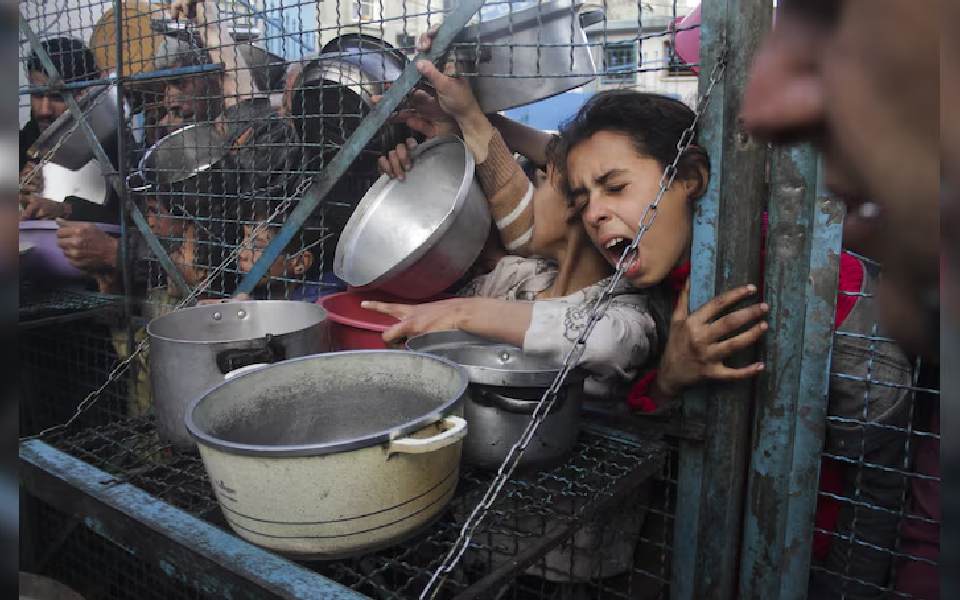
The United Nations meanwhile raised alarm over the mounting impact of Israel's six-week-old blockade preventing all food and other supplies from entering the territory.
Israel ended its ceasefire with Hamas last month and renewed its bombardment, killing hundreds of people and seizing large parts of the territory to pressure the fighter group to accept changes to the agreement.
A strike in the southern city of Khan Younis killed five children, four women and a man from the same family, all of whom suffered severe burns, according to Nasser Hospital, which received the bodies. Strikes in northern Gaza killed 13 people, including nine children, according to the Indonesian Hospital.
The Israeli military says it tries to avoid harming civilians and blames their deaths on Hamas because it operates in residential areas. There was no immediate comment on the latest strikes.
The UN humanitarian office, known as OCHA, said that almost all of Gaza's more than 2 million people now rely for food on the only 1 million prepared meals produced daily by charity kitchens supported by aid groups.
Other food distribution programmes have shut down for lack of supplies, and the UN and other aid groups have been sending their remaining stocks to the charity kitchens.
The only other way to get food in Gaza is from markets. But most cannot afford to buy there because of spiralling prices and widespread shortages, meaning humanitarian aid is the primary food source for 80 per cent of the population, the World Food Programme said in its monthly report for April on Gaza's markets.
“The Gaza Strip is now likely facing the worst humanitarian crisis in the 18 months since the escalation of hostilities in October 2023,” OCHA said.
Most people in Gaza are now down to one meal a day, said Shaina Low, a spokesperson for the Norwegian Refugee Council. “It's far lower than what is needed,” she said.
Water is also growing scarce, with Palestinians standing in long lines to fill jerry cans from trucks. Omar Shatat, an official with a local water utility, said people are down to six or seven litres per day, well below the amount the UN estimates is needed to meet basic needs.
Israeli Defence Minister Israel Katz said Wednesday that preventing humanitarian aid is one of the “central pressure tactics” used against Hamas, which Israel accuses of siphoning off aid to maintain its rule.
Israel is demanding that Hamas release more hostages at the start of any new ceasefire and ultimately agree to disarm and leave the territory. Katz said that even afterward Israel will continue to occupy large “security zones” inside Gaza.
Hamas is currently holding 59 hostages, 24 of whom are believed to be alive. It says it will only return them in exchange for the release of more Palestinian prisoners, a full Israeli withdrawal from Gaza and a lasting truce, as called for in the now-defunct ceasefire agreement reached earlier this year.
Hani Almadhoun, co-founder of Gaza Soup Kitchen, said his kitchen has food for about three more weeks.
“But food is loosely defined. We have pasta and rice but nothing much beyond that. No fresh produce. There is no chicken or beef. The only thing we have is canned meat,” he said. He said 15-20 per cent of the people who come to his kitchen for food leave empty-handed.
The war began when Hamas-led group attacked southern Israel on October 7, 2023, killing some 1,200 people, mostly civilians, and abducting 251. Most of the hostages have since been released in ceasefire agreements or other deals. Israel has rescued eight and recovered dozens of bodies.
Israel's offensive has killed over 51,000 Palestinians, mostly women and children, according to the Gaza Health Ministry, which does not say how many of the dead were civilians or combatants. Israel says it has killed around 20,000 members of the Hamas group, without providing evidence.
The war has destroyed vast parts of Gaza and most of its food production capabilities. The war has displaced around 90 per cent of the population, with hundreds of thousands of people living in tent camps and bombed-out buildings.
Let the Truth be known. If you read VB and like VB, please be a VB Supporter and Help us deliver the Truth to one and all.
Suvendu defeats Mamata in Bhabanipur by over 15,000 votes

Kolkata (PTI): BJP’s Suvendu Adhikari defeated West Bengal Chief Minister Mamata Banerjee in the prestigious Bhabanipur seat by a margin of 15,105 votes on Monday, the EC said.
While Adhikari bagged 73,917 votes, Banerjee secured 58,812 votes.
The result marks a virtual “action replay” of the 2021 Nandigram battle, where Adhikari had unseated Banerjee in a fiercely fought contest that redefined Bengal’s political narrative.