Israeli strikes kill 23 Palestinians, including children, as Gaza ceasefire inches forward
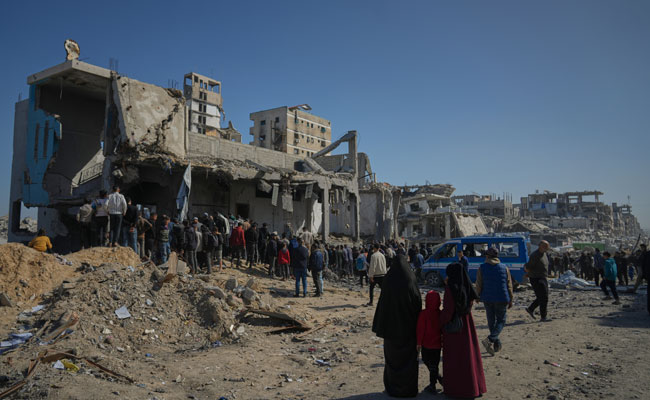
Deir Al-Balah (Gaza Strip) (AP): Hospitals in Gaza said Israeli strikes killed at least 23 Palestinians Saturday, one of the highest tolls since the October ceasefire aimed at stopping the fighting.
A day after Israel accused Hamas of new ceasefire violations, strikes hit locations throughout Gaza, including lethal ones on an apartment building in Gaza City and a tent camp in Khan Younis, officials at hospitals that received the bodies said. The casualties included two women and six children from two different families. An airstrike also hit a police station in Gaza City, killing at least 11 and wounding others, Shifa Hospital director Mohamed Abu Selmiya said.
The series of strikes also came a day before the Rafah crossing along the border with Egypt is set to open in Gaza's southernmost city. All of the territory's border crossings have been closed throughout almost the entire war. Palestinians see Rafah as a lifeline for the tens of thousands in need of treatment outside the territory, where the majority of medical infrastructure has been destroyed.
The crossing's opening, limited at first, marks the first major step in the second phase of the US-brokered ceasefire. Reopening borders is among the challenging issues on the agenda for the phase now underway, which also includes demilitarising the strip after nearly two decades of Hamas rule and installing a new government to oversee reconstruction.
Still, Saturday's strikes are a reminder that the death toll in Gaza is still rising even as the ceasefire agreement inches forward.
Nasser Hospital said the strike on the tent camp caused a fire to break out, killing seven, including a father, his three children and three grandchildren. Meanwhile, Shifa Hospital said the Gaza City apartment building strike killed three children, their aunt and grandmother on Saturday morning, while the strike on the police station killed at least 11 officers, including four policewomen, and inmates held at the station. The Hamas-run Interior Ministry said Palestinians civilians were also killed in the strike.
Hamas called Saturday's strikes “a renewed flagrant violation” and urged the United States and other mediating countries to push Israel to stop strikes.
A military official, speaking Saturday on the condition of anonymity in line with protocol, could not comment on the specific targets, but said Israel carried out overnight and Saturday strikes in response to what the army said were ceasefire violations the day before.
Israel's military, which has hit targets on both sides of the ceasefire's yellow line, has said strikes since October have been in response to violations of the agreement. In a statement on Friday, the military said they killed three militants exiting a tunnel in an Israeli-controlled zone in Rafah.
Gaza's Health Ministry has recorded 509 Palestinians killed by Israeli fire since the start of the ceasefire on Oct. 10. The ministry, which is part of the Hamas-led government, maintains detailed casualty records that are seen as generally reliable by UN agencies and independent experts.
Let the Truth be known. If you read VB and like VB, please be a VB Supporter and Help us deliver the Truth to one and all.
AIITA welcomes Karnataka’s ban on obscene songs in school events
Bhatkal: The Karnataka unit of the All India Ideal Teachers Association (AIITA) has welcomed the Karnataka government’s decision to strictly ban school children from dancing to obscene songs during educational and cultural programmes in government, aided, and private schools across the state.
AIITA Karnataka State President M. R. Manvi congratulated the government for taking what he termed an important step to preserve the sanctity of education.
“Such decisions to safeguard the dignity of school children and uphold the values of education are the need of the hour. This rule should not be limited to government schools alone but must be strictly implemented in all private educational institutions as well,” he said.
He further urged the government to address other concerns within school programmes.
“The government should not only prohibit obscene dances in the name of school anniversaries, but also ensure that plays and dialogues that incite religious hatred are avoided. Schools should be centres of harmony, not platforms for spreading hatred,” he added.
According to a recent circular issued by the Department of School Education and Literacy, obscene dances are adversely affecting the mental health and moral values of students.
In this regard, schools have been advised to use songs that promote nationalism, positive thinking, the greatness of Kannada culture, and value-based traditions instead of inappropriate content during programmes.
The circular also emphasises that students should be dressed in decent attire.
AIITA also backed the department’s warning that disciplinary action would be taken against head teachers if such guidelines are violated. The association has further demanded that district Deputy Directors of Public Instruction strictly monitor the implementation of these rules.