Israeli strikes kill 30 in Gaza, health officials say
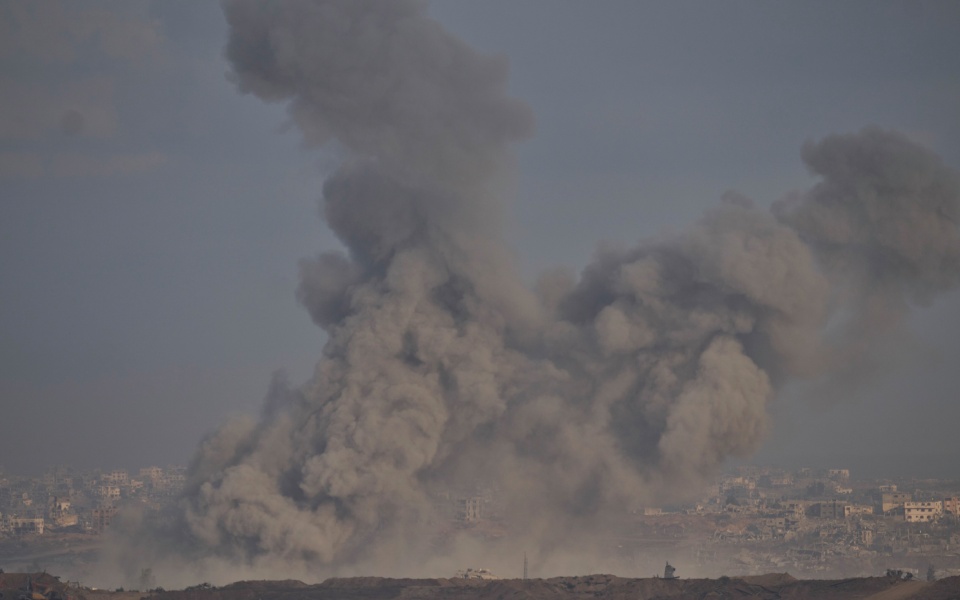
Deir al-Balah (Gaza Strip), Jul 14 (AP): Israeli strikes across the Gaza Strip overnight and into Monday killed at least 30 people, according to local hospitals. The Israeli military meanwhile said it killed a senior Hamas leader last month who had held a hostage in his home.
The 21-month war triggered by Hamas' October 7 attack is raging on after two days of talks between US President Donald Trump and Israeli Prime Minister Benjamin Netanyahu ended last week with no sign of a breakthrough in negotiations over a ceasefire and hostage release.
Twelve people were killed by strikes in southern Gaza, including three who were waiting at an aid distribution point, according to Nasser Hospital in Khan Younis, which received the bodies.
Shifa Hospital in Gaza City also received 12 bodies, including three children and two women, after a series of strikes in the north, according to the hospital's director, Dr. Mohammed Abu Selmia.
Al-Awda Hospital in central Gaza reported six killed and eight wounded in strikes in the built-up Nuseirat refugee camp.
The Israeli military says it only targets fighters and tries to avoid harming civilians. It blames civilian deaths on Hamas because the fighters operate in densely populated areas.
The military said a June 19 strike killed Muhammad Nasr Ali Quneita, who it said had taken part in the October 7 attack and held hostage Emily Damari, a dual Israeli-British citizen, in his home at the start of the war. There was no comment from Hamas nor independent confirmation.
Thousands of Hamas-led members stormed into Israel that day, killing some 1,200 people, mostly civilians, and abducting 251 people, most of whom have since been released in ceasefire agreements or other deals. The Hamas members are still holding 50 hostages, less than half of them believed to be alive.
Israel's retaliatory offensive has killed over 58,000 Palestinians, according to Gaza's Health Ministry, which has said women and children make up more than half of the dead. It does not distinguish between civilians and fighters in its tally.
The ministry is part of the Hamas-run government and is led by medical professionals. The United Nations and other experts consider its figures to be the most reliable count of war casualties.
Israel's air and ground war has destroyed vast areas of Gaza and driven some 90 per cent of the population from their homes. Aid groups say they have struggled to bring in food and other assistance because of Israeli military restrictions and the breakdown of law and order, and experts have warned of famine.
Let the Truth be known. If you read VB and like VB, please be a VB Supporter and Help us deliver the Truth to one and all.
Two injuries, one DNF, a DQ as India end messy World Relays campaign

Gaborone (Botswana) (PTI): Amoj Jacob and Ragul Kumar got injured during the men's 4x400m and 4x100 races respectively as India ended their World Athletics Relays campaign in disappointment on the second day of competitions here on Sunday.
The Indian camp had high hopes of making the 2027 World Championships in the men's 4x400m relay but the team did not finish (DNF) the race as Jacob suffered cramps and pulled out of the race after taking the baton from the first leg runner Dharamveer Choudhary. Rajesh Ramesh and Vishal TK were to run in the third and fourth legs.
Those teams which could not qualify for the 2027 Beijing World Championships by reaching the final round of each of the six relay events on Saturday were given another chance in the second qualification round on Sunday.
The top two teams in each of the two heats (in all six relay events) booked the Beijing ticket on Sunday.
India will now have to try and qualify for the World Championships through the Top Lists of the World Athletics, which is a long and tedious process.
In the men's 4x100m race, third leg runner Ragul Kumar fell down the track after failing to hand over the baton inside the exchange zone to fourth leg runner Gurindervir Singh, which clearly showed the lack of coordination among the runners.
Harsh Santosh Raut and Animesh Kujur ran the first two legs.
The Indian quartet was disqualified and Kumar was seen being taken away from the Field of Play with the help of the volunteers.
It was a comedy of errors in the case of the women's 4x100m race, which saw the baton being dropped during an exchange between first leg runner Tamanna and second runner Nithya Gandhe, though the Indians finished the race in 53.09 seconds.
Gandhe started running quite a distance, but after realising that the baton was not in her hand, she turned and ran back to pick it up.
The only silver-lining for the Indian contingent was the national record time in the mixed 4x100m relay race, though the quartet of Ragul Kumar, Nithya Gandhe, Animesh Kujur and Sneha SS finished sixth in heat number two with a time of 41.35 seconds, bettering the previous national mark of 42.30 seconds set in March in Chandigarh.
The mixed 4x400m relay quartet of Theerthesh P Shetty, Kumari Saloni, Nihal William and Rashdeep Kaur ended at fifth in heat number one with a time of 3 minutes and 19.40 seconds.
On Saturday, all the five Indian relay teams had failed to make it to the respective final rounds and thus missed out on the 2027 World Championships berths.