Italian journalist freed from detention in Iran, returns home
Rome, Jan 8: An Italian journalist detained in Iran for three weeks was freed Wednesday and returned home, after her fate had become intertwined with that of an Iranian engineer arrested in Italy and wanted by the United States.
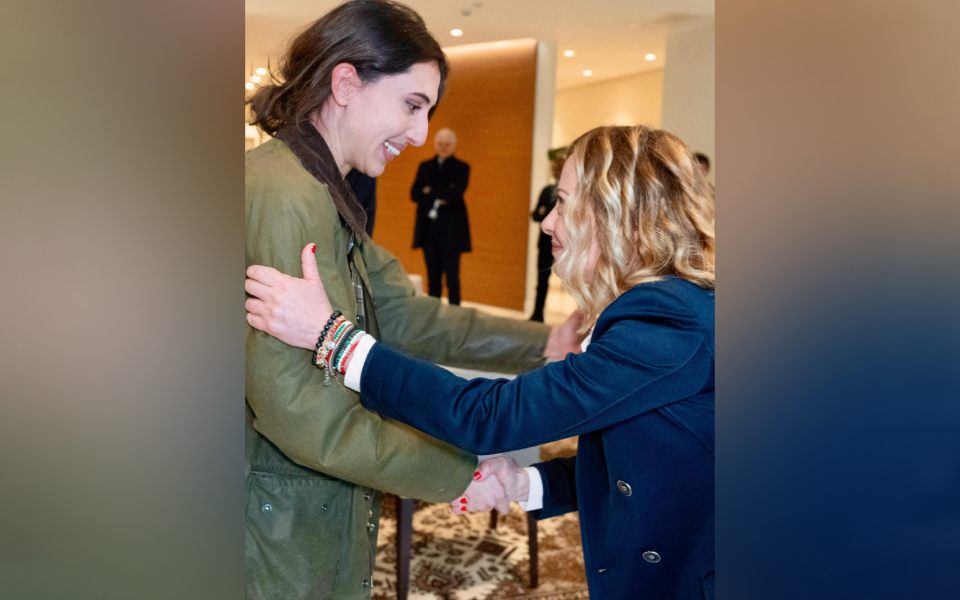
A plane carrying Cecilia Sala, 29, landed at Rome's Ciampino airport, where Premier Giorgia Meloni was on hand to welcome her alongside Sala's family members. Sala descended from the plane and ran to embrace her boyfriend, Daniele Raineri, who later posted a photo of a smiling Sala greeting Meloni in the airport on social media.
Sala's liberation marked a major diplomatic and political victory for Meloni, whose recent visit to President-elect Donald Trump at his Mar-a-Lago retreat greatly enhanced her stature internationally at a time when Italy was negotiating Sala's release.
In announcing that Sala was flying home, Meloni's office said the premier had personally informed Sala's parents and credited the release to the government's “intensive work on diplomatic and intelligence channels.”
Iranian media acknowledged the journalist's release, citing only the foreign reports. Iranian officials offered no immediate comment.
Sala, a reporter for the Il Foglio daily, was detained in Tehran on Dec. 19, a week after she arrived on a journalist visa. She was accused of violating the laws of the Islamic Republic, the official IRNA news agency said.
Italian commentators had speculated that Iran detained and held Sala as a bargaining chip to ensure the release in Italy of Mohammad Abedini, who was arrested by Italian authorities at Milan's Malpensa airport three days before, on Dec 16, on a US warrant.
The US Justice Department has accused Abedini and another Iranian of supplying the drone technology to Iran that was used in a January 2024 attack on a US outpost in Jordan that killed three American troops.
Abedini remains in detention in Italy but has asked a Milan court to grant him house arrest pending an extradition hearing.
Sala's release was met with cheers in Italy, where her plight had dominated headlines. Lawmakers from across the political spectrum praised the outcome, with the opposition Democratic leader Elly Schlein thanking the government specifically.
It came after Meloni made a surprise trip to Florida last weekend to meet Trump at his Mar-a-Lago estate.
Meloni in a statement on X thanked “all those who helped make Cecilia's return possible, allowing her to re-embrace her family and colleagues.”
Meloni's visit to Trump had a strong impact on the premier's international standing, which strengthened Italy's hand in negotiations, Defense Minister Guido Crosetto said.
“Any time you can reinforce the credibility of a leader of a country at a particular moment, the stronger the country is,” he told Italy's Sky Tg24.
Sala's fate had become intertwined with that of Abedini. Each country's foreign ministry summoned the other's ambassador to demand the prisoner's release and decent detention conditions. The diplomatic tangle was particularly complicated for Italy, which is a historic ally of Washington but maintains good relations with Tehran.
Members of Meloni's cabinet took personal interest in the case given the geopolitical implications. Foreign Minister Antonio Tanaji and Crosetto hailed the diplomatic teamwork involved to secure Sala's release.
But the release also posed a delicate political question for Italy given Abedini's status. The United States has complained in the past when Italy has lost track of suspects in the Italian judicial system awaiting hearings for extradition to the US.
A hearing on his bid to be given house arrest is scheduled for Jan 15.
Advocacy group Reporters Without Borders, which had flagged Sala's detention as an attack on press freedom, cheered her release.
“Now the 25 journalists still held in Iranian prisons must also be released,” the group said in a social media post.
Since the 1979 US Embassy crisis, which saw dozens of hostages released after 444 days in captivity, Iran has used prisoners with Western ties as bargaining chips in negotiations.
In September 2023, five Americans detained for years in Iran were freed in exchange for five Iranians in US custody and for $6 billion in frozen Iranian assets to be released by South Korea.
Western journalists have been held in the past. Roxana Saberi, an American journalist, was detained by Iran in 2009 for around 100 days before being released.
Also detained by Iran was Washington Post journalist Jason Rezaian, who was held for more than 540 days before being released in 2016 in a prisoner swap between Iran and the US.
Both cases involved Iran making false espionage accusations in closed-door hearings.
Bentornata Cecilia! pic.twitter.com/iKKjegeS38
— Giorgia Meloni (@GiorgiaMeloni) January 8, 2025
Let the Truth be known. If you read VB and like VB, please be a VB Supporter and Help us deliver the Truth to one and all.
Punjab CM Mann meets President Murmu, seeks cancellation of membership of 6 RS members
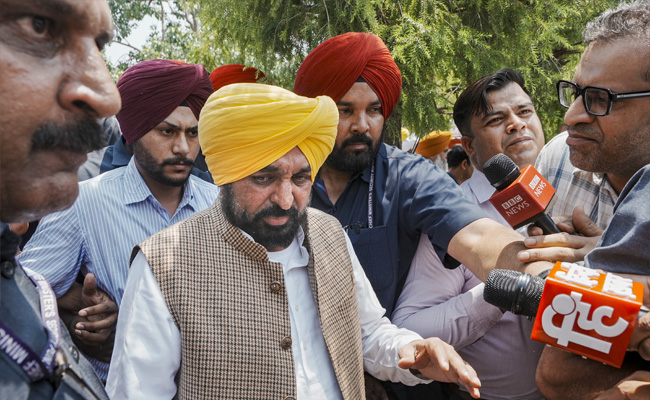
Chandigarh (PTI): Chief Minister Bhagwant Mann on Tuesday met President Droupadi Murmu, demanding the termination of the membership of six Rajya Sabha MPs from Punjab who defected to the BJP and also pressed for the introduction of a constitutional provision allowing for the recall of members.
Accompanied by party MLAs and ministers, Mann visited Rashtrapati Bhavan in Delhi.
This meeting followed a significant setback for the Aam Aadmi Party (AAP) on April 24, when seven of its 10 Rajya Sabha MPs -- Raghav Chadha, Ashok Mittal, Sandeep Pathak, Harbhajan Singh, Rajendra Gupta, Vikramjit Sahney and Swati Maliwal -- quit and merged with the BJP, alleging that the party had strayed from its principles, values and core morals. Six of the seven MPs who left AAP hailed from Punjab.
After he met with the President, Mann addressed the media here, describing the departure of the seven MPs as a "murder" of the Constitution. He stated, "Seven MPs merging with another party is completely unconstitutional. I spoke to Rashtrapati ji in detail."
Mann pointed out that he told the President that the BJP holds only two MLA seats (in Punjab), yet now has six MPs in the Rajya Sabha. He questioned, "How can this be possible? Isn't it a mockery of the Constitution?
"If they are such revolutionaries at heart, then they should have resigned from their six seats. The AAP could have sent someone else," Mann said, taking a swipe at them.
He emphasised the need for a recall provision in the Constitution, referencing MP Raghav Chadha's previous demands for such a measure when members fail to meet public expectations.
"Have you lived up to the expectations of the people?" Mann challenged the MPs during his statement.
Mann also presented a letter to the President, signed by all AAP MLAs. He differentiated between the terms 'elected' and 'selected,' stating, "They were 'selected.' Therefore, their membership should be cancelled."
The President assured Mann that she would consult constitutional experts before responding.
Earlier in the day, Mann, along with party MLAs, departed for Delhi from Chandigarh.
Speaking to reporters in Chandigarh, Mann affirmed that all AAP MLAs stand united with the party. "Only I have been given time for the meeting," Mann said.
"The President is the guardian of the Constitution. She is the constitutional head of the country," he added.
Later in a post on X in Hindi, Mann said, "Our struggle to protect Punjab's rights and interests continues. Today, along with all AAP MLAs, I have left to discuss Punjab's burning issues and present the state's strong voice before the President.
As your public servant, our government remains fully committed to Punjab's prosperity and the safeguarding of the rights of every section of society."
The MLAs and ministers gathered at the chief minister's residence in the morning before heading to Delhi, carrying placards that read 'Punjab Mann De Naal' and 'Punjab's Traitors.'
The legislators left for Delhi in buses.
Mann had previously sought an appointment with the President to meet with party MLAs and demand the "recall" of the Rajya Sabha MPs who defected to the BJP. However, only Mann was given a time slot for the meeting.