Jane Goodall, celebrated primatologist and conservationist, has died
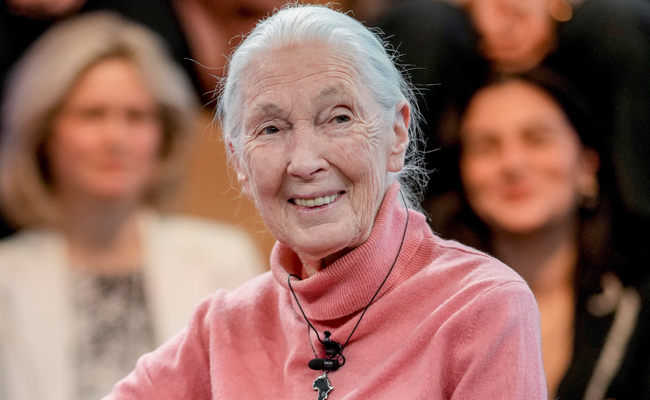
Washington (AP): Jane Goodall, the intellectual, soft-spoken conservationist renowned for her groundbreaking, immersive chimpanzee field research in which she documented the primates' distinct personalities and use of tools, has died.
She was 91.
The environmental advocate became a beloved household name who transcended generations through her appearances in documentaries and on television, as well as her travels to address packed auditoriums around the world.
The Jane Goodall Institute announced the primatologist's death Wednesday in an Instagram post. According to the Washington, DC-based institute, Goodall died of natural causes while in California on a US speaking tour.
Her discoveries “revolutionised science, and she was a tireless advocate for the protection and restoration of our natural world,” it said.
While living among chimpanzees in Africa decades ago, Goodall documented them doing activities previously believed to be exclusive to humans. Her observations and subsequent magazine and documentary appearances in the 1960s transformed how the world perceived not only humans' closest living biological relatives but also the emotional and social complexity of all animals, while propelling her into the public consciousness.
“Out there in nature by myself, when you're alone, you can become part of nature and your humanity doesn't get in the way,” she told The Associated Press in 2021. “It's almost like an out-of-body experience when suddenly you hear different sounds and you smell different smells and you're actually part of this amazing tapestry of life.”
Goodall never lost hope for the future
She had been scheduled to meet with students and teachers on Wednesday to launch the planting of 5,000 trees around wildfire burn zones in the Los Angeles area. Organisers learned of her death as the event was to begin at EF Academy in Pasadena, said spokesperson Shawna Marino. The first tree was planted in Goodall's name after a moment of silence.
“I don't think there's any better way to honour her legacy than having a thousand children gathered for her,” Marino said.
Goodall in her later years devoted decades to education and advocacy on humanitarian causes and protecting the natural world. In her British accent, she was known for balancing the grim realities of the climate crisis with a sincere message of hope for the future.
From her base in the British coastal town of Bournemouth, she travelled nearly 300 days a year, even after she turned 90, for public speeches. Between more serious messages, her speeches often featured her whooping like a chimpanzee or lamenting that Tarzan chose the wrong Jane.
Tributes from animal rights organisations, political leaders and admirers poured in following news of her death.
“I'm deeply saddened to learn about the passing of Jane Goodall, our dear Messenger of Peace. She is leaving an extraordinary legacy for humanity & our planet,” said United Nations Secretary-General António Guterres.
Nature broadcaster Chris Packham reflected on her relentless advocacy until the very end.
“In many ways Jane just died on the job,” he said. “The job that her life became. And that was protecting life on earth.”
Living among the chimpanzees
While first studying chimps in Tanzania in the early 1960s, Goodall was known for her unconventional approach. She didn't simply observe them from afar but immersed herself in every aspect of their lives. She fed them and gave them names instead of numbers, which some scientists criticized.
Her findings were circulated to millions when she first appeared on the cover of National Geographic in 1963 and then in a popular documentary. A collection of photos of Goodall in the field helped her and even some of the chimps become famous. One iconic image showed her crouching across from the infant chimpanzee named Flint. Each has arms outstretched, reaching for the other.
In 1972, the Sunday Times published an obituary for Flo, Flint's mother and the dominant matriarch. Flint died soon after showing signs of grief and losing weight.
“What the chimps have taught me over the years is they're so like us. They've blurred the line between humans and animals,” she said in 1997.
University of St Andrews primatologist Catherine Hobaiter, who studies communication in chimpanzees, said that when she first heard Goodall speak, it transformed her view of science.
“It was the first time as a young scientist working with wild apes and wild chimpanzees that I got to hear that it was OK to feel something,” she said.
Goodall earned top civilian honours from a number of countries. She was awarded the Presidential Medal of Freedom in 2025 by then-US President Joe Biden and in 2021 won the prestigious Templeton Prize, which honours individuals whose life's work embodies a fusion of science and spirituality.
The Humane World for Animals said Wednesday that Goodall's influence on the animal protection community was immeasurable.
“Her work on behalf of primates and all animals will never be forgotten,” said Kitty Block, president and CEO of the group formerly the Humane Society of the United States and Humane Society International.
Charting a course from an early age
Born in London in 1934, Goodall said her fascination with animals began around when she learned to crawl. In her book, “In the Shadow of Man,” she described an early memory of hiding in a henhouse to see a chicken lay an egg. She was there so long her mother reported her missing to police.
She bought her first book — Edgar Rice Burroughs' “Tarzan of the Apes” — when she was 10 and soon made up her mind about her future: Live with wild animals in Africa.
That plan stayed with her through a secretarial course when she was 18 and two different jobs. By 1957, she accepted an invitation to travel to a farm in Kenya.
There she met the famed anthropologist and paleontologist Louis Leakey at a natural history museum in Nairobi. He gave her a job as an assistant secretary.
Three years later, despite Goodall not having a college degree, Leakey asked if she would be interested in studying chimpanzees in what is now Tanzania. She told the AP that he chose her “because he wanted an open mind.”
The beginning was filled with complications. British authorities insisted she have a companion, so she brought her mother. The chimps fled if she got within 460 metres of them. She also spent weeks sick from what she believed was malaria.
Eventually she gained the animals' trust. By the fall of 1960, she observed the chimpanzee named David Greybeard make a tool from twigs to fish termites from a nest. It was previously believed that only humans made and used tools.
She also found that chimps have individual personalities and share humans' emotions of pleasure, joy, sadness and fear. She documented bonds between mothers and infants, sibling rivalry and male dominance. She found there was no sharp line between humans and the animal kingdom.
In later years, she discovered chimpanzees engage in a type of warfare, and in 1987 she and her staff observed a chimp “adopt” a 3-year-old orphan that wasn't closely related.
Becoming an activist
Her work moved into global advocacy after she watched a disturbing film of experiments on laboratory animals in 1986.
“I knew I had to do something,” she said. “It was payback time.”
When the COVID-19 pandemic hit in 2020 and halted her in-person events, she began podcasting from her childhood home in England. Through dozens of “Jane Goodall Hopecast” episodes, she talked with guests including US Sen Cory Booker, author Margaret Atwood and marine biologist Ayana Elizabeth Johnson.
“If one wants to reach people; If one wants to change attitudes, you have to reach the heart,” she said during her first episode. “You can reach the heart by telling stories, not by arguing with people's intellects.”
In later years, she pushed back on “gloom and doom” messaging and aggressive tactics by climate activists, saying they could backfire.
Her advice: “Focus on the present and make choices today whose impact will build over time.”
Let the Truth be known. If you read VB and like VB, please be a VB Supporter and Help us deliver the Truth to one and all.
4 workers die after being buried under coal slurry in Jharkhand's Dhanbad
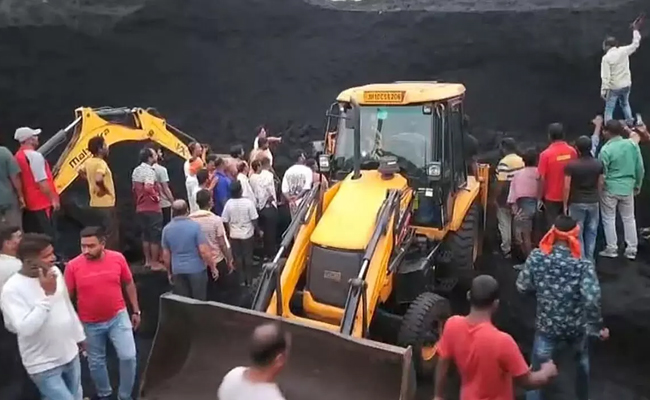
Dhanbad (Jharkhand) (PTI): At least four workers died after being buried under coal slurry in Jharkhand's Dhanbad district on Saturday, a police official said.
The incident took place at Moonidih coal washery in the command area of Bharat Coking Coal Limited (BCCL).
"Bodies of all four workers were dug out of debris during a rescue operation," Putki police station in-charge Waqar Hussain told PTI.
The incident took place when coal slurry was being loaded into trucks by workers, during which a large chunk of slurry fell and trapped several workers underneath, officials said.
The deceased have been identified as Manik Bauri, Dinesh Bauri, Deepak Bauri, and Hemlal Gope.
Meanwhile, the family members of the deceased and local villagers placed the bodies in front of the washery gate and began a protest.
They demanded compensation, jobs for dependents and action against those responsible for the incident.
Police and administration officials are trying to pacify the protesters, an official said.