Japan enacts controversial law to accept foreign workers
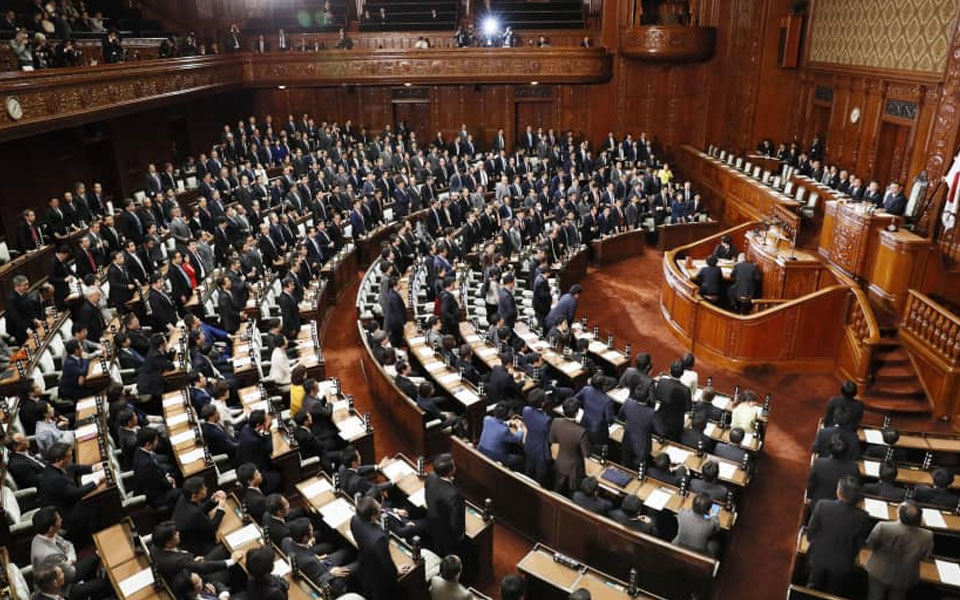
Tokyo, Dec 8 : Japanese Prime Minister Shinzo Abe's ruling coalition early Saturday rammed through legislation to bring more blue-collar foreign workers into the country, in a controversial move to address chronic labour shortages.
The bill was enacted after the upper house gave approval despite a raft of criticism by opposition parties following its passage through the lower house in late November.
Both chambers are controlled by Abe's ruling camp. Under the new system, the government plans to bring in as many as 345,000 foreign workers in construction, food services, nursing and other designated sectors for five years.
"We aim at starting it in April next year because we need to swiftly launch the new system in order to deal with the current labour shortage," Abe told parliament on Thursday.
But opposition parties claimed that the law fails to address the potential impact on Japanese society of new foreign labour, and does not protect foreign workers' rights.
In a bid to block its passage, opposition parties submitted censure motions against Abe and Justice Minister Takashi Yamashita, but they were easily rejected by the ruling bloc.
The law allows foreign nationals with skills in sectors facing particularly severe shortages to obtain five-year visas, which would not allow them to bring their families.
Foreign workers in those fields who hold stronger qualifications and pass a more difficult Japanese language test will be able to obtain a visa that can be extended indefinitely, eventually leading to residency, and will be able to bring over family.
But there have been questions about whether an influx of foreign workers will depress wages, how the workers will be incorporated into Japan's social security system, and worries about exploitation of migrant labour. Many of Japan's low-skilled foreign workers are in the country under a so-called "technical training" programme, which has repeatedly faced allegations of abuse.
"We should not create a new system hastily without reviewing the technical training programme in which problems are mounting," Yoshifu Arita, an opposition lawmaker, told parliament.
Businesses have long lobbied for looser immigration rules, saying they struggle to find workers in a country where unemployment hovers around 2.5 per cent. The chronic labour shortages are only worsening as Japan's ageing and shrinking population means a declining pool of workers.
Let the Truth be known. If you read VB and like VB, please be a VB Supporter and Help us deliver the Truth to one and all.
Man arrested with Rs 2.54-crore heroin in Mumbai

Mumbai (PTI): Police have arrested a man and seized over 500 grams of heroin worth Rs 2.54 crore in the illicit market from him in Mumbai, officials said on Friday.
The police's Anti-Narcotics Cell (ANC) made the drug seizure in Santacruz in the western suburbs. The operation was conducted by the Kandivali unit of the ANC on Thursday as part of a special crackdown against drug trafficking in the area, they said.
Acting on specific inputs, an ANC team conducted a raid in Santacruz (East) and intercepted a man. During a search, the team recovered 508 grams of high-grade heroin from his possession, an official said.
The seized contraband, a highly addictive, opioid drug derived from morphine, is estimated to be worth Rs 2.54 crore in the international market, he informed.
Following the seizure, a case was registered against the man under relevant sections of the Narcotic Drugs and Psychotropic Substances (NDPS) Act, 1985, and he was formally placed under arrest in the early hours of Friday.
The police are currently investigating the source of the drug and trying to identify the intended recipients of the consignment, he said.