Japan to start releasing Fukushima water into sea in 2 years
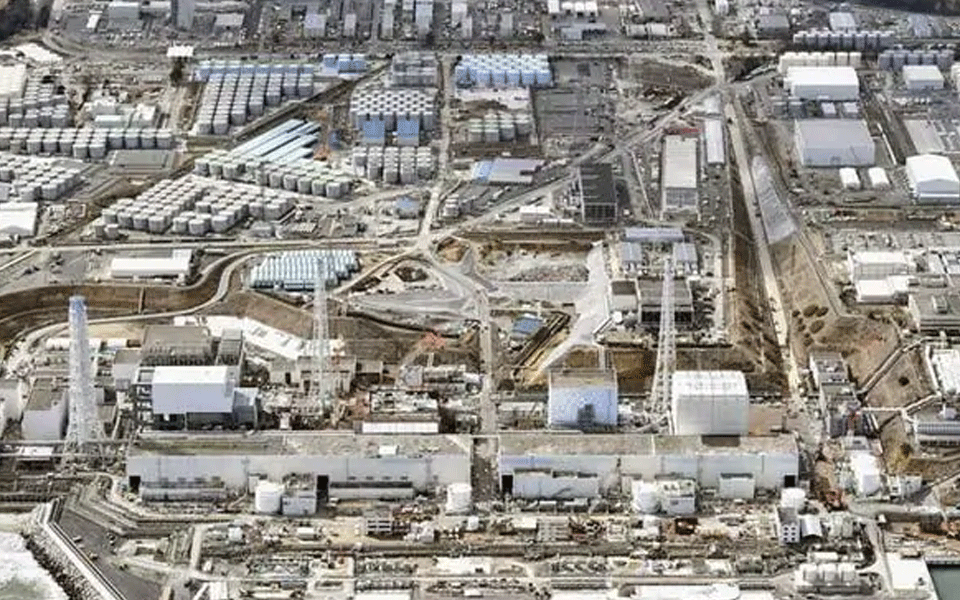
Tokyo: Japan's government decided Tuesday to start releasing massive amounts of treated radioactive water from the wrecked Fukushima nuclear plant into the Pacific Ocean in two years an option fiercely opposed by local fishermen and residents.
The decision, long speculated but delayed for years due to safety concerns and protests, came at a meeting of Cabinet ministers who endorsed the ocean release as the best option.
The accumulating water has been stored in tanks at the Fukushima Daiichi plant since 2011, when a massive earthquake and tsunami damaged its reactors and their cooling water became contaminated and began leaking.
The plant's operator, Tokyo Electric Power Co., says its storage capacity will be full late next year.
Prime Minister Yoshihide Suga said the ocean release was the "most realistic" option and that disposing the water is "unavoidable" for the decommissioning of the Fukushima plant, which is expected to take decades.
TEPCO and government officials say tritium, which is not harmful in small amounts, cannot be removed from the water, but all other selected radionuclides can be reduced to levels allowed for release. Some scientists say the long-term impact on marine life from low-dose exposure to such large volumes of water is unknown.
Under the basic plan adopted by the ministers, TEPCO will start releasing the water in about two years after building a facility under the regulatory authority's safety requirements. It said the disposal of the water cannot be postponed further and is necessary to improve the environment surrounding the plant so residents can live there safely.
TEPCO says its water storage capacity of 1.37 million tons will be full around the fall of 2022. Also, the area now filled with storage tanks will have to be freed up for building new facilities that will be needed for removing melted fuel debris from inside the reactors, a process expected to start in coming years.
In the decade since the tsunami disaster, water meant to cool the nuclear material has constantly escaped from the damaged primary containment vessels into the basements of the reactor buildings.
To make up for the loss, more water has been pumped into the reactors to continue to cool the melted fuel. Water is also pumped out and treated, part of which is recycled as cooling water, and the remainder stored in 1,020 tanks now holding 1.25 million tons of radioactive water.
Those tanks that occupy a large space at the plant complex interfere with the safe and steady progress of the decommissioning, Economy and Industry Minister Hiroshi Kajiyama said. The tanks also could be damaged and leak in case of another powerful earthquake or tsunami, the report said.
Releasing the water to the ocean was described as the most realistic method by a government panel that for nearly seven years had discussed how to dispose of the water without further harming Fukushima's image, fisheries and other businesses. The report it prepared last year mentioned evaporation as a less desirable option.
About 70 per cent of the water in the tanks exceeds allowable discharge limits for contamination but will be filtered again and diluted with seawater before it is released, the report says. According to a preliminary estimate, gradual releases of water will take about 30 years but will be completed before the plant is fully decommissioned.
Japan will abide by international rules for a release, obtain support from the International Atomic Energy Agency and others, and ensure disclosure of data and transparency to gain understanding of the international community, the report said.
China and South Korea have raised serious concern about the discharge of the water and its potential impact.
The government has said it will do the utmost to support local fisheries, and the report said TEPCO would compensate for damages if they occur despite those efforts.
Kajiyama is set to visit Fukushima on Tuesday afternoon to meet with local town and fisheries officials to explain the decision. He said he will continue to make efforts to gain their understanding over the next two years.
Let the Truth be known. If you read VB and like VB, please be a VB Supporter and Help us deliver the Truth to one and all.
Allahabad HC orders probe into 'reinstatement' of teacher in UP's Barabanki
Lucknow (PTI): The Lucknow Bench of the Allahabad High Court on Friday ordered a probe by the special task force (STF) into alleged irregularities in the rejoining of a teacher at City Intermediate College in Barabanki, observing that the reinstatement appeared to be prima facie illegal.
The court also directed the recovery of the salary paid to the teacher during the disputed period.
A bench of Justice Rajeev Singh passed the order on a petition filed by the college management committee. The court expressed doubts over the roles of the District Inspector of Schools (DIOS), Barabanki, the college principal and the teacher concerned and hence, directed a detailed inquiry into the matter.
Taking note of alleged manipulation of records and misleading submissions, the court ordered the immediate transfer of the Barabanki DIOS to ensure a fair probe. It also directed the initiation of disciplinary proceedings against the then joint director of education of the Ayodhya division.
In its order, the court found that the teacher, Abhay Kumar, was initially appointed as an assistant teacher in 2018 but joined an Eklavya Model Residential School in Chhattisgarh as a lecturer in June 2024 without obtaining permission from the management. His subsequent request to retain the lien was rejected.
Despite this, he was allowed to rejoin the Barabanki College in September 2025 on the directions of the joint director of education and the DIOS, and was even paid the salary for October 2025. The court termed the rejoining "wholly illegal" and lacking any legal basis.
The bench also expressed concern over lapses in communication within the education department and directed the Uttar Pradesh chief secretary to ensure that official orders are communicated through email and WhatsApp as well, to prevent disputes.
The matter is next listed for hearing on May 28 when a compliance report is sought.