Japanese PM announces state of emergency for Tokyo with Olympics opening in just two weeks
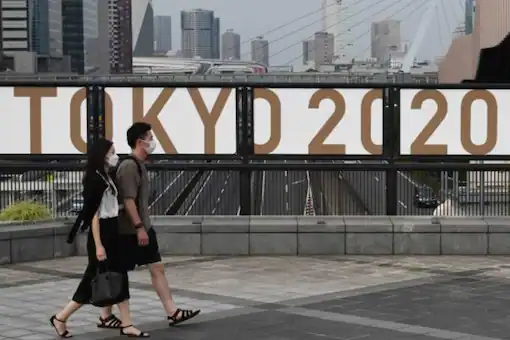
Tokyo, Jul 8: IOC President Thomas Bach arrived in Tokyo on Thursday just as a ban on spectators at the Tokyo Olympics is likely after Japan Prime Minister Yoshihde Suga announced a state of emergency because of rising coronavirus infections in the capital.
Suga said the state of emergency would go in effect on Monday and last through Aug. 22. This means the Olympics, opening on July 23 and running through Aug. 8, will be held entirely under emergency measures.
Suga said the state of emergency was needed to prevent the resurgence of the future spread on cases across the country.
Bach largely avoided cameras at Tokyo's Haneda Airport and, on a rainy afternoon, went to the International Olympic Committee's games headquarters in Tokyo, a five-star hotel in the center of the city. He is reported to need to self-isolate for three days.
Bach's arrival comes just two weeks before the postponed Tokyo Games are to open. The IOC and local organizers are attempting to hold the games during a pandemic despite opposition from the Japanese public and medical community.
The main focus of the emergency is a request for bars, restaurants and karaoke parlors serving alcohol to close. A ban on serving alcohol is a key step to tone down Olympic-related festivities and keep people from drinking and partying. Tokyo residents are expected to face stay-home requests and watch the games on TV from home.
How to stop people enjoying the Olympics from going out for drinks is a main issue, Health Minister Norihisa Tamura said.
The present state of emergency ends Sunday. Tokyo reported 920 new cases on Wednesday, up from 714 a week earlier. It was the 18th straight day of week-on-week increases, and was the highest total since 1,010 were reported on May 13.
Fans from abroad were months ago banned from attending the Olympics. But just two weeks ago, organizers and the IOC decided to allow venues to be filled to 50 per cent of capacity but crowds not to exceed 10,000. The state-of-emergency will force them to change plans again with a decision probably coming later on Thursday.
The soaring cases are likely to mean that venues will be without any spectators, although sponsors and others may have access. The no-fan atmosphere could include the opening ceremony at the USD 1.4 billion National Stadium.
The uptick in infections has also forced the Tokyo city government to pull the Olympic torch relay off capital streets, allowing it to run only on remote islands off the Tokyo coast. It's unclear how the torch will enter the stadium for the opening ceremony.
The infections are in their expansion phase and everyone in this country must firmly understand the seriousness of it, Dr. Shigeru Omi, a top government medical adviser, said.
He urged authorities to quickly take tough measures ahead of the Olympics, with summer vacations approaching.
Omi has repeatedly called for a ban on spectators, and has said it's abnormal to hold the Olympics during a pandemic.
Separately, a government COVID-19 advisory panel met Wednesday and expressed concerns about the ongoing resurgence of the infections.
Two-thirds of the infections in the capital region are from Tokyo, and our concern is the spread of the infections to neighboring areas, said Ryuji Wakita, director-general of the National Institute of Infectious Diseases.
The Olympics are pushing ahead against most medical advice, partially because the postponement stalled the IOC's income flow. It gets almost 75% of its income from selling broadcast rights, and estimates suggest it would lose 3 billion to 4 billion if the Olympics were canceled.
About 11,000 Olympians and 4,400 Paralympians are expected to enter Japan, with tens of thousands of officials, judges, administrators, sponsors, broadcasters, and media also entering. The IOC says more than 80% of resident of the Olympic Village will be vaccinated.
Nationwide, Japan has had about 810,000 cases and nearly 14,900 deaths. Only 15 per cent of Japanese are fully vaccinated, still low compared with 47.4% in the United States and almost 50 per cent in Britain.
Let the Truth be known. If you read VB and like VB, please be a VB Supporter and Help us deliver the Truth to one and all.
Two injuries, one DNF, a DQ as India end messy World Relays campaign
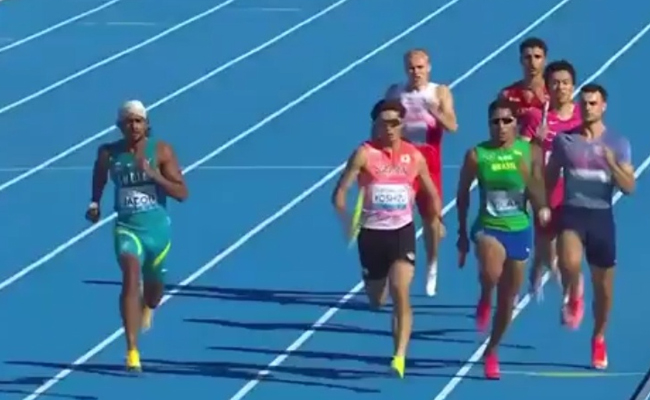
Gaborone (Botswana) (PTI): Amoj Jacob and Ragul Kumar got injured during the men's 4x400m and 4x100 races respectively as India ended their World Athletics Relays campaign in disappointment on the second day of competitions here on Sunday.
The Indian camp had high hopes of making the 2027 World Championships in the men's 4x400m relay but the team did not finish (DNF) the race as Jacob suffered cramps and pulled out of the race after taking the baton from the first leg runner Dharamveer Choudhary. Rajesh Ramesh and Vishal TK were to run in the third and fourth legs.
Those teams which could not qualify for the 2027 Beijing World Championships by reaching the final round of each of the six relay events on Saturday were given another chance in the second qualification round on Sunday.
The top two teams in each of the two heats (in all six relay events) booked the Beijing ticket on Sunday.
India will now have to try and qualify for the World Championships through the Top Lists of the World Athletics, which is a long and tedious process.
In the men's 4x100m race, third leg runner Ragul Kumar fell down the track after failing to hand over the baton inside the exchange zone to fourth leg runner Gurindervir Singh, which clearly showed the lack of coordination among the runners.
Harsh Santosh Raut and Animesh Kujur ran the first two legs.
The Indian quartet was disqualified and Kumar was seen being taken away from the Field of Play with the help of the volunteers.
It was a comedy of errors in the case of the women's 4x100m race, which saw the baton being dropped during an exchange between first leg runner Tamanna and second runner Nithya Gandhe, though the Indians finished the race in 53.09 seconds.
Gandhe started running quite a distance, but after realising that the baton was not in her hand, she turned and ran back to pick it up.
The only silver-lining for the Indian contingent was the national record time in the mixed 4x100m relay race, though the quartet of Ragul Kumar, Nithya Gandhe, Animesh Kujur and Sneha SS finished sixth in heat number two with a time of 41.35 seconds, bettering the previous national mark of 42.30 seconds set in March in Chandigarh.
The mixed 4x400m relay quartet of Theerthesh P Shetty, Kumari Saloni, Nihal William and Rashdeep Kaur ended at fifth in heat number one with a time of 3 minutes and 19.40 seconds.
On Saturday, all the five Indian relay teams had failed to make it to the respective final rounds and thus missed out on the 2027 World Championships berths.