Jatiya Party denounces blaming India for Bangladesh floods; Calls for Hasina’s extradition
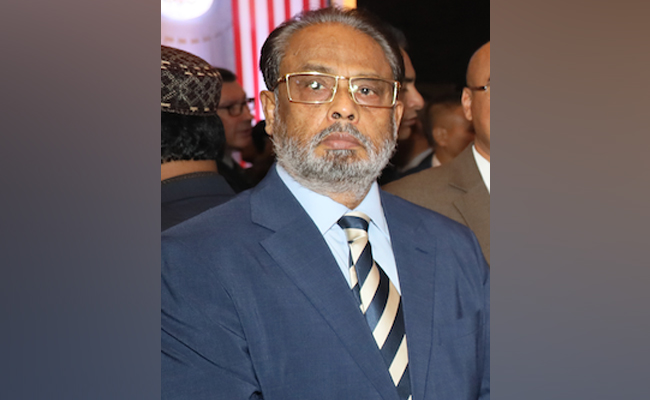
Dhaka (PTI): Jatiya Party chairman Ghulam Muhammed Quader has denounced those who blame India for the flood situation in Bangladesh as a “wrong narrative” that exploits existing anti-India sentiments to wrongly attribute responsibility on New Delhi for a natural calamity.
Quader, who was Leader of the Opposition in the last Bangladesh Parliament (Jatiya Sangsad), which was dissolved on August 6, a day after Prime Minister Sheikh Hasina resigned and fled the country following deadly protests against her government over a controversial quota system in jobs, asserted that Hasina should be extradited from India and tried in a Bangladeshi court for all the crimes committed by her and her regime.
In an interview with PTI, the former Bangladeshi cabinet minister said that while people in both countries want good relations, it’s important to stop acting as if one country is the "supreme lord" and instead treat each other as equal partners.
Reflecting on the “India out” campaign in Bangladesh, Quader stated that the “animosity is not against India but against its policy of unquestionable support for one specific political party (Awami League) and its leader (Sheikh Hasina)” despite several allegations of misrule and ushering in a dictatorial regime in the country.
“Blaming India for floods in Bangladesh is not right. It is a wrong narrative. How can you blame someone for floods or any natural calamity? It is normal that water will flow down to lowland areas. The problem we face is less release of water from India. But during the rainy season, if water is not released, then the dams situated there could collapse and cause a calamity of much bigger magnitude,” the 76-year-old leader said.
"It would have been better if there was an early warning from India so that we had time to prepare," he said.
His remarks come in the backdrop of reports emerging from Dhaka blaming India for the floods in Bangladesh.
Monsoon rainfall-triggered floods in deltaic Bangladesh and upstream Indian regions have killed several people and marooned or affected nearly three million others in Bangladesh, posing a huge administrative challenge to the newly installed interim government amid a political transition.
India on Thursday described as factually incorrect reports in Bangladesh that the current flood situation in certain parts of the country has been caused by the opening of a dam on the Gumti River in Tripura.
The Ministry of External Affairs (MEA) in New Delhi stated that floods in the shared rivers between the two countries are a "shared" problem affecting people on both sides and require close mutual cooperation to resolve.
“Those who don’t understand the situation and are using the present anti-India sentiments are trying to mislead people. Naturally, water will flow from higher elevations to lower elevations. If excess water is not released from dams, then the dams could collapse, leading to a bigger disaster,” Quader said.
Bangladesh is crisscrossed by more than 200 rivers, 54 of which are transboundary rivers with upper riparian India, across four major basins.
Replying to a query about the rise in anti-India sentiments despite India being a “time-tested friend of Bangladesh,” Quader said, “The anti-India sentiment is not against its people but against the policymakers.”
“The anger is not against Indian people per se; there are still people here who desire good people-to-people relations. But the problem is that India backed the Awami League so much despite all its flaws, misrule, lack of proper elections, and corruption, that the Indian establishment is now seen as a supporter of the Awami League, and that is why people are angry and view India as an enemy of Bangladesh,” he said.
“Sheikh Hasina’s decision to flee to India has worsened matters. I think Sheikh Hasina should be extradited to Bangladesh and tried here. India must hand her over to the Bangladeshi government,” he said.
Bangladesh’s interim government has revoked ousted prime minister Sheikh Hasina's diplomatic passport, along with those of all members of her former Cabinet.
Speaking about the future of India-Bangladesh bilateral ties, Quader said both countries need each other and must adopt a fresh and positive outlook following the fall of the Awami League government.
“The Awami League is the past; we must look forward. Both countries need to sit down and reassess ways to improve bilateral ties. However, in a relationship between two countries, both nations should be treated as equals, and any big-brotherly attitude should be avoided. No one should behave as the supreme lord,” he said.
Regarding the present situation in Bangladesh, Quader said the people of the country want to return to a democratic process as soon as possible.
“Right now, after the people’s uprising, the common masses want a proper democratic structure. For the last several decades, although governments were formed by the people, those governments never worked for the people,” he said.
Quader called for reforms not only in the government structure but also in the constitution to prevent “no single political party or individual from becoming too powerful.”
“In the past, we have seen parties, after coming to power, turn into autocratic regimes by undermining independent institutions. This should not happen. If necessary, there should be reforms in our constitution to stop this trend,” he said.
Quader welcomed Bangladesh’s interim government Chief Adviser Muhammad Yunus’s appeal on Sunday for the people to have "patience" as it is difficult to address the "mountain-like challenges" overnight while promising them a free, fair, and participatory election after implementing key reforms in various sectors.
“I think the appeal and comments he made are very positive, and these reforms must take place as soon as possible,” he said.
The interim government led by Yunus is trying to stabilise the country, with reforms in various sectors being their top priority.
Let the Truth be known. If you read VB and like VB, please be a VB Supporter and Help us deliver the Truth to one and all.
CM Siddaramaiah alleges ‘criminal conspiracy’ in Sringeri recount, vows legal action
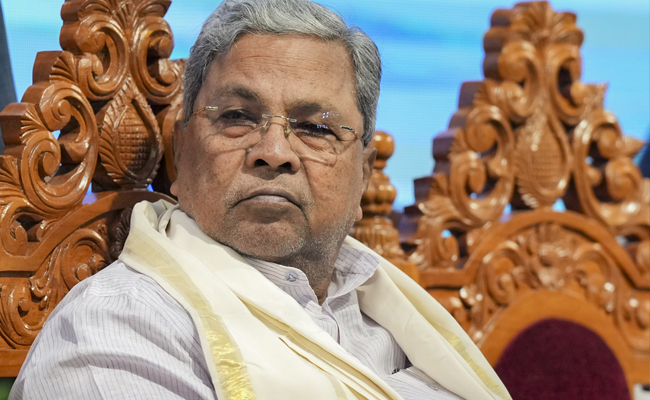
Bengaluru (PTI): Alleging a “criminal conspiracy” by BJP candidate D N Jeevaraj in the Sringeri Assembly poll recounting, Karnataka CM Siddaramaiah on Tuesday said the outcome was manipulated after valid postal ballot votes in favour of Congress leader T D Raje Gowda were tampered with during the recounting process.
Following a Karnataka High Court order on an election petition filed by Jeevaraj, challenging Raje Gowda’s election, the reverification and recounting were conducted on Saturday.
After the reverification and recount of postal ballots for the Sringeri Assembly constituency, votes polled in favour of Raje Gowda were reduced by 255, the returning officer said.
A report on the matter has been submitted to the Election Commission of India for further action, the officer added.
Congress leader Raje Gowda had won the 2023 Assembly polls from Sringeri by 201 votes, defeating his nearest rival Jeevaraj.
Addressing a press conference in Bengaluru, Siddaramaiah said the High Court had directed the recounting of postal ballots and that irregularities were noticed during the exercise conducted on May 2.
“This is a clear case of criminal conspiracy,” Siddaramaiah said, alleging that valid votes cast in favour of Raje Gowda were altered after being accepted by counting agents of all parties, including Congress, BJP, and JD(S).
He claimed that during the recounting of postal ballots, 255 votes were initially accepted as valid by all agents but were later tampered with by subordinate officials.
“There is a second mark on the votes polled in favour of Raje Gowda. They had accepted these as valid votes. Subsequently, another mark was made by officials. This is a clear case of criminal conspiracy,” he said.
When asked who was behind the alleged conspiracy, the CM replied, “It was hatched by Jeevaraj and others. It is planned.”
Siddaramaiah further alleged that the returning officer acted improperly by declaring the result despite the presence of an Election Commission observer during the recounting.
“Immediately after the counting, the returning officer announced the result. He should not have done so; this is against the law,” he said.
He pointed out that Raje Gowda had originally won by 201 votes, but after the recounting, the BJP candidate was declared the winner by 52 votes.
“The BJP has committed a criminal act of conspiracy. This is not vote chori but vote dacoity,” he alleged.
The CM said a police complaint had already been filed by Raje Gowda’s election agent, Sudhir Kumar, and emphasised the need for electoral integrity.
“We want transparency and free and fair elections. That is what our Constitution mandates,” he added.
Stating that the government would pursue legal remedies, Siddaramaiah said, “We are preparing an appeal challenging the returning officer’s announcement in a court of law.”
Responding to a separate query on elections in other states, the CM said there appeared to be an anti-incumbency factor in West Bengal, while results in Tamil Nadu were “surprising,” adding that Vijay’s party was emerging as the largest there.
Following the victory of party candidates in Bagalkote and Davanagere South, Siddaramaiah expressed confidence about future electoral prospects in Karnataka.
“Even in 2028, we will win the Assembly elections. We will come back,” the CM said.
Siddaramaiah added that he would order a forensic examination into the alleged tampering of postal ballots.