Joe Biden names Indian-American Senator Kamala Harris as running mate

Washington: Joe Biden has picked Indian-origin Senator Kamala Devi Harris as his running mate, recognising the crucial role Black voters could play in his determined bid to defeat President Donald Trump in the US presidential election in November.
By naming the 55-year-old lawyer and politician from California as his running mate, Biden made history by selecting the first Black woman to compete on a major party's presidential ticket.
Harris, whose father is an African from Jamaica and mother an Indian, is currently the US Senator from California and has been described as a trailblazer by former president Barack Obama.
Biden, 77, made the announcement in a text message to his supporters on Tuesday afternoon, ending days of suspense about a week ahead of his virtual Democratic National Convention that would formally nominate him as the party's candidate for the November 3 presidential election, challenging Trump, a Republican.
"Joe Biden here. I've chosen Kamala Harris as my running mate. Together, with you, we're going to beat Trump. Add your name to welcome her to the team, Biden said in his message.
Biden said Harris will be the best partner for him to finally get the country back on track.
He described her as "a fearless fighter for the little guy, and one of the country's finest public servants". He noted how she had worked closely with his late son, Beau, when she was California's attorney general.
"I was proud then, and I'm proud now to have her as my partner in this campaign."
Harris later tweeted that Biden "can unify the American people because he's spent his life fighting for us. And as president, he'll build an America that lives up to our ideals.
"I'm honored to join him as our party's nominee for Vice President, and do what it takes to make him our Commander-in-Chief."
Biden pledged in March to name a woman on the ticket. He had faced mounting calls to pick a Black woman in recent months as the nation was hit by massive social unrest over police brutality against African Americans, a key voting bloc to the Democratic Party.
Joe Biden is running to restore the soul of the nation and unite the country to move us forward. Joe knows more about the importance of the Vice Presidency than just about anyone, and he is confident that Kamala Harris will be the best partner for him to finally get the country back on track, the Biden campaign said.
If elected she would be the first ever women to be the vice president of the US and the first ever Indian-American and African vice president of the country.
Explaining the reasons for selecting Harris as Biden's running mate, the Biden campaign alleged that since Donald Trump became president, he has made everything worse.
He has pursued economic policies that reward wealth over work and benefited corporations and his buddies over working families. He has walked away from American leadership on the national stage. He has used division and stoked hatred for political purposes to pit Americans against one another, the campaign alleged.
A first term Democratic Senator from California, Harris had launched her presidential campaign in January 2019.
After initial few months, her campaign could not take off and by the end of the year, she withdrew from the race.
Early this year, she endorsed Biden for presidency and during the primaries and pre-primary season, she did not have a good relationship with Biden. They once again became allies in the last few months.
Biden started appreciating her skills. Harris raised millions of dollars for the Biden campaign.
Harris is known for many firsts. She has been a county district attorney; the district attorney for San Francisco the first woman and first African-American and Indian-origin to be elected to the position.
She was also the first female African-American and Indian-origin to become California's attorney general. Harris became the first Indian-origin and second African-American woman to join the Senate, winning the California seat vacated by Senator Barbara Boxer, who retired after 24 years.
Harris held the first event of her 2020 presidential campaign in Washington on the landmark campus of Howard University, from which Harris earned an undergraduate degree in 1986.
Criminal justice and legal rights were central to her campaign themes. Political pundits say that she would perform much better in the vice presidential debate against Vice President Mike Pence.
While she supports broader immigration overhaul legislation, she also contends that the deferred action for immigration enforcement against some immigrants could be substantially expanded even without congressional action.
Harris batted for H-4 work visas which mainly impacted Indian spouses.
During her presidential bid, she advocated for a proposal to direct the Department of Homeland Security to provide retroactive work authorisation for immigrants who came to the US as children often referred to as Dreamers.
Harris was born in Oakland and grew up in Berkeley. After her parents divorced, she spent her high school years living in French-speaking Canada her mother was teaching at McGill University in Montreal.
In 2010, Harris became the first Black woman to be elected as California's Attorney General, overseeing the country's second largest Justice Department, only behind the US Department of Justice.
Let the Truth be known. If you read VB and like VB, please be a VB Supporter and Help us deliver the Truth to one and all.
Representative of Iran's Supreme Leader in India calls current situation 'no war, no peace'
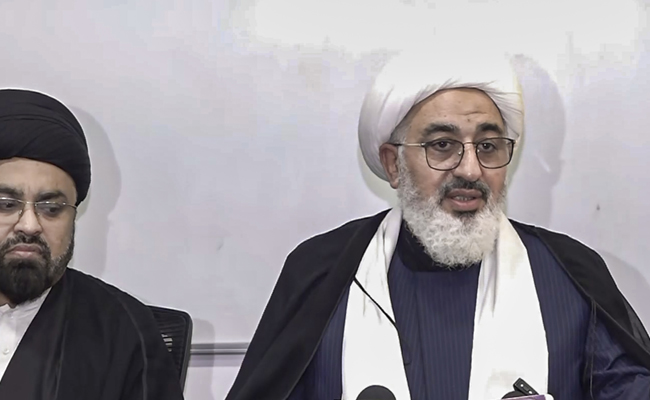
Bengaluru (PTI): Representative of Iran's Supreme Leader in India, Abdul Majeed Hakeem Ilahi on Saturday characterised the ongoing tensions between his country and the Israel-US alliance as a state of “no war, no peace”.
Calling for an immediate halt to the conflict, he said the global stability hinges on those who initiated the war.
He questioned why countries affected by the war and suffering from the energy crisis are not pressuring the US and Israel to stop the aggression.
Addressing a press conference here, Ilahi said Iran did not want the conflict, but was compelled to respond amid continued attacks, even as negotiations were expected to continue.
"Iran didn't want this war, but Iran was forced by the war and several times Iran tried to avoid this war... I don't know what is the condition of these people and these countries (US-Israel)... they want to impose on other countries what they want, and who gave them this authority?" he questioned.
Recalling the negotiations Iran held in Oman, he said talks later moved to Geneva and made progress before being disrupted by sudden attacks.
Ilahi claimed that airstrikes and missile attacks led to the deaths of Iran’s supreme leader Ayatollah Ali Khamenei, ministers, commanders and civilians.
"They killed a lot of civilians… They attacked a primary school, and they killed 175 innocent girls," he said, claiming over 4,000 deaths, more than 40,000 injuries, and widespread damage to houses, hospitals, universities and public infrastructure.
Despite these losses, he said Iran resisted calls for “unconditional surrender” and stood firm and defended itself.
"They wanted unconditional surrender. Which no one—no one can accept it. Iran said, 'Okay, we are ready to be sacrificed,' but we are not ready to submit ourselves," he added.
He argued that they (US-Israel) proposed the current ceasefire only after realising that they could not achieve any of their objectives after 40 days of conflict.
The envoy further claimed that the ceasefire is not an actual ceasefire, but a “no war, no peace” situation.
Explaining the current situation in Iran, he said conditions remain stable and people are going about their daily lives.
"They are working ....(leading) their ordinary life. They are working—they're going farming and they do everything....and they aren't scared of anything. And they are ready to defend themselves," he added.
Addressing the crisis in the Strait of Hormuz, he said the situation was stable before February 28 and all countries benefited from it.
"(For) 10,000 years, the Strait of Hormuz was open...and Iran daily yearly spent a lot for providing security in the Strait of Hormuz... so no one even complained anything about the Strait of Hormuz. Everyone was free...and even our enemies their warship was passing through the Strait of Hormuz," he said.
However, he linked the current maritime instability to the actions of the US and Israel.
"So Iran cannot do anything. Those people who initiated, created and started this war, they have to stop it. And everything will go back to normal," he said.
Criticising the mentality of the "great powerful country", Ilahi said, "they think they have the right to do whatever they want. It should change."
He sought to know why the countries affected by the conflict are not exerting pressure on the US and the "Zionist" regime to halt the war.
"Why are they not asking them? This crisis and problem by which a lot of countries are affected was created by them. A lot of factories are closed and even working days in some countries reduced... A lot of restaurants are closed," he said.
Seeking fairness and justice, Ilahi said instead of asking Iran, all those nations should ask those who initiated this war to stop it, by telling them, "we are suffering."
To a query on international mediation, Ilahi, referring to the US, asked, "Is it acceptable and reasonable that one country orders all countries -- you should not deal with this country, You should not purchase from this country. You should not have business with this country. You should not buy from this country."
Ilahi also highlighted Iran's long-standing ties with India and said, "It is a great country and we respect India and Indians."
"We have 5,000 years relationship and friendship. We are connected to India by education, by philosophy, by culture, by civilisation and by the economy," he said.
According to him, the bilateral cooperation remains strong, citing diplomatic engagement.
"At the moment also, our relationship, collaboration, cooperation with India is very good," he said, adding Iran allowing Indian ships to pass through Strait of Hormuz reflects the ties.
"Iran allowed Indian ships to pass through the Strait of Hormuz. Why? A lot of countries couldn't get this permission?... The relationship between Iran and India is very good," he added.
He expressed confidence that in future too, the ties between Iran and India will be strong.