Johnson & Johnson ordered to pay USD 572 million for opioid addiction crisis
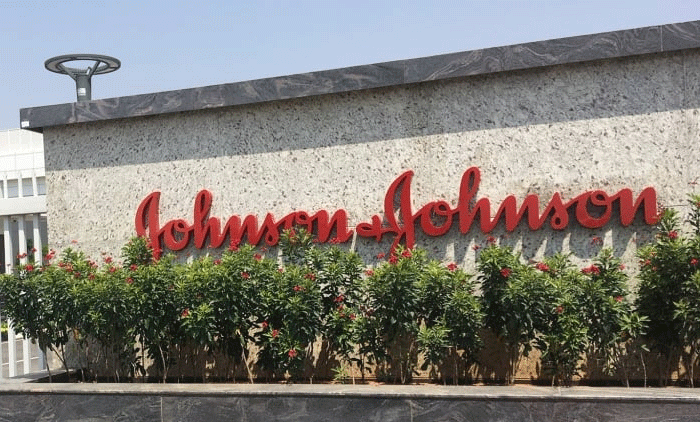
Washington: An Oklahoma judge has ordered US health care giant Johnson & Johnson to pay USD 572 million in damages for its role in fostering the state's opioid addiction crisis.
In the first civil trial of a drugmaker over an epidemic that has caused hundreds of thousands of overdose deaths, Judge Thad Balkman on Monday said prosecutors had demonstrated that J&J contributed to a "public nuisance" in its deceptive promotion of highly addictive prescription painkillers.
"Those actions compromised the health and safety of thousands of Oklahomans," he said. According to the ruling, the company and its Janssen pharmaceuticals division will fund an "abatement plan" for care for addicts, families and communities ravaged by the crisis.
"The defendants Janssen and Johnson & Johnson's misleading marketing and promotion of opioids created a nuisance," Balkman said. J&J was the first pharmaceutical company tried over the US opioid crisis, which fuelled over 70,000 overdose deaths in 2017 alone.
But there are some 2,000 outstanding lawsuits against many drugmakers and distributors filed by state and local governments, many overwhelmed by the costs of an epidemic that has only slightly abated.
Most of those are being rolled into a case to go to trial in October in Ohio that will likely set the basis for potentially many billions of dollars in settlements across the country.
Prosecutors had sought USD 17 billion in damages against J&J for an abatement program to be spread over 30 years.
But Balkman said the state had not made a strong case for the future costs of the crisis to it and the community beyond one year, and so limited his ruling to that.
J&J's shares rose about two percent to USD 130 in after-market trade following the decision. The company immediately said it would appeal the decision.
"Janssen did not cause the opioid crisis in Oklahoma, and neither the facts nor the law support this outcome," said J&J executive vice president Michael Ullmann.
"The unprecedented award for the state's 'abatement plan' has sweeping ramifications for many industries and bears no relation to the company's medicines or conduct."
J&J argued that the law was being inappropriately applied and that its products had a very small role in the addiction epidemic in Oklahoma and nationally.
Balkman said J&J had promoted its drugs by telling doctors and patients that pain was not being treated enough and that "there was a low risk of abuse and a low danger" in the drugs themselves.
"The defendants used the phrase 'pseudoaddiction' to convince doctors that patients who exhibited signs of addiction... were not actually suffering from addiction, but from the undertreatment of pain," he said in his decision.
He also said the company consciously downplayed risks it knew were present, pointing to the 2007 USD 600 million fine in a Virginia trial of Purdue Pharma, one of the leading prescription opioid makers, for misleading the health industry and the public about the highly addictive properties of its Oxycontin painkiller.
J&J is the first drugmaker to go to trial and the case is seen as a bellwether for thousands of possible criminal and civil suits over the seeming uncontrolled distribution of highly addictive painkillers like oxycodone and hydrocodone, and J&J's Nucynta and Duragesic, between 2000 and 2015.
Two other major drugmakers accused in the same suit, Purdue Pharma of the United States and Israel's Teva, settled with Oklahoma before the case went to trial.
Purdue, which produced the widely abused opioid Oxycontin, agreed to pay the state USD 270 million in March and Teva negotiated an USD 85 million settlement.
Dozens of local and state governments across the country have also already exacted settlements with opioid manufacturers and distributors to address their problems.
Let the Truth be known. If you read VB and like VB, please be a VB Supporter and Help us deliver the Truth to one and all.
BJP using women's quota bill as front to pass Delimitation Bill that will break India: Mamata
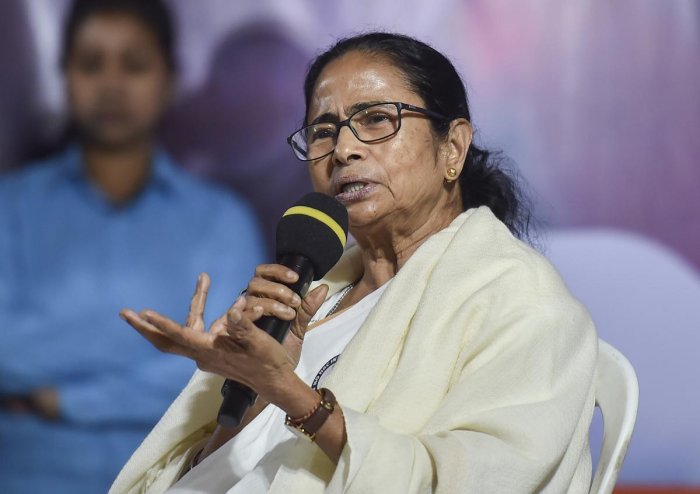
Cooch Behar (WB) (PTI): Chief Minister Mamata Banerjee on Friday alleged the BJP-led NDA government at the Centre was using the proposed amendment to the women's quota law in Parliament as a front for the Delimitation Bill that would "break the country into pieces".
The TMC will fight this Central government's move at every step, she asserted at her party's poll rally here.
The Constitution (131st Amendment) Bill to tweak the women's quota law, along with the Delimitation Bill and the Union Territories Laws (Amendment) Bill, to implement the proposed amended women's quota law, in the Union territories of Delhi, Puducherry and Jammu and Kashmir, were introduced in the Lok Sabha on Thursday.
According to the Constitution amendment bill, Lok Sabha seats will be increased to a maximum of 850 from the current 543 to "operationalise" the women's reservation law before the 2029 parliamentary polls, following a delimitation exercise based on the 2011 Census.
Seats will also be increased in state and Union territory assemblies to accommodate 33 per cent reservation for women.
Opposing the Centre's move, Banerjee alleged that "the BJP brought the Delimitation Bill while keeping the women's reservation bill at the front".
"The BJP is trying to increase the number of seats in the Lok Sabha to nearly 850 through the Delimitation Bill. It will break the country into pieces," the TMC supremo said.
She also alleged that Prime Minister Narendra Modi was not speaking the truth about the development of north Bengal at a BJP rally last week.
"The prime minister said nothing was done for the development of north Bengal. But we spent Rs 1.72 lakh crore on the development of the region," Banerjee said and asked Modi to cross-check data before making such remarks.