Kash Patel confirmed by US Senate as Trump’s FBI director
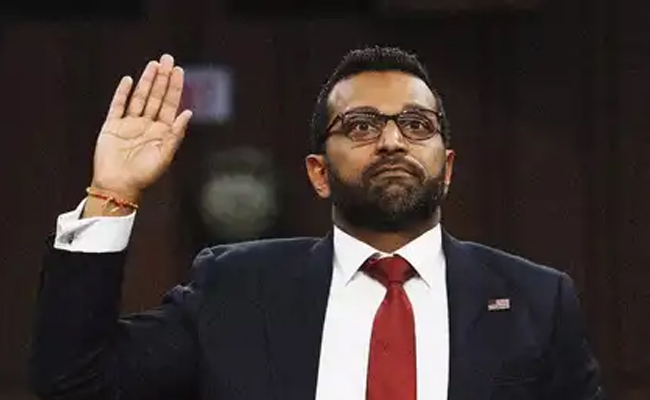
New York (PTI): New FBI director Kash Patel has vowed to "rebuild" trust in the bureau as he becomes the first Indian-American to lead the country’s premier law enforcement agency after being confirmed by the US Senate.
The Republican-led Senate narrowly voted to confirm 44-year-old Patel on Thursday. The Senate voted 51 to 49 to confirm Patel. Two Republicans, Susan Collins and Lisa Murkowski, voted against his confirmation.
The nomination faced intense scrutiny from Democrats on Capitol Hill who have warned that Patel is poised to use the position to seek retribution against Donald Trump’s perceived political enemies.
In his confirmation hearings, Patel also denied keeping a list of "deep state" enemies, while playing down controversial past remarks he had made such as referring to law enforcement officials who investigated Trump as "criminal gangsters".
After his confirmation, Patel posted on X," I am honoured to be confirmed as the ninth Director of the Federal Bureau of Investigation. Thank you to President Trump and Attorney General Bondi for your unwavering confidence and support."
"The FBI has a storied legacy—from the “G-Men” to safeguarding our nation in the wake of 9/11. The American people deserve an FBI that is transparent, accountable, and committed to justice. The politicisation of our justice system has eroded public trust—but that ends today. My mission as Director is clear: let good cops be cops—and rebuild trust in the FBI," he said.
He also warned that the agency would hunt down those who seek to harm Americans.
He was the 18th Cabinet official approved by lawmakers since Trump was inaugurated a month ago.
Patel takes the helm of an FBI in flux after the justice department forced out some of its top officials and demanded the names of agents who investigated the 2021 riot by Trump supporters at the US Capitol.
Patel replaces Christopher Wray whom Trump picked in 2017. Wray resigned before inauguration day last month after the incoming Republican president indicated he would fire him.
The role of FBI director is supposed to be a 10-year term.
Republicans have defended Trump’s pick to lead the FBI, arguing that Patel will bring needed transparency to the FBI and dismissing controversial past statements as hyperbole.
After announcing Patel as his FBI pick, Trump posted on social media calling him "an advocate for truth, accountability, and the constitution".
"Kash is a brilliant lawyer, investigator, and 'America First' fighter who has spent his career exposing corruption, defending justice, and protecting the American people," Trump said.
Meanwhile, Democrats say Patel is a far-right conspiracy theorist with little experience in law enforcement, and someone who would put fealty to Trump above his oath to lead a department that is meant to operate independently.
"(Patel's) poor judgment and lack of experience make him wholly unqualified to keep Americans safe as our FBI Director. I voted no," Senator Martin Heinrich said on X.
“We will vote no,” Sen. Adam Schiff (D-California) said at the morning news conference.
“Our Republican colleagues, intimidated by this president and threats of primary challenges from the MAGA (Make America Great Again) world, may vote to confirm him. But... they will have to live with that vote.”
In his new position, Patel will lead a mammoth organisation with more than 30,000 employees, hundreds of offices nationwide and a sprawling mandate to investigate cases involving national security, terrorism and violent crimes.
Since long before his nomination, Patel has called for profound changes within the FBI. His 2023 book described the bureau as “a tool of surveillance and suppression of American citizens” and said its powers should be dramatically curtailed.
Trump announced his plans to make Patel the FBI director in November. Patel’s supporters include a group of former agents who have previously been accused of misconduct and were suspended, the New York Times reported.
These former agents, who deny wrongdoing, have accepted financial help from Patel’s nonprofit foundation in some cases and say they have been in touch with him since he was nominated, the report added.
New York-born Patel has his roots in Gujarat. However, his parents are from East Africa - his mother is from Tanzania and his father is from Uganda. They came to the US from Canada in 1970.
“We are Gujarati,” he had told PTI in an earlier interview.
The family moved to Queens in New York - often called Little India -- in the late 70s. It is here that Patel was born and grew.
Patel's parents are retired now and spend their time in both the US and Gujarat. After his schooling in New York and college in Richmond, Virginia, and law school in New York, Patel went to Florida where he was a state public defender for four years and then a federal public defender for another four years.
Patel is an Ice-hockey fan and has been playing the sport since he was six. “I still play and I spend a lot of time volunteering coaching youth hockey in the area.”
Patel, who attended both the Houston and Ahmedabad rallies of Trump and Prime Minister Narendra Modi in September 2019 and February 2020, had earlier told PTI that the bilateral relationship had deteriorated under the Biden administration.
Let the Truth be known. If you read VB and like VB, please be a VB Supporter and Help us deliver the Truth to one and all.
EAM Jaishankar meets Jamaican PM, gifts over 10 BHISHM Cubes
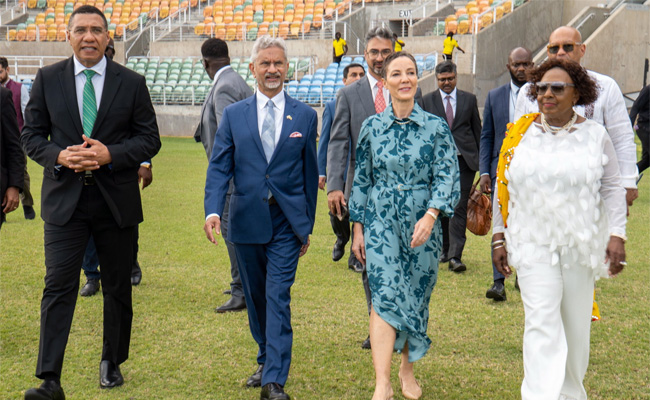
Kingston (PTI): External Affairs Minister S Jaishankar on Monday met Jamaican Prime Minister Andrew Holness and discussed ways to further deepen "political, economic and people-to-people cooperation."
Jaishankar also conveyed greetings from Prime Minister Narendra Modi to Holness.
"Pleased to call on Prime Minister @AndrewHolnessJM in Kingston. Conveyed the greetings of PM @narendramodi," Jaishankar posted on X.
"Discussed deepening our political, economic and people-to-people cooperation. Value his commitment towards further strengthening India-Jamaica relations," the post further read.
Also, the external affairs minister handed over 10 BHISHM (Bharat Health Initiative for Sahyog Hita & Maitri) Cubes as a gift to Jamaica.
"Formally handed over 10 BHISHM Cubes as a gift from India to Jamaica, in the presence of PM @AndrewHolnessJM, Health Minister @christufton and FM @kaminajsmith," Jaishankar posted on X.
"The BHISHM Cube mobile hospital system, designed for rapid deployment, will help Jamaica during disasters and emergencies. The gift of these cubes is a statement of friendship, a commitment to disaster preparedness, and an outcome of innovation," the post said.
Jaishankar arrived in Kingston on Saturday evening, marking the first leg of his nine-day tour of Jamaica, Suriname, and Trinidad and Tobago, aimed at further strengthening India's strategic and cultural ties with the Caribbean nations.
Earlier in the day, he interacted with the Indian diaspora and discussed India's ongoing transformation in infrastructure, human development and technology-driven governance and entrepreneurship with them.
He also highlighted the cricket bond between both countries as India gifted a scoreboard to Jamaica.
A scoreboard was dedicated at Sabina Park in Kingston. It is the home of the Jamaica cricket team and is the only Test cricket ground in the Caribbean island nation.
The minister expressed hope that the new scoreboard would witness many memorable innings, including those symbolising the enduring friendship between the two countries.
Cricket has long been a strong cultural bridge between India and Jamaica, which is part of the West Indies cricket team.
Jamaican players, including Chris Gayle, Courtney Walsh and Michael Holding, have played a major role in shaping the legacy of West Indies cricket in the international arena, contributing to its dominance in earlier decades and its continued global appeal.