Kashmir a bilateral issue: UK PM Boris Johnson tells PM Modi
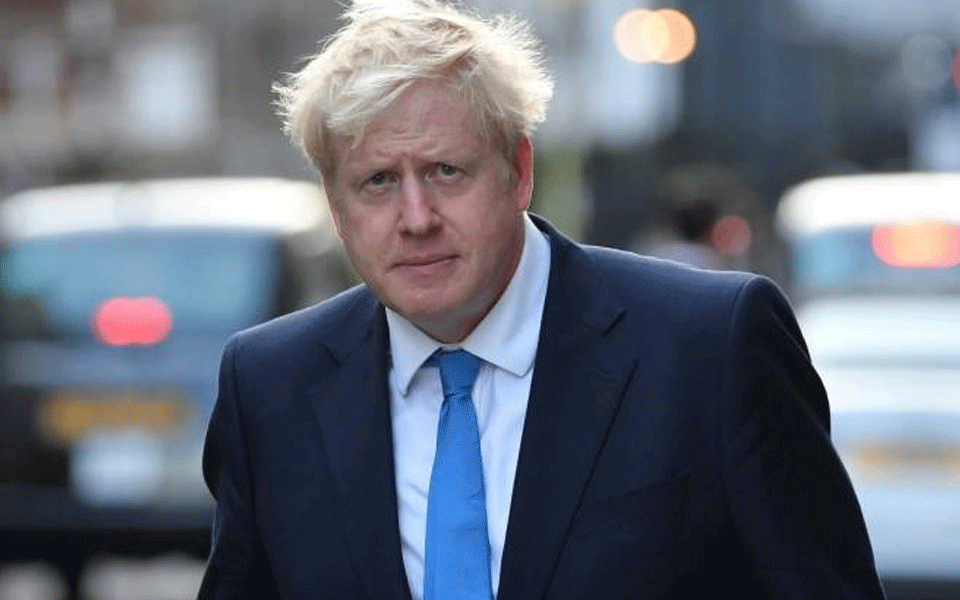
London: British Prime Minister Boris Johnson has made clear to Prime Minister Narendra Modi that Kashmir remains a bilateral matter between India and Pakistan as far as the UK's view is concerned, during a telephone call between the two leaders.
The conversation, part of a series of similar telephone calls being undertaken by Johnson with world leaders since he took charge at Downing Street last month, covered the current situation in Kashmir alongside a discussion on the importance of the India-UK partnership.
"The Prime Minister and Prime Minister Modi discussed the current situation in Kashmir, a Downing Street spokesperson said in an official readout of the phone call on Tuesday.
"The Prime Minister made clear that the UK views the issue of Kashmir as one for India and Pakistan to resolve bilaterally. He underlined the importance of resolving issues through dialogue," the spokesperson said.
The conversation came against the backdrop of the Indian government revoking the special status to Jammu and Kashmir and bifurcating the state into two Union Territories.
Regarding India-UK ties, Johnson and Modi agreed on the importance of the bilateral partnership and the need to build on it further, particularly through trade and economic relations and through the living bridge that links our countries .
"Prime Minister Modi said there are immense possibilities for the UK and India which would increase prosperity in both countries, the Downing Street spokesperson said.
The telephone conversation came ahead of the G7 meeting in France over the weekend, where the two leaders are scheduled to meet for the first time since Johnson became the UK Prime Minister. Therefore, their discussions also covered the summit in Biarritz and the issue of importance to both nations.
"Ahead of the G7, the Prime Minister and Prime Minister Modi agreed on the importance of working together to tackle climate change and other threats to biodiversity. They looked forward to meeting at the summit this weekend to discuss this and other issues, the spokesperson added.
While the Downing Street readout of the conversation made no reference to any other issues discussed between the two leaders, the Prime Minister's Office in India said that the topics covered also included a fight against terrorism and violence.
Modi drew Johnson's attention to the challenges posed by vested interests pursuing their motivated agenda, including by violent means, the Prime Minister's Office in a statement said.
In this context, Prime Minister Modi referred to the violence and vandalism perpetrated by a large mob against the High Commission of India in London during Independence Day celebrations last week.
Johnson regretted the incident and assured that all necessary steps would be taken to ensure safety and security of the High Commission, its personnel and visitors, the statement said.
Let the Truth be known. If you read VB and like VB, please be a VB Supporter and Help us deliver the Truth to one and all.
Vijayanagara: One dead, 12 injured as trucks hits their vehicle from behind on NH 50
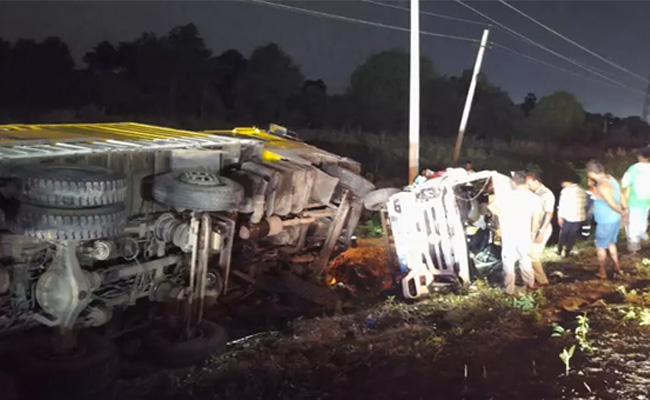
Vijayanagara: One man was killed and 12 others were injured after a truck hit vehicle they were traveling in on the National Highway 50 stretch on the outskirts of Koodligi in the district.
The accident victim, Madhu (27), is learned to have been an employee of Reliance Digital from Andhra Pradesh.
The vehicle was reportedly traveling from Bengaluru to Koodligi and the passengers are learned to have been seriously injured following the collision with the truck, which was found to have a Maharashtra registration.
Koodligi Deputy Superintendent of Police (DySP) Mallesh Dodmani and Circle Inspector Prahlad Channagiri arrived at the accident spot on being informed of the accident.
The police officers and locals rescued the injured passengers and got them shifted to the Koodligi Government Hospital. Some of the passengers were reportedly taken to the Ballari Trauma Care Centre for further treatment.
A case has been registered at the Koodligi Police Station and the officers are investigating the incident.