Khaleda Zia’s funeral prayer held in Bangladesh amid tight security
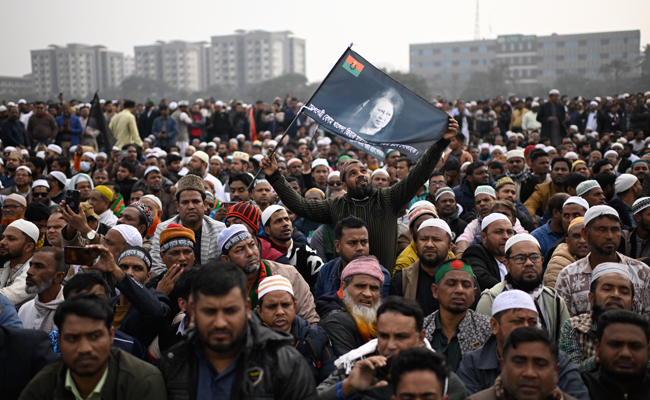
Dhaka (PTI): Bangladesh's former prime minister Khaleda Zia's funeral prayers were held on Wednesday amid tight security.
The funeral prayer (namaz-e-janaza) was held at the Manik Mia Avenue on Wednesday afternoon.
Baitul Mukarram National Mosque Khatib Mufti Mohammad Abdul Malek conducted the funeral prayers while Bangladesh Nationalist Party's Standing Committee Member Nazrul Islam Khan read out a brief biography of Zia.
Zia, who dominated Bangladesh's politics for decades, died on Tuesday in Dhaka.
Chief Adviser Professor Muhammad Yunus, Chief Justice Zubayer Rahman Chowdhury, and Khaleda Zia's son and BNP Acting Chairman Tarique Rahman joined the funeral prayers along with foreign dignitaries, advisers of the interim government, leaders of different political parties and senior government and military officials.
"Please pray to Allah seeking her place in heaven," Zia’s elder son, Rahman, told the crowd ahead of the prayers.
Millions of people joined namaz-e-janaza of Zia, three-time Prime Minister and political icon of Bangladesh.
Mourners from all walks of life offered prayers seeking forgiveness for the departed soul of Zia as they burst into tears, being emotional with the passing of their beloved leader.
The national flag-draped coffin of Zia was placed at the west end of Manik Mia Avenue. After the funeral prayers, Zia will be laid to eternal rest beside her husband, Shaheed President Ziaur Rahman's grave in the city with state honour while the general public will not be allowed during the burial as there will be an elaborate state funeral ceremony.
Zia’s appearance as a public figure in the political arena at the age of 35 was not a planned debut; rather, she was thrust into politics after the 1981 assassination of her husband, a military ruler turned politician who founded BNP in 1978.
But she broke through a male-dominated political landscape and transformed into one of the region’s most formidable leaders, though as a housewife she was a reserved presence alongside her famous husband.
She took up Rahman’s mantle, steadily learnt the art of politics and leadership and gained a nationwide following with her uncompromising stance against the military dictatorship, maintaining her widely acknowledged kindheartedness.
The funeral prayer for Begum Khaleda Zia, Chairperson of the Bangladesh Nationalist Party (BNP) and a three-time former Prime Minister, was held today, Wednesday, at Manik Mia Avenue in the capital. Chief Adviser Professor Muhammad Yunus attended the funeral prayer of Begum… pic.twitter.com/YmgYnMPVDS
— Chief Adviser of the Government of Bangladesh (@ChiefAdviserGoB) December 31, 2025
Let the Truth be known. If you read VB and like VB, please be a VB Supporter and Help us deliver the Truth to one and all.
India should create strategic buffers to navigate 'most difficult' energy shock: CEA Nageswaran
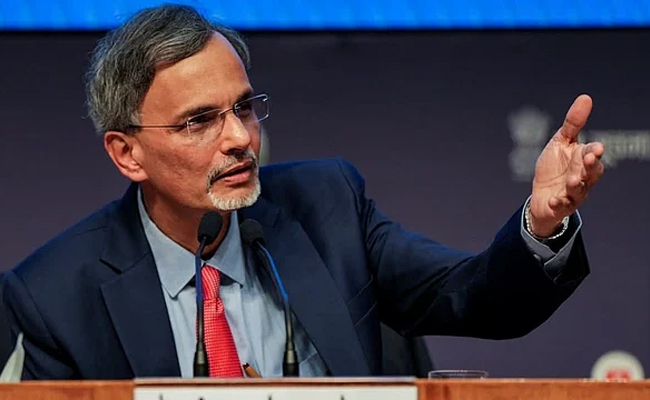
New Delhi (PTI): Chief Economic Advisor V Anantha Nageswaran on Saturday said India needs to create strategic buffers in the face of the "most difficult" energy shock that the country is facing amid the West Asia crisis.
Nageswaran also said the rising prices of fertiliser and petroleum products globally due to the crisis will make it challenging to achieve the 4.3 per cent fiscal deficit target for the current fiscal, while below normal monsoon and pass-through of higher energy prices could lead to "potential inflation spike".
He also said India has employment challenge emanating from AI, and there is a need to ensure that IT sector becomes more competitive and not lose jobs to AI, and instead create jobs that use AI within the IT sector or in other services.
Speaking at the ICPP Growth Conference organised by the Ashoka University, Nageswaran said the current account deficit (CAD) in the current fiscal could rise to over 2 per cent of GDP, from less than 1 per cent in FY'26.
"The ... priority for us is to create strategic buffers. This energy shock is the most difficult one compared to any other previous energy shock in terms of energy lost as a percentage of total global energy supply, not just oil, including gas.
"And we also need to use this occasion to think about other areas where we are vulnerable in terms of import dependence, nickel, tin, and copper. We need to build strategic buffers if we have to make a shot at manufacturing and becoming indispensable," Nageswaran said.
Since the beginning of the war in West Asia on February 28, crude oil prices soared to a four-year high of USD 126 per barrel on Thursday, from about USD 73 level before the war.
Stating that geopolitics will compel policymakers to be nimble and flexible and shed old model of thinking, Nageswaran said India is better prepared than many other countries to deal with the crisis because of the fiscal leeway that the country has due to lowering of fiscal deficit ratio to 4.4 per cent of GDP in FY'26.
Nageswaran said the West Asia conflict is more of a price shock than supply shock for India as the government is managing the supply side deftly.
"This particular conflict, which is going to be on a low simmer or a high flame situation, whatever it is, it is going to be there with us in some form or the other because the military conflict may be over, but the strategic conflict is well and truly alive. It will be so for some time," Nageswaran said.
He said the conflict has four channels of shock: price and supply shock, trade impact, sticky logistics costs and remittance shock.
India imports 60 per cent of its LPG usage and of that, 90 per cent flows through the now closed Strait of Hormuz.
Nageswaran said the pass-through of high global energy prices would have to be a "balancing act". He said some pass-through is already happening in commercial LPG, and the levy of export duty on diesel and ATF.
The government has cut excise duty on petrol and diesel to shield customers from the impact of the rise in petroleum prices. "We are coming around to arriving at a certain modus vivendi with respect to burden-sharing between the fiscal policy side, inflation, households and the oil marketing companies. So it has to be a balancing act," Nageswaran said.