Kim Jong Un says North Korean launches were warning to US, South Korea

Seoul: North Korea said Wednesday leader Kim Jong Un supervised a live-fire demonstration of newly developed, short-range ballistic missiles intended to send a warning to the United States and South Korea over their joint military exercises.
The official Korean Central News Agency said two missiles launched from a western airfield flew across the country and over the area surrounding the capital, Pyongyang, before accurately hitting an island target off its eastern coast.
Its four rounds of weapons demonstrations in two weeks come during a stalemate in nuclear negotiations and after President Donald Trump repeatedly dismissed the significance of the tests, even though the weapons show North Korea's ability to strike at U.S. allies South Korea and Japan and its military bases there.
Experts say Trump's downplaying of the North's weapons displays allowed the country more room to advance its capabilities and build leverage ahead of negotiations, which could possibly resume sometime after the end of the allies' drills later this month.
Lee Sang-min, spokesman from South Korea's Unification Ministry, said North Korea's recent testing activity doesn't help efforts to stabilize peace and called for Pyongyang to uphold an inter-Korean agreement reached last year to form a joint military committee to discuss reducing military tensions.
He did not provide a specific answer when asked whether Seoul believes the North's weapons display will intensify.
The KCNA said the launches early Tuesday verified the reliability and combat ability of "new-type tactical guided missiles." Kim expressed satisfaction and said the launches would send an appropriate level of warning to the military exercises between the United States and South Korea that began on Monday, the report said.
Pyongyang's official Rodong Sinmun also published photos showing what appeared to be a missile soaring from a launcher installed on a vehicle and Kim smiling and celebrating with military officials.
KCNA's report came a day after South Korea's military said it detected two early morning launches that were likely ballistic missiles.
Seoul's Joint Chiefs of Staff said the projectiles traveled about 450 kilometers (279 miles) on an apogee of 37 kilometers (23 miles) before landing in waters off the country's eastern coast. It said the projectiles showed similar flight characteristics to short-range missiles North Korea fired on July 25.
South Korea's military had described those missiles as similar to the Russian-made Iskander, a solid-fuel, nuclear-capable missile that is highly maneuverable and travels on low trajectories, improving its chances of evading missile defense systems. Last week, North Korea conducted two test firings of what it described as a new rocket artillery system.
Kim Dong-yub, an analyst at Seoul's Institute for Far Eastern Studies, said North Korea's decision to fly the missiles over its capital indicated it was confident about the reliability of the system. Kim, a former South Korean military official who had participated in inter-Korean military talks, said Kim Jong Un is making a measured effort to advance the North's military capabilities without allowing nuclear negotiations with Washington collapse.
North Korea has denounced Washington and Seoul over their joint military exercises. South Korea confirmed they started Monday but hasn't given details about the drills, which were expected to involve computer simulations and not troops or equipment.
The North's Foreign Ministry said Tuesday the drills "compelled (North Korea) to develop, test and deploy the powerful physical means essential for national defense." (AP)
Let the Truth be known. If you read VB and like VB, please be a VB Supporter and Help us deliver the Truth to one and all.
Hospital wall collapse: CM orders suspension of executive engineer; kin of victims get solatium
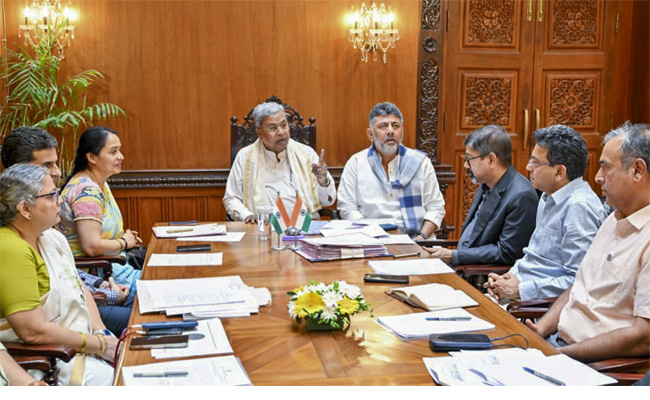
Bengaluru (PTI): Karnataka Chief Minister Siddaramaiah on Thursday ordered the immediate suspension of an executive engineer for the Bowring and Lady Curzon Hospital wall collapse that claimed the lives of seven people, during a high-level review meeting at Vidhana Soudha.
A compensation of Rs 5 lakh, as announced by the CM Siddaramaiah, was distributed to the families of seven victims who lost their lives in the tragedy on Wednesday evening, which occurred due to heavy downpour with gusty winds and hailstorm.
The meeting of municipal commissioners of the five corporations, chaired by the chief minister and attended by Deputy Chief Minister D K Shivakumar, focused on fixing accountability and examining lapses that led to the tragedy.
"Why was soil dumped in a way that damaged the wall? Why did you not monitor this?" Siddaramaiah asked, pulling up hospital authorities during the meeting.
A statement from the chief minister's office said that the CM ordered the immediate suspension of the executive engineer of the Karnataka Health Systems Development Project (KHSDP).
ALSO READ: Three arrested for running fake Aadhaar racket in UP's Badaun
He also questioned the hospital authorities, asking why they failed to monitor the dumping of soil that weakened the structure.
The chief minister directed that a notice be issued to the head of the Hospital.
During the meeting, Siddaramaiah said the rains had caused extensive damage in the city, with over 250 trees uprooted.
The Chief Minister instructed officials to take necessary measures before the onset of the monsoon to avoid untoward incidents.
Commissioners of all five municipal zones in Bengaluru have been asked to take precautionary steps, including trimming dry and dangerous tree branches, the CMO said.
Siddaramaiah also directed them to get the silt cleared from stormwater drains to prevent flooding, and that immediate action be taken to remove debris and fallen branches from roads.
Further, he instructed that barricades be placed at underpasses where water stagnates and restricts public movement.
The Greater Bengaluru Authority (GBA) Chief Commissioner M Maheshwar Rao said in a statement that Shivajinagar MLA Rizwan Arshad distributed compensation cheques of Rs 5 lakh each to the families of the deceased on Thursday.
Seven people, including a six-year-old girl, were killed and seven others injured when the compound wall collapsed amid heavy rain, strong winds and a hailstorm on Wednesday evening.
Police said the victims, comprising three from Bengaluru, two from Kerala on a study tour and one each from Uttar Pradesh and Assam, had taken shelter near the wall when it suddenly gave way, trapping them under the debris.
The chief minister questioned officials over the dumping of soil near the wall despite knowing it could weaken the structure, and directed that a notice be issued to the head of Bowring Hospital.
Siddaramaiah, who had visited the spot soon after the incident along with senior officials, reviewed the situation and ordered a detailed probe into the collapse.