Larry King, broadcasting giant for half-century, dies at 87
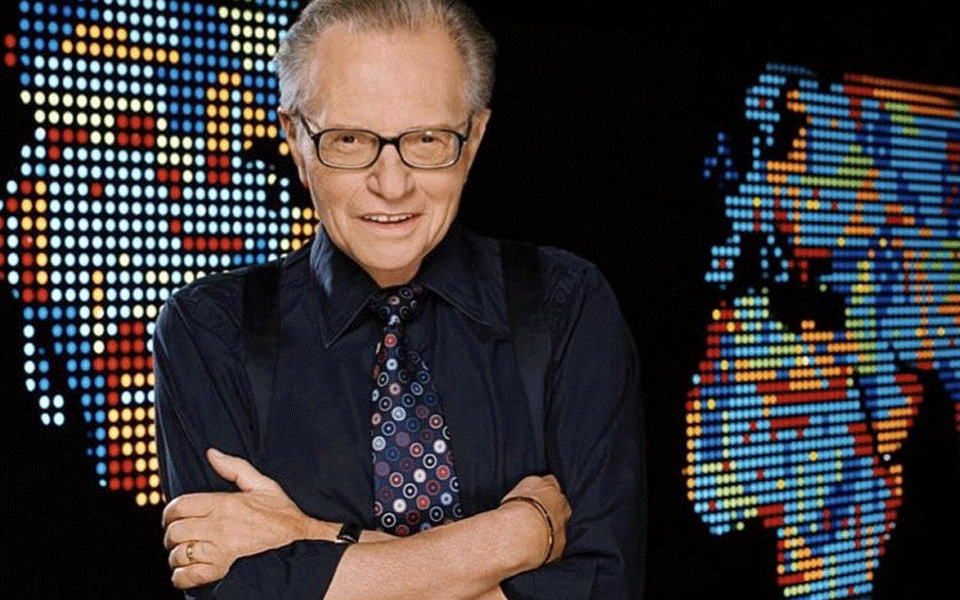
Los Angeles: Larry King, the suspenders-sporting everyman whose broadcast interviews with world leaders, movie stars and ordinary Joes helped define American conversation for a half-century, died Saturday. He was 87.
King died at Cedars-Sinai Medical Center in Los Angeles, Ora Media, the studio and network he co-founded, tweeted. No cause of death was given, but CNN reported January 2 that King had been hospitalised for more than a week with COVID-19.
A longtime nationally syndicated radio host, from 1985 through 2010 he was a nightly fixture on CNN, where he won many honors, including two Peabody awards.
With his celebrity interviews, political debates and topical discussions, King wasn't just an enduring on-air personality. He also set himself apart with the curiosity be brought to every interview, whether questioning the assault victim known as the Central Park jogger or billionaire industrialist Ross Perot, who in 1992 rocked the presidential contest by announcing his candidacy on King's show.
In its early years, Larry King Live was based in Washington, which gave the show an air of gravitas. Likewise King. He was the plainspoken go-between through whom Beltway bigwigs could reach their public, and they did, earning the show prestige as a place where things happened, where news was made.
King conducted an estimated 50,000 on-air interviews. In 1995 he presided over a Middle East peace summit with PLO Chairman Yasser Arafat, King Hussein of Jordan and Israeli Prime Minister Yitzhak Rabin. He welcomed everyone from the Dalai Lama to Elizabeth Taylor, from Mikhail Gorbachev to Barack Obama, Bill Gates to Lady Gaga.
Especially after he relocated to Los Angeles, his shows were frequently in the thick of breaking celebrity news, including Paris Hilton talking about her stint in jail in 2007 and Michael Jackson's friends and family members talking about his death in 2009.
King boasted of never overpreparing for an interview. His nonconfrontational style relaxed his guests and made him readily relatable to his audience.
I don't pretend to know it all, he said in a 1995 Associated Press interview. Not, `What about Geneva or Cuba?' I ask, `Mr. President, what don't you like about this job?' Or `What's the biggest mistake you made?' That's fascinating.
At a time when CNN as the lone player in cable news was deemed politically neutral, and King was the essence of its middle-of-the-road stance, political figures and people at the center of controversies would seek out his show.
And he was known for getting guests who were notoriously elusive. Frank Sinatra, who rarely gave interviews and often lashed out at reporters, spoke to King in 1988 in what would be the singer's last major TV appearance.
Sinatra was an old friend of King's and acted accordingly.
Why are you here? King asks. Sinatra responds, Because you asked me to come and I hadn't seen you in a long time to begin with, I thought we ought to get together and chat, just talk about a lot of things.
King had never met Marlon Brando, who was even tougher to get and tougher to interview, when the acting giant asked to appear on King's show in 1994. The two hit it off so famously they ended their 90-minute talk with a song and an on-the-mouth kiss, an image that was all over media in subsequent weeks.
After a gala week marking his 25th anniversary in June 2010, King abruptly announced he was retiring from his show, telling viewers, It's time to hang up my nightly suspenders. Named as his successor in the time slot: British journalist and TV personality Piers Morgan.
By King's departure that December, suspicion had grown that he had waited a little too long to hang up those suspenders. Once the leader in cable TV news, he ranked third in his time slot with less than half the nightly audience his peak year, 1998, when Larry King Live drew 1.64 million viewers.
His wide-eyed, regular-guy approach to interviewing by then felt dated in an era of edgy, pushy or loaded questioning by other hosts.
Meanwhile, occasional flubs had made him seem out of touch, or worse. A prime example from 2007 found King asking Jerry Seinfeld if he had voluntarily left his sitcom or been canceled by his network, NBC.
I was the No. 1 show in television, Larry, replied Seinfeld with a flabbergasted look. Do you know who I am?
Always a workaholic, King would be back doing specials for CNN within a few months of performing his nightly duties.
He found a new sort of celebrity as a plainspoken natural on Twitter when the platform emerged, winning over more than 2 million followers who simultaneously mocked and loved him for his esoteric style.
I've never been in a canoe. #Itsmy2cents, he said in a typical tweet in 2015.
His Twitter account was essentially a revival of a USA Today column he wrote for two decades full of one-off, disjointed thoughts. Norm Macdonald delivered a parody version of the column when he played King on Saturday Night Live, with deadpan lines like, The more I think about it, the more I appreciate the equator.
King was constantly parodied, often through old-age jokes on late-night talk shows from hosts including David Letterman and Conan O'Brien, often appearing with the latter to get in on the roasting himself.
He was born Lawrence Harvey Zeiger in 1933, a son of Jewish immigrants from Eastern Europe who ran a bar and grill in Brooklyn. But after his father's death when Larry was a boy, he faced a troubled, sometimes destitute youth.
Let the Truth be known. If you read VB and like VB, please be a VB Supporter and Help us deliver the Truth to one and all.
Bengal awaits May 4 results; TMC looks to retain power, BJP aims historic win after record turnout
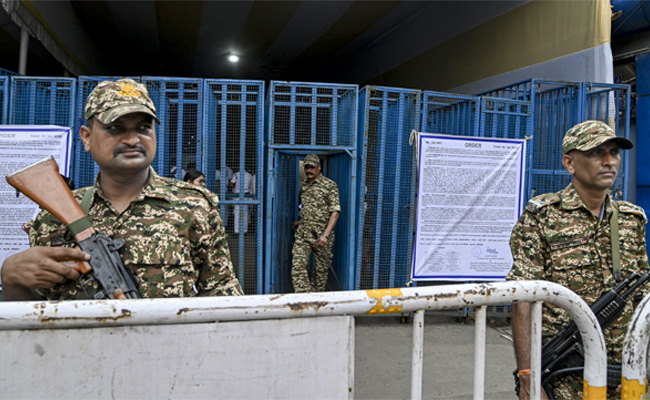
Kolkata (PTI): West Bengal heads into verdict day on Monday after over a month of frenzied campaigning, as it waits with bated breath to see whether the TMC manages to hold on to power or the BJP makes a historic breakthrough and claims the state for the first time.
As the EVMs open at 8 am, the CPI(M) and the Congress will be watching with equal keenness, hoping to reclaim a foothold in the state's electoral map after five years in the wilderness, following their wipeout in the 2021 polls.
Counting of votes will take place across 77 centres in the state, with elaborate security arrangements and a charged political atmosphere setting the stage for the declaration of results in 293 of the 294-seat House.
The Election Commission countermanded polls in the entire Falta constituency in South 24 Parganas district, citing “severe electoral offences and subversion of democratic process during polling in a large number of polling stations”.
ALSO READ: SC to hear on May 4 PIL seeking stringent guidelines for issuing Aadhaar to adolescents, adults
The fresh poll in that seat and the counting will take place on May 21 and May 24, respectively.
The two-phase polls in the state ended on April 29, with what the election watchdog said was the state's highest-ever voter turnout of 92.47 per cent since Independence.
Repolling in 15 booths in South 24 Parganas concluded on Saturday, with around 87 per cent turnout recorded, officials said.
The state’s political climate bordered on the vicious, even after the conclusion of polls, leading to fervent anticipation ahead of the announcement of results, with both primary contenders TMC and BJP, claiming they were dead certain about their victory prospects.
Courtesy the tight security arrangements – with over 2.5 lakh central paramilitary personnel on the ground, besides the presence of a thoroughly reshuffled state police force – electoral violence remained at a minimum, and no deaths were reported for the first time in the state’s election history of recent decades.
This was also the first election held in the state in twenty years, conducted after an extensive, albeit controversial, SIR exercise that revised the electoral rolls, removing over 9 million voters.
The jury is out on the impact of the exercise on the electoral fortunes of all parties across the board, prompting pollsters to burn the midnight oil to make sense of the likely choice of voters and keeping the public greatly enthused about what verdict the result day would deliver.
The campaigns recorded the BJP unleashing its full might, with top leaders like Prime Minister Narendra Modi, Union Home Minister Amit Shah and Defence Minister Rajnath Singh launching all-out attacks on the TMC over corruption, law and order, infiltration, women’s safety and unemployment, while promising welfare measures.
The TMC’s retaliation, with the CM and party MP Abhishek Banerjee leading the charge, focused on SIR harassment, Bengali persecution and ‘outsider’ plank, accusing the BJP of failing to deliver on its national commitments and upholding TMC’s development report card.
Polling for the elections was held on April 23 and April 29, with a total electorate of over 3.21 crores.
The poll body has scaled down the number of counting centres this year to 77 from 87 announced earlier, and 108 in 2021, while putting in place a multi-layered security grid.
“Comprehensive security arrangements have been made to ensure that counting is conducted in a peaceful, transparent and orderly manner,” a senior EC official said.
The run-up to counting, however, has been marked by high political drama, with TMC leaders, helmed by CM Mamata Banerjee, rushing to strongrooms in Kolkata, apprehending counting malpractice and alleging attempts to tamper with the sealed EVMs.
The EC rejected those allegations, maintaining that all electronic voting machines are kept under strict surveillance with round-the-clock security and CCTV monitoring.
“Strongrooms are secured under a three-tier security system, and candidates or their representatives are allowed to keep watch as per protocol. There is no scope for any tampering,” another poll panel official said.
Closer to the counting date, security outside strongrooms has been further tightened, with the EC deploying 165 additional counting observers and 77 police observers to oversee the process and ensure adherence to norms.
In Kolkata, counting for 11 assembly constituencies will be conducted across five locations - Ballygunge Government High School, Baba Saheb Ambedkar Education University, Shakhawat Memorial School, Netaji Indoor Stadium and St Thomas Boys’ School.
Counting for the Bhabanipur seat, arguably carrying the highest symbolic weight where Mamata Banerjee is taking on senior BJP leader Suvendu Adhikari in a prestige fight on her home turf, will be held at the Sakhawat Memorial centre.
The EC has introduced stringent access control measures, mandating entry only through QR code-based photo identity cards issued via its ECINet system. Mobile phones have been barred inside counting halls, except for returning officers and observers.
The counting exercise will be conducted under a framework upheld by the Supreme Court, which on Saturday declined to pass further directions on a TMC plea challenging the deployment of central government personnel.
The elections saw the TMC contesting in 291 seats and its ally Bharatiya Gorkha Prajatantrik Morcha (BGPM), led by Anit Thapa, fielding candidates in three seats in the Darjeeling hills.
The BJP, Congress and the Left Front are gunning for all 294 segments, with parties like Humayun Kabir’s AJUP and Asaduddin Owasi’s AIMIM also trying their luck in some crucial pockets.
BJP leaders like Dilip Ghosh, Agnimitra Paul, Roopa Ganguly and Nishit Pramanik are in the fray, while prominent TMC candidates include Firhad Hakim, Kunal Ghosh, Madan Mitra and Udayan Guha.