Lifting virus lockdowns too quickly could spark 'deadly resurgence': WHO
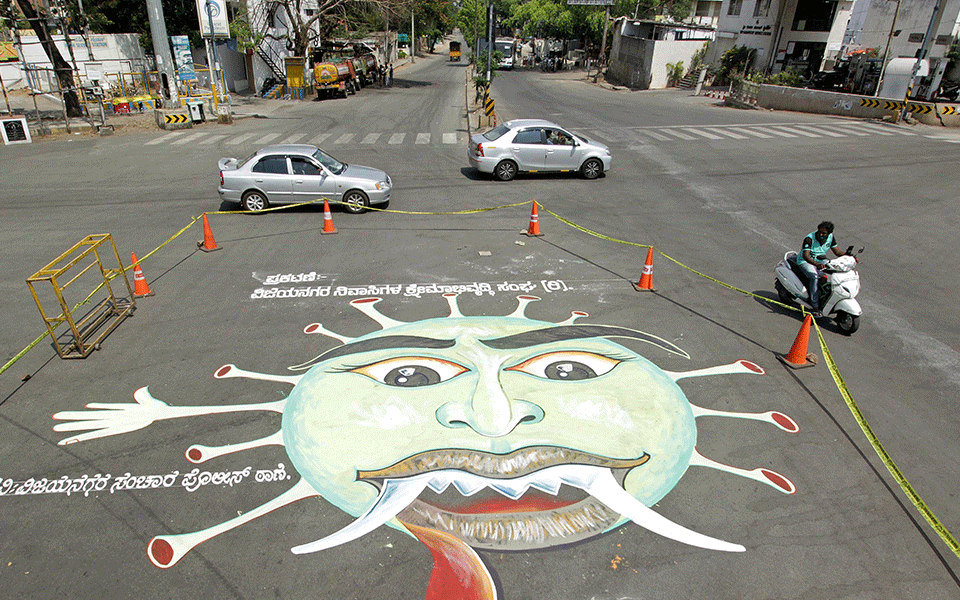
Geneva: A hasty lifting of restrictions imposed to control the COVID-19 pandemic could lead to a fatal resurgence of the new coronavirus, the World Health Organisation warned on Friday.
WHO chief Tedros Adhanom Ghebreyesus said it was working with countries on ways in which lockdowns could be gradually eased, but said doing so too quickly could be dangerous.
"I know that some countries are already planning the transition out of stay-at-home restrictions. WHO wants to see restrictions lifted as much as anyone," he told a virtual press conference in Geneva.
"At the same time, lifting restrictions too quickly could lead to a deadly resurgence. The way down can be as dangerous as the way up if not managed properly.
"WHO is working with affected countries on strategies for gradually and safely easing restrictions." The global death toll is rapidly approaching 100,000.
More than 1.6 million infections have been recorded globally, according to an AFP tally, since the virus first emerged in China in December.
Tedros welcomed signs that the spread of the virus was slowing in some of the hardest-hit countries in Europe -- namely Spain, Italy, Germany and France.
But he also warned of an "alarming acceleration" of the virus in some countries, highlighting Africa, where he said the virus was beginning to spread to rural areas.
"We are now seeing clusters of cases and community spread in more than 16 countries" on the continent, he said.
"We anticipate severe hardship for already overstretched health systems, particularly in rural areas, which normally lack the resources of those in cities."
Tedros also sent his best wishes to British Prime Minister Boris Johnson, who has been moved out of intensive care as he battles the coronavirus.
Let the Truth be known. If you read VB and like VB, please be a VB Supporter and Help us deliver the Truth to one and all.
Man arrested with Rs 2.54-crore heroin in Mumbai

Mumbai (PTI): Police have arrested a man and seized over 500 grams of heroin worth Rs 2.54 crore in the illicit market from him in Mumbai, officials said on Friday.
The police's Anti-Narcotics Cell (ANC) made the drug seizure in Santacruz in the western suburbs. The operation was conducted by the Kandivali unit of the ANC on Thursday as part of a special crackdown against drug trafficking in the area, they said.
Acting on specific inputs, an ANC team conducted a raid in Santacruz (East) and intercepted a man. During a search, the team recovered 508 grams of high-grade heroin from his possession, an official said.
The seized contraband, a highly addictive, opioid drug derived from morphine, is estimated to be worth Rs 2.54 crore in the international market, he informed.
Following the seizure, a case was registered against the man under relevant sections of the Narcotic Drugs and Psychotropic Substances (NDPS) Act, 1985, and he was formally placed under arrest in the early hours of Friday.
The police are currently investigating the source of the drug and trying to identify the intended recipients of the consignment, he said.