London protest organised by far-right activist exceeds 100,000 as small clashes break out
_vb_21.jpeg)
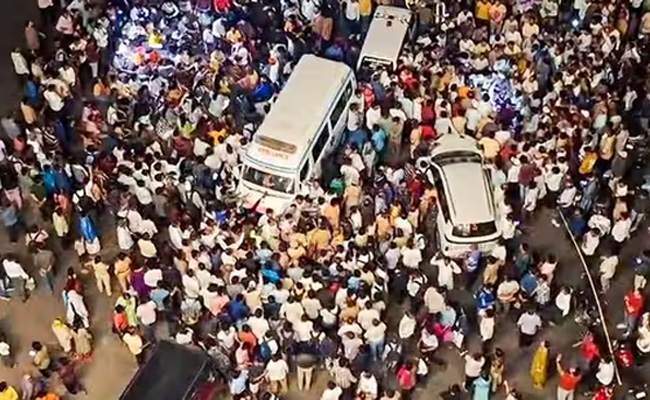
London (AP): A London march organized by far-right activist Tommy Robinson drew more than 100,000 people and became unruly on Saturday as a small group of his supporters clashed with police officers who were separating them from counterprotesters.
Several officers were punched, kicked and struck by bottles tossed by people at the fringes of the “Unite the Kingdom” rally, Metropolitan Police said. Reinforcements with helmets and riot shields were deployed to support the 1,000-plus officers on duty.
At least nine people were arrested, but police indicated that many other offenders had been identified and would be held accountable.
Police estimated that Robinson drew about 110,000 people, while the rival “March Against Fascism” protest organised by Stand Up To Racism had about 5,000 marchers.
Anti-migrant theme
Robinson, whose real name is Stephen Yaxley-Lennon, founded the nationalist and anti-Islam English Defense League and is one of the most influential far-right figures in Britain.
The march was billed as a demonstration in support of free speech — with much of the rhetoric by influencers and several far-right politicians from across Europe aimed largely at the perils of migration, a problem much of the continent is struggling to control.
“We are both subject to the same process of the great replacement of our European people by peoples coming from the south and of Muslim culture, you and we are being colonized by our former colonies,” far-right French politician Eric Zemmour said.
Elon Musk, the Tesla CEO and owner of the X platform who has waded into British politics several times this year, was beamed in by video and condemned the left-leaning U.K. government.
“There's something beautiful about being British and what I see happening here is a destruction of Britain, initially a slow erosion, but rapidly increasing erosion of Britain with massive uncontrolled migration," he said.
Robinson told the crowd in a hoarse voice that migrants now had more rights in court than the “British public, the people that built this nation.”
The marches come at a time when the UK has been divided by debate over migrants crossing the English Channel in overcrowded inflatable boats to arrive on shore without authorization.
Numerous anti-migrant protests were held this summer outside hotels housing asylum-seekers following the arrest of an Ethiopian man who was later convicted of sexually assaulting a 14-year-old girl in a London suburb. Some of those protests became violent and led to arrests.
Sea of flags
Participants in the “Unite the Kingdom” march carried the St. George's red-and-white flag of England and the union jack, the state flag of the United Kingdom, and chanted “we want our country back.”
UK flags have proliferated this summer across the UK — at events and on village lampposts — in what some have said is a show of national pride and others said reflects a tilt toward nationalism.
Supporters held signs saying “stop the boats,” “send them home,” and “enough is enough, save our children.”
At the counterprotest, the crowd held signs saying “refugees welcome” and ”smash the far right,” and shouted “stand up, fight back.”
Robinson supporters chanted crude refrains about UK Prime Minister Keir Starmer, leader of the center-left Labour Party and also shouted messages of support for slain US conservative activist Charlie Kirk.
Several speakers paid tribute to Kirk, who was remembered in a moment of silence, followed by a bagpiper playing “Amazing Grace.”
One demonstrator held a sign saying: “Freedom of speech is dead. RIP Charlie Kirk.”
Crowd covered blocks of London
The crowd at one point stretched from Big Ben across the River Thames and around the corner beyond Waterloo train station, a distance of about three-quarters of a mile (around a kilometre).
The marches had been mostly peaceful, but toward the late afternoon, “Unite the Kingdom” supporters threw items at the rival rally and tried to break through barriers set up to separate the groups, police said. Officers had to use force to keep a crowd-control fence from being breached.
Counterprotesters heckled a man with blood pouring down his face who was being escorted by police from the group of Robinson supporters. It wasn't immediately clear what happened to him.
While the crowd was large, it fell far short of the one of the biggest recent marches when a pro-Palestinian rally drew an estimated 300,000 people in November 2023.
Robinson had planned a “Unite the Kingdom” rally last October, but couldn't attend after being jailed for contempt of court for violating a 2021 High Court order barring him from repeating libelous allegations against a Syrian refugee who successfully sued him. He previously served jail time for assault and mortgage fraud.
Let the Truth be known. If you read VB and like VB, please be a VB Supporter and Help us deliver the Truth to one and all.
Road crash in Rajasthan leaves woman dead, husband injured
Jaisalmer (PTI): A woman was killed, while her husband sustained serious injuries when their car rammed into a tractor trolley parked on the roadside in Rajasthan's Jaisalmer district, police said on Sunday
The accident occurred near Hadda crossing on Saturday night when the woman was travelling in the car along with her husband and daughter.
The deceased has been identified as Hariya Choudhary (35), who was posted as an Auxiliary Nurse Midwife in Salkha village.
All occupants were taken to the Government Jawahar Hospital where doctors declared Choudhary brought dead.
The body will be handed over to family members after postmortem.