Love my legacy to be made as great peacemaker: Trump
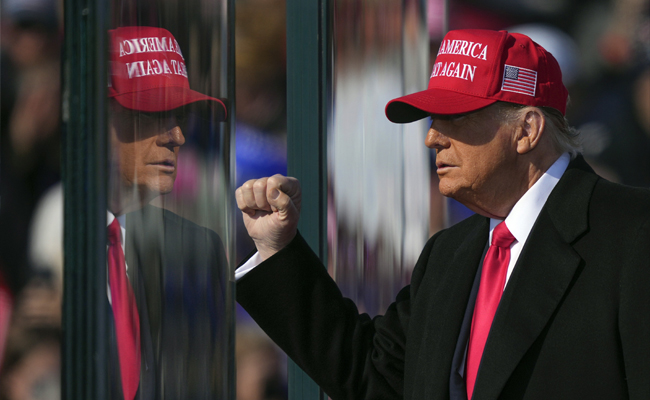
Washington (PTI): US President Donald Trump has said he would love his legacy to be made as a great peacemaker as he stopped eight wars, including the one between India and Pakistan last year.
Addressing the Saudi-backed Future Investment Initiative (FII) Priority Summit in Miami, Trump also said reopening the Strait of Hormuz was a condition for any agreement with Iran and stressed that maritime access for oil shipments must be restored.
"We're negotiating now, and it would be great if we could do something, but they have to open it up," he said.
The US President reiterated his claim that he helped stop eight wars, including those between Armenia and Azerbaijan; the Democratic Republic of the Congo and Rwanda; Cambodia and Thailand; Egypt and Ethiopia; Serbia and Kosovo; Israel and Hamas.
ALSO READ: India only country with no increase in petrol, diesel prices, says Amit Shah
"I would love my legacy to be made as a great peacemaker because I really believe I am a peacemaker. It doesn't seem like it right now, but I think I am a peacemaker," Trump said.
"I even stopped India and Pakistan, and they were going at it for a week.. nine planes already shot down. They were in a war. I stopped them. How did I stop them? I said, if you keep fighting, I'm going to put a 250 per cent tariff on each one," the US President said.
"No, no, no, you cannot do that. I said, I'm doing it. All right, we won't fight anymore. That's how I stopped them." Trump said.
Trump jokingly referred to the Strait of Hormuz as the "Strait of Trump" during his remarks before correcting himself, later saying the comment was not accidental.
Trump described Iran as a longstanding force shaping instability in the Middle East but said its position had weakened under the US military operation Epic Fury.
"For 47 years, Iran has been known as the bully of the Middle East, but they are not the bully any longer. They're on the run," he said, adding that Iran's leadership, armed forces, and nuclear program had suffered damage during the operation.
Trump refused to refer to the attacks on Iran as "war" and chose to refer to it as a military operation.
The US president was harshly critical of the North Atlantic Treaty Organization (NATO) for not "helping" him with the war with Iran.
"NATO is a paper tiger. And I always said we help NATO, but they never help us. And if the big one ever happened and I don't think it will, but if the big one ever happened, I guarantee you they wouldn't be there."
Trump reiterated that if the U.S. had not "knocked the hell" out of Iran, the country would have had a nuclear weapon "within two to four weeks" despite his insistence that the U.S. bombing of Iranian nuclear sites last year set its programs back years.
"They would have used it on you, and on Israel, and on everyone else," he said, addressing the Saudi attendees. The president also hinted at potential action against Cuba.
"And Cuba is next by the way, but pretend I didn't say that," he said. "Please, please, please, media, disregard that statement. Thank you very much. Cuba’s next," Trump said.
Let the Truth be known. If you read VB and like VB, please be a VB Supporter and Help us deliver the Truth to one and all.
Power tariffs under BESCOM to rise from May 1
Bengaluru (PTI): Power bills for consumers under the Bangalore Electricity Supply Company Limited (BESCOM) will go up from May 1, following an order issued by the Karnataka Electricity Regulatory Commission (KERC) on Friday.
The hike comes after KERC allowed the BESCOM to recover a revenue deficit of Rs 2,068 crore incurred in 2024-25, from the consumers.
As a result, for every unit of electricity consumed in 2024-25, the customers will be charged an additional 56 paise, it said.
"BESCOM shall calculate, for each of the active consumers of FY2024-25 the amount to be recovered based on their actual energy consumption during FY2024-25. Such amount shall be recovered during FY 2026-27 in equal monthly instalments, to be called as 'FY25 True up Charges', commencing from the first meter reading date falling on or after 1 May 2026 and concluding with the reading date ending on 30 April 2027," the order said.
"It is further ordered that BESCOM shall maintain a separate head of account, allocated for the purpose, to record the adjustment of the said amount to ensure full recovery of the deficit," it added.
Similarly Chamundeshwari Electricity Supply Corporation Limited (CESC) has also recorded a revenue deficit of Rs 121.71 crore and can collect an additional 15 paisa per unit for consumption in 2024-25, official sources said.