Macron to hold crisis meeting after anti-government riots
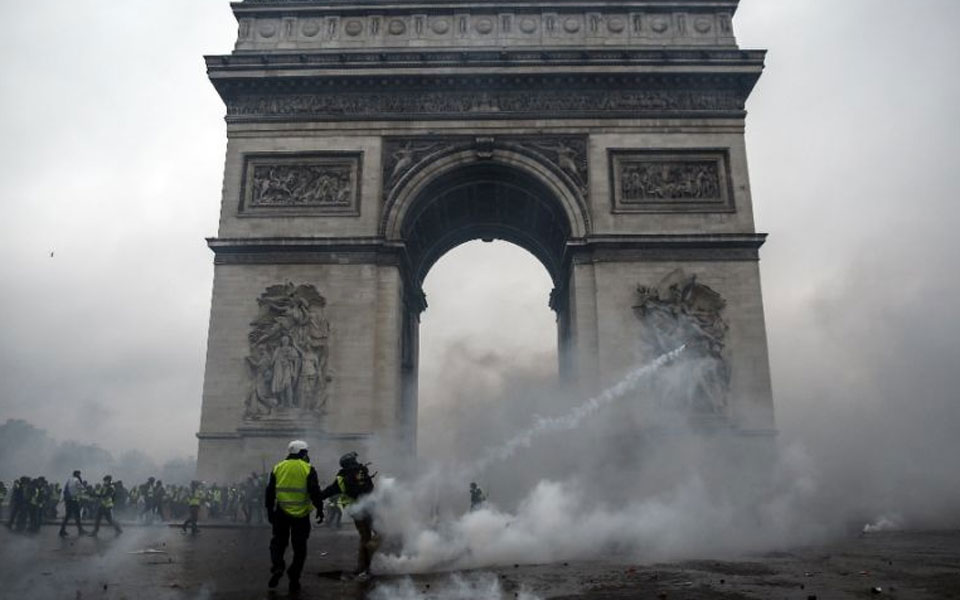
Paris, Dec 2 : French President Emmanuel Macron is to hold a crisis meeting on Sunday after anti-government protests in Paris that left 133 people injured and a trail of destruction around the capital.
Macron is set to fly into Paris late morning after attending a G20 summit in Argentina and will meet the prime minister, interior minister and top security service officials at the presidential palace.
New figures released from the Paris police service showed that 412 people were arrested on Saturday during the worst clashes for years in the capital and 378 were still in custody.
A total of 133 had been injured, including 23 members of the security forces who battled rioters for most of the day in some of the most famous parts of the capital.
"I will never accept violence," Macron told a news conference in Buenos Aires before flying home.
"No cause justifies that authorities are attacked, that businesses are plundered, that passers-by or journalists are threatened or that the Arc du Triomphe is defiled," he said.
In a fresh incident on Sunday morning, a motorway pay booth was set on fire by arsonists in southern France near the city of Narbonne, a judicial source told AFP.
The main north-south motorway in eastern France, the A6, was also blocked by protesters near the city of Lyon on Sunday morning, its operator said.
The capital was calm, however, but as groups of workers moved around cleaning up the mess from the previous day, the scale of the destruction became clear.
In famed areas around the Champs-Elysees, the Louvre palace, the Opera or Place Vendome, smashed shop windows, broken glass and the occasional burned out car were testament to the violence.
Dozens of cars were torched by the gangs of rioters, some of whom wore gas masks and ski goggles to lessen the effects of tear gas which was fired continually by police.
One person was in a critical condition after protesters pulled down one of the huge iron gates of the Tuileries garden facing the Louvre museum, crushing several people.
Nearly 190 fires were put out and six buildings were set alight, the interior ministry said.
At the Arc de Triomphe, a monument to France's war dead, graffiti had been daubed, saying: "The yellow vests will win." -- What response? -
This was a reference to the so-called "yellow vest" anti-government protests that have swept France over the last fortnight, sparked initially by a rise in taxes on diesel.
The movement has since morphed into a broad opposition front to Macron, a 40-year-old pro-business centrist elected in May 2017. Violent anarchist and far-right groups have since infiltrated it and are thought to be behind Saturday's clashes.
Macron faces a dilemma in how to respond to the "yellow vests", not least because they are a grassroots movement with no formal leaders and a wide range of demands.
Some representatives have also insisted on public talks broadcast on TV.
"We have said that we won't change course. Because the course is good," government spokesman Benjamin Griveaux told BFM television defiantly on Sunday morning.
"It's been thirty years that people change course every 18 months," he added, referring to Macron's presidential predecessors who have often caved in to pressure from French street protests.
Macron has so far refused to roll back taxes on fuel, which he says are needed to fund the country's transition to a low-emission economy.
And he remains a fervent defender of the tax cuts he has delivered for businesses and high-earners, which he believes were necessary to lower the country's chronic high unemployment.
"We're at a time when a bit of national unity around our security forces, around those who are really struggling would be a good thing for the country," Griveaux added.
An estimated 75,000 demonstrators, most of them peaceful, were counted across the country on Saturday, the interior ministry said.
The number was well below the first day of protests on November 17, which attracted around 282,000 people, and also down from the 106,000 who turned out last Saturday.
Interior Minister Castaner attributed the violence to "specialists in sowing conflict, specialists in destruction".
Let the Truth be known. If you read VB and like VB, please be a VB Supporter and Help us deliver the Truth to one and all.
Man arrested with Rs 2.54-crore heroin in Mumbai

Mumbai (PTI): Police have arrested a man and seized over 500 grams of heroin worth Rs 2.54 crore in the illicit market from him in Mumbai, officials said on Friday.
The police's Anti-Narcotics Cell (ANC) made the drug seizure in Santacruz in the western suburbs. The operation was conducted by the Kandivali unit of the ANC on Thursday as part of a special crackdown against drug trafficking in the area, they said.
Acting on specific inputs, an ANC team conducted a raid in Santacruz (East) and intercepted a man. During a search, the team recovered 508 grams of high-grade heroin from his possession, an official said.
The seized contraband, a highly addictive, opioid drug derived from morphine, is estimated to be worth Rs 2.54 crore in the international market, he informed.
Following the seizure, a case was registered against the man under relevant sections of the Narcotic Drugs and Psychotropic Substances (NDPS) Act, 1985, and he was formally placed under arrest in the early hours of Friday.
The police are currently investigating the source of the drug and trying to identify the intended recipients of the consignment, he said.