Mark Carney is sworn in as Canada's new prime minister as country deals with Trump's trade war
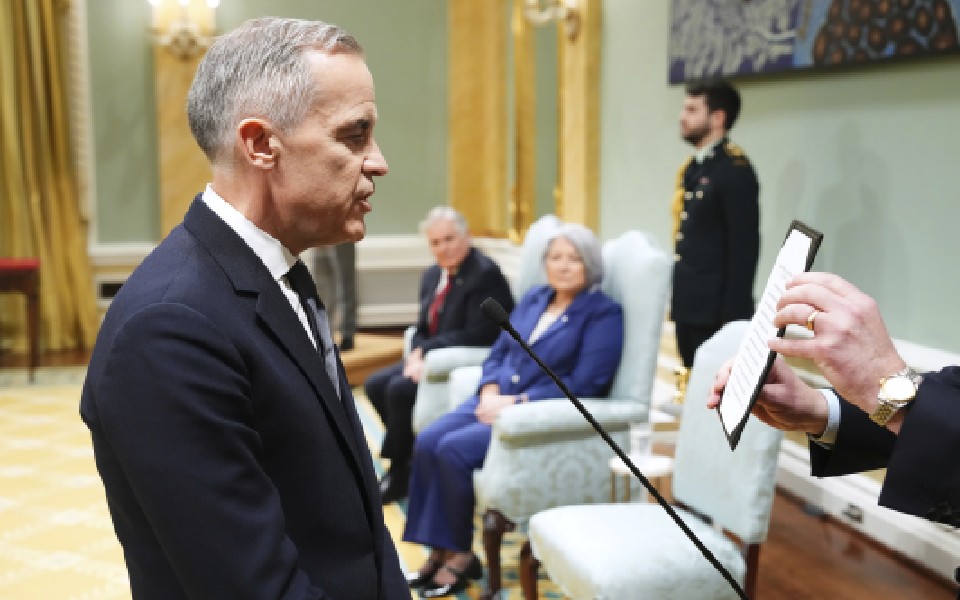
Toronto, Mar 14 (AP): Former central banker Mark Carney was sworn in as Canada's new prime minister on Friday, and will now try to steer his country through a trade war brought by US President Donald Trump, a threat of annexation and an expected federal election.
Carney, 59, replaces Prime Minister Justin Trudeau, who announced his resignation in January but remained in power until the Liberal Party elected a new leader. Carney is widely expected to trigger a general election in the coming days or weeks.
The governing Liberal Party had appeared poised for a historic election defeat this year until Trump declared economic war and threatened to annex the entire country as a 51st state. Now the party and its new leader could come out on top.
Carney has said he's ready to meet with Trump if he shows “respect for Canadian sovereignty" and is willing to take ”a common approach, a much more comprehensive approach for trade."
Trump put 25 per cent tariffs on Canada's steel and aluminum and is threatening sweeping tariffs on all Canadian products April 2. He has threatened economic coercion in his annexation threats and suggested the border is a fictional line.
The US trade war and Trump's talk of making Canada the 51st US state have infuriated Canadians, who are booing the American anthem at NHL and NBA games. Some are cancelling trips south of the border, and many are avoiding buying American goods when they can.
The surge in Canadian nationalism has bolstered the Liberal Party's chances in a parliamentary election expected within days or weeks, and Liberal showings have been improving in opinion polls.
Carney, who navigated crises when he was the head of the Bank of Canada from 2008, and then in 2013 when he became the first noncitizen to run the Bank of England — helping to manage the worst impacts of Brexit in the UK — will now try to steer Canada through the trade war brought by Trump.
“He will do very well. He's respected internationally,” former Prime Minister Jean Chrétien told reporters Friday. But, he added: “There is no magic solution. This is not a normal situation. We've never seen someone who changes his mind every five minutes as president of the United States. It creates problems everywhere, not only in Canada.”
Let the Truth be known. If you read VB and like VB, please be a VB Supporter and Help us deliver the Truth to one and all.
Maharashtra sets up state vaccination task force to strengthen immunisation programme

Mumbai (PTI): The Maharashtra government has set up a State Vaccination Task Force to strengthen the regular immunisation programme and review the progress of related campaigns, a health department official said on Monday.
The State Vaccination Task Force will comprise at least 29 members and will be headed by the administrative head of the health department, he informed.
The government has also constituted separate district-level and municipal vaccination task forces to improve implementation and address challenges at the grassroots level, he said.
Municipal task forces, chaired by respective civic commissioners, have been constituted in view of the vast urban population in Maharashtra and the role of civic bodies in implementing different health programmes.
The district-level task forces will function under the chairmanship of collectors.
"Complete immunisation of children at the appropriate age is an extremely simple, cost-effective and highly effective measure to reduce child mortality and the prevalence of diseases among kids. Immunisation is a powerful tool for reducing illness in children," maintained the official.
To ensure full vaccination of all children, the state government implements various campaigns from time to time as per the central government guidelines, he pointed out.
"Active participation and cooperation of other relevant government departments are essential (in making these campaigns successful)," according to the official.
The state-level body will review the regular immunisation programme, associated campaigns and vaccine-preventable diseases in detail. It will also conduct focused assessments of high-risk districts and municipal corporations, including vacancies at district, municipal and sub-district levels, availability of cold chain equipment, resource gaps and training requirements, he noted.
The state task force will review allocation and utilisation of funds for immunisation and ensure timely action by officers concerned based on reports from district and municipal task forces and state-level monitoring mechanisms, the official said.
It will also ensure active coordination and participation of other government departments in immunisation drives, while district and municipal task forces will carry out similar functions at their respective levels, the official added.