Martial law imposed in parts of Myanmar city as deaths rise
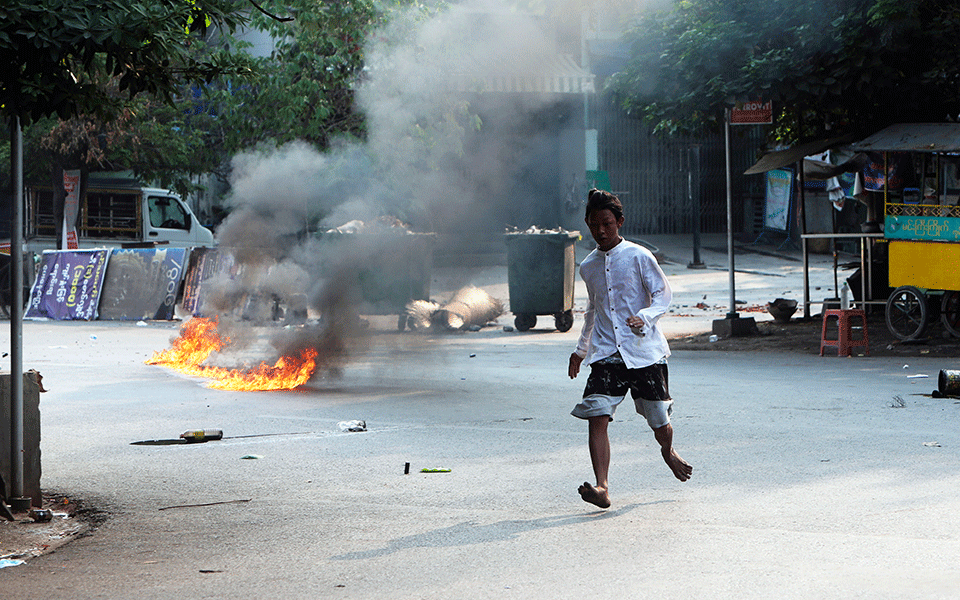
Yangon(AP): Myanmar's ruling junta has declared martial law in parts of the country's largest city as security forces killed more protesters in an increasingly lethal crackdown on resistance to last month's military coup.
At least 38 people were killed Sunday and dozens were injured in one of the deadliest days of the crackdown, according to the Assistance Association for Political Prisoners, an independent group tracking the toll of the violence.
Most of those killed 34 were in Yangon, where two townships, Hlaing Thar Yar and neighboring Shwepyitha were being placed under martial law.
Video from Hlaing Thar Yar township showed people running away after gunfire was heard. Those fleeing carried one injured person and tried to revive two others, one who seemed to be dead or dying, the footage from independent Democratic Voice of Burma showed.
Hlaing Thar Yar was the location of 22 civilian deaths Sunday, according to the aid group, which said more than a dozen civilians were wounded and described a large number of junta forces engaged in the township.
Since the takeover six weeks ago, Myanmar has been under a nationwide state of emergency, with its civilian leaders ousted and detained and military leaders in charge of all government.
But the announcement on state broadcaster MRTV late Sunday appeared to be the first use of the term martial law since the coup and suggested more direct military control of security, instead of local police.
The announcement said the State Administrative Council acted to enhance security and restore law and order and said the Yangon regional commander has been entrusted with administrative, judicial and military powers in the area under his command.
Four other deaths were reported in Bago, Mandalay, and the northern city of Hpakant in Kachin state, according to the aid group and local media.
In Yangon, video posted on social media showed crowds of people, some wearing hard hats and gas masks, running down a street amid sounds of gunfire.
The demonstrators quickly sprayed vapor from fire extinguishers as they retreated a tactic widely used to smother tear gas and create a vapour screen that makes it harder for police to pursue or shoot demonstrators.
There were also reports of injuries from live rounds and rubber bullets in other parts of Yangon, including Insein district, where billows of black smoke could be seen after security forces reportedly set roadblocks on fire.
In a new tactic, anti-coup demonstrators used the cover of darkness to hold mass candlelight vigils Saturday and Sunday nights in a Yangon commercial area that was usually the scene of their daytime protests. After-dark rallies were also held in Mandalay and elsewhere.
The protest movement has been grounded in non-violent civil disobedience from the start, with marches and general strikes among its main features. But some protesters have advocated stronger, more agile methods of self-defense such as holding small rallies that are quick to disband and reunite, and devising cover from fire extinguishers and billowing laundry.
On Saturday, the civilian leader of Myanmar's government in hiding vowed to continue supporting a revolution to oust the military leaders who seized power in the Feb. 1 coup. Mahn Win Khaing Than, who was named the acting vice president by Myanmar's ousted lawmakers and is a member of deposed leader Aung San Suu Kyi's political party, addressed the public for the first time since the coup.
This is the darkest moment of the nation and the moment that the dawn is close, he said in a video posted on the shadow government's website and social media.
In order to form a federal democracy, which all ethnic brothers who have been suffering various kinds of oppressions from the dictatorship for decades really desired, this revolution is the chance for us to put our efforts together," he said.
He added: We will never give up to an unjust military, but we will carve our future together with our united power. Our mission must be accomplished.
At the end of the message, he flashed the three-finger salute that has become a symbol of resistance to the military rulers.
The aid group's tally of Sunday's victims appeared to raise beyond 100 the number of civilians killed by security forces since the coup. Confirmation is nearly impossible in the country due to the security situation and a crackdown on independent media, but various groups have carefully compiled tallies with similar figures.
The actual death toll is likely higher, as police apparently seized some bodies, and some victims have had serious gunshot wounds that medical staff at makeshift clinics would be hard-pressed to treat. Many hospitals are occupied by security forces, and as a result are boycotted by medical personnel and shunned by protesters.
Police have also aggressively patrolled residential neighborhoods at night, firing into the air and setting off stun grenades as an intimidation tactic. They have also taken people from their homes in targeted raids with minimal resistance. In at least two known cases, the detainees died in custody within hours of being hauled away.
Let the Truth be known. If you read VB and like VB, please be a VB Supporter and Help us deliver the Truth to one and all.
Indian startup's 'Drishti' satellite launched aboard SpaceX rocket
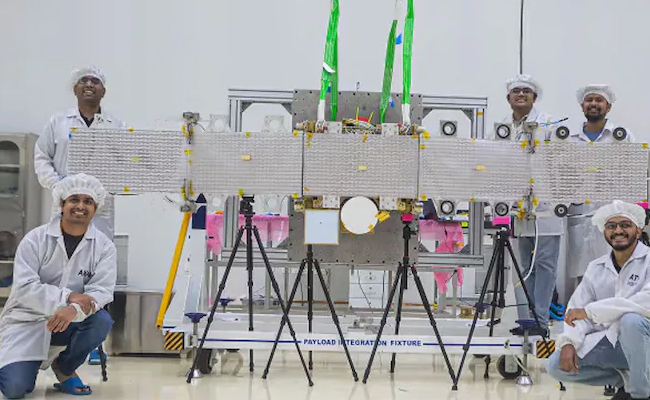
New Delhi (PTI): Bengaluru-based space start-up GalaxEye's Mission Drishti satellite was launched on Sunday aboard SpaceX's Falcon 9 rocket from California.
Mission Drishti is the world's first OptoSAR satellite, integrating electro-optical (EO) and synthetic aperture radar (SAR) sensors into a single operational platform, according to the company.
While EO sensors capture high-resolution images during sunlight and clear skies, SAR sensors provide all-weather and all-time images, using radar pulses.
In a statement, Suyash Singh, founder and CEO of GalaxEye, said, "With the satellite (Mission Drishti) now successfully in orbit, our immediate focus is on completing its commissioning. As we move through this phase, we are already witnessing strong global interest in the differentiated datasets enabled by our OptoSAR payload."
The satellite will help address long-standing limitations of conventional systems and enable more reliable and consistent data acquisition across diverse environmental conditions, the company said.
As a dual-use Earth observation satellite, the mission will support use cases across defence, agriculture, disaster management, maritime monitoring, and infrastructure planning.
The satellite is also expected to complement India's broader initiatives, including the 29 active Earth Observation satellites outlined in ISRO's recent annual report.
The launch came after five years of indigenous research and development, and extensive environmental testing and performance validation of the Mission Drishti.
In a statement, Lt Gen AK Bhatt (Retd), director general of Indian Space Association (ISpA), said, "GalaxEye has achieved what only a few global players have, which is seamlessly combining optical and SAR capabilities on a single platform to enable persistent, all-weather intelligence."
What stands out is not just the technology, but its broader impact on how downstream applications will increasingly define value in the space economy, particularly in Earth observation, where timely, decision-grade insights are critical," he added.
ISpA is the premier industry association of space and satellite companies in the country.
Union Minister Jitendra Singh also took note of the Mission Drishti launch, saying the development marked a significant milestone in India's space journey.
In a post on X, the minister said, "The successful launch of the world's first OptoSAR satellite, and the largest privately-built satellite in the country, reflects the immense potential of our young innovators driving nation-building."
GalaxEye aims to scale up Mission Drishti to a constellation of 10 satellites by 2030, developing a robust and sovereign Earth observation infrastructure for India.