Meet Zohran Mamdani: Indian-origin NYC’s mayoral candidate, son of director Mira Nair
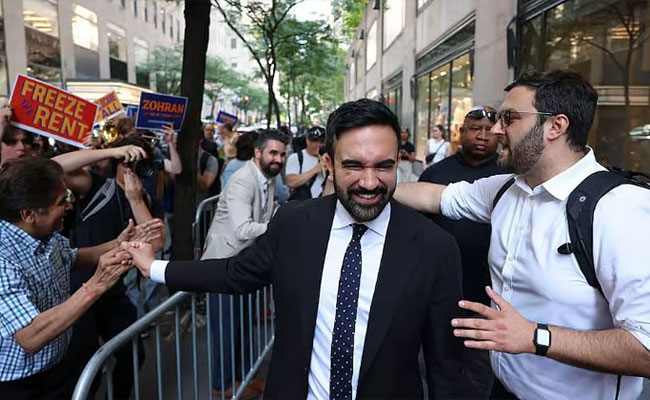
New York: In a stunning political upset, 33-year-old democratic socialist Zohran Mamdani has secured the Democratic nomination for New York City mayor, defeating former governor Andrew Cuomo in a high-stakes ranked-choice primary held Tuesday night.
“I will be the mayor for every New Yorker, whether you voted for me, for governor Cuomo, or felt too disillusioned by a long-broken political system to vote at all,” Mamdani told his supporters.
Born in Kampala, Uganda, on October 18, 1991, Mamdani is the son of acclaimed Indian-origin filmmaker Mira Nair and Indian-born Ugandan academic Mahmood Mamdani. He spent his early years in Cape Town, South Africa, before moving to New York City at age of seven.
Educated at the Bank Street School, Bronx High School of Science, and Bowdoin College, where he earned a degree in Africana Studies, Mamdani’s path to politics was shaped by activism. As a college student, he co-founded a chapter of Students for Justice in Palestine, laying the foundation for his progressive ethos.
Mamdani’s organising work spans several grassroots campaigns, including those of Khader El-Yateem, Ross Barkan, and Tiffany Cabán. In 2019, he was elected to the New York State Assembly, representing Astoria and Long Island City.
His legislative agenda has focused on affordable housing, immigrant rights, and public transit—themes that also defined his mayoral campaign.
A practicing Shia Muslim, Mamdani recently married Syrian artist Rama Duwaji. His campaign has drawn from his cultural heritage, using Bollywood-inspired messaging such as “roti, kapda, aur makaan”—a slogan from the 1974 classic of the same name—to advocate for basic economic dignity.
His historic candidacy has galvanised younger, left-leaning voters, and with the Democratic nomination in hand, Mamdani, if elected in November, would become New York City’s first Muslim and first Indian-American mayor—a milestone in the city’s political history.
Let the Truth be known. If you read VB and like VB, please be a VB Supporter and Help us deliver the Truth to one and all.
Two injuries, one DNF, a DQ as India end messy World Relays campaign
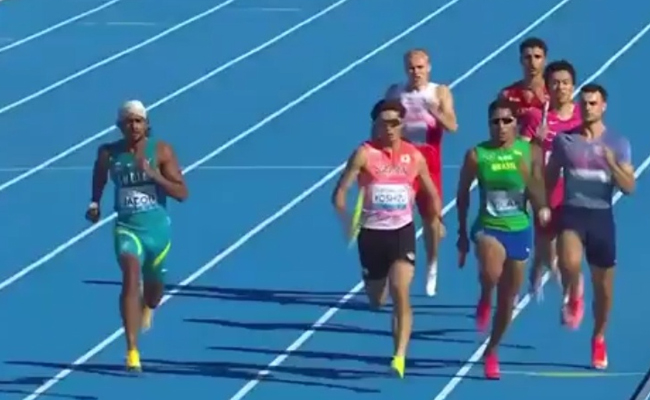
Gaborone (Botswana) (PTI): Amoj Jacob and Ragul Kumar got injured during the men's 4x400m and 4x100 races respectively as India ended their World Athletics Relays campaign in disappointment on the second day of competitions here on Sunday.
The Indian camp had high hopes of making the 2027 World Championships in the men's 4x400m relay but the team did not finish (DNF) the race as Jacob suffered cramps and pulled out of the race after taking the baton from the first leg runner Dharamveer Choudhary. Rajesh Ramesh and Vishal TK were to run in the third and fourth legs.
Those teams which could not qualify for the 2027 Beijing World Championships by reaching the final round of each of the six relay events on Saturday were given another chance in the second qualification round on Sunday.
The top two teams in each of the two heats (in all six relay events) booked the Beijing ticket on Sunday.
India will now have to try and qualify for the World Championships through the Top Lists of the World Athletics, which is a long and tedious process.
In the men's 4x100m race, third leg runner Ragul Kumar fell down the track after failing to hand over the baton inside the exchange zone to fourth leg runner Gurindervir Singh, which clearly showed the lack of coordination among the runners.
Harsh Santosh Raut and Animesh Kujur ran the first two legs.
The Indian quartet was disqualified and Kumar was seen being taken away from the Field of Play with the help of the volunteers.
It was a comedy of errors in the case of the women's 4x100m race, which saw the baton being dropped during an exchange between first leg runner Tamanna and second runner Nithya Gandhe, though the Indians finished the race in 53.09 seconds.
Gandhe started running quite a distance, but after realising that the baton was not in her hand, she turned and ran back to pick it up.
The only silver-lining for the Indian contingent was the national record time in the mixed 4x100m relay race, though the quartet of Ragul Kumar, Nithya Gandhe, Animesh Kujur and Sneha SS finished sixth in heat number two with a time of 41.35 seconds, bettering the previous national mark of 42.30 seconds set in March in Chandigarh.
The mixed 4x400m relay quartet of Theerthesh P Shetty, Kumari Saloni, Nihal William and Rashdeep Kaur ended at fifth in heat number one with a time of 3 minutes and 19.40 seconds.
On Saturday, all the five Indian relay teams had failed to make it to the respective final rounds and thus missed out on the 2027 World Championships berths.