Melbourne's air quality 'worst in the world', authorities issue health warnings

Melbourne: The air quality in Melbourne deteriorated to the "worst in the world" on Tuesday as smoke from the massive bushfires engulfed Australia's second biggest city with authorities issuing health warnings advising people to stay indoors and take precautionary measures.
The raging Australian bushfires, one of the worst in its history, has killed at least 26 people, burned over 10 million hectares of land, destroyed over 2,000 homes and pushed many species towards extinction.
Meanwhile, the Bureau of Meteorology has forecast rains through the week, bringing some relief to the bushfire affected communities and the firefighters.
According to report in the Australian Broadcasting Corporation (ABC), widespread rainfall is expected for the east coast of the country, including the firegrounds, starting Tuesday and lasting into the weekend.
Melbourne's air quality went down overnight to "hazardous" due to bushfire smoke as the smoke from Victoria state engulfed it. 16 fires were still burning and 1.4 million hectares have been destroyed across Victoria.
It is the second biggest city in Australia after Sydney with a population of over 4.2 million. "I think overnight for Melbourne it did reach the worst in the world," Victoria's chief health officer Brett Sutton said. Sutton said warmer temperatures would help lift "particulate matter" that had resulted in the poor air quality.
He warned that people might experience a worsening cough and a dry nose and throat.
"For those vulnerable groups - over 65s, under 15s, pregnant women and people with existing lung/heart disease or diabetes - we are saying avoid exposure to the smoke by staying indoors and limiting physical activity," he said.
While heart and respiratory patients were being told to keep safe, the healthy were being warned to stay inside.
The ABC report said several outdoor suburban swimming pools were shut down and horse races at Werribee suburb were also cancelled. Australian Open organisers also temporarily suspended qualifying matches and player practice sessions for Tuesday morning.
According to the Environmental Protection Authority's AirWatch website, the air quality in Melbourne was "very poor'' and visibility down to 900 metres in some parts of inner Melbourne on Tuesday.
The entire state was choking under a blanket of bushfire smoke, including Geelong town, the Latrobe Valley, Central Victoria, Gippsland and the North Central regions, considered to have "hazardous" air quality at 7 am (local time).
In Melbourne's Central Business District (CBD), the smoke was measured at "hazardous" levels between 12 am and 4 am (local time).
Sutton said people in East Gippsland and the state's north-east, where poor to hazardous air quality is likely to remain for some time, should try to let fresh air into their homes when possible.
"When conditions are good that's the time to open doors and windows to air your house, to get the smoke out and then when the air quality's poor, close doors and windows, stay inside, minimise your activity," he said.
The bushfires this summer season has destroyed over 10 million hectares of land across the country, while over 8.4 million hectares have been destroyed in North South Wales alone.
With 30 per cent of their habitat already been destroyed in the devastating bushfires, Koalas -- the herbivorous marsupial animal native to Australia -- have become a big focus for the Australian government.
The ongoing blaze is also believed to have killed approximately half of the Koala population in the Kangaroo Island, described as Australia's Galapagos Islands.
Let the Truth be known. If you read VB and like VB, please be a VB Supporter and Help us deliver the Truth to one and all.
Ladakh a living land of dharma for centuries: Amit Shah
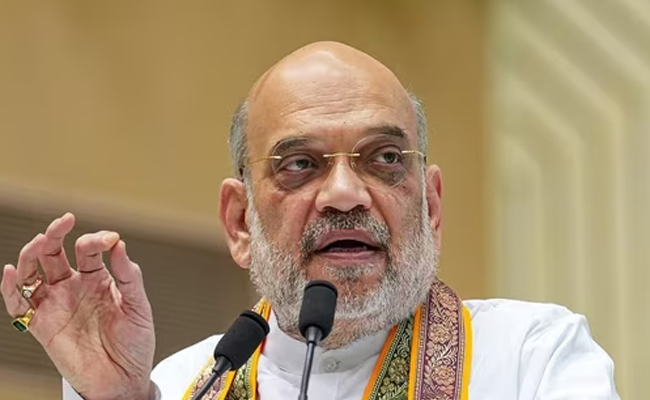
Leh/Jammu (PTI): Union Home Minister Amit Shah on Friday described the return of sacred relics of Lord Buddha to Ladakh after 75 years as a "historic reunion" and said that the Union Territory has remained a "living land of dharma", preserving and nurturing Buddhist knowledge for centuries.
Stressing the relevance of Buddha's teachings in modern times, Shah said the message of peace, compassion and the middle path was even more important today than it was 2,500 years ago.
"Ladakh has been a living land of dharma for centuries. When the Dalai Lama comes here, he says this land is not merely a geographical land but a living laboratory of Buddhist culture and compassion," Shah said, speaking after the inauguration of the sacred holy relics exposition of Tathagata Buddha and the 2569th Buddha Purnima celebrations at Jivetsal in Leh during his two-day visit to Ladakh.
Calling Ladakh a land of compassion, he said this land has preserved and nurtured knowledge. "Whenever Buddhism faced crises, this land worked to protect the teachings of Buddha. And when peace returned, it helped to expand and carry forward that preserved wisdom," he added.
"Unless one internalises knowledge and makes it a part of oneself, liberation is not possible. Knowledge is incomplete without spiritual practice, while spiritual practice without knowledge is blind. Therefore, the union of spiritual practice and knowledge is the right path. Even after all this, if there is no moral discipline, one cannot lead a truly wise life. The basis of a life of wisdom is moral discipline," he said.
Shah said it was through Ladakh and adjoining routes that the teachings of Tathagata Buddha, which originated in India, spread to China and several other countries.
"The message that emerged from the land of Ladakh has become a guiding force for many people around the world to take their lives forward. The presence of these sacred relics in Ladakh reminds us that India's civilisation has, for thousands of years, given the message of peace and coexistence," he said.
He said that in a diverse region like Ladakh and Kargil, this message becomes even more relevant. "This heritage still tells us today that amidst conflict and unrest, only the path of peace and compassion can provide solutions."
He said the return of the relics on Buddha Purnima had enhanced the significance of the festival for the people of Ladakh.
"These sacred relics have come to Ladakh after 75 years. It is as if Buddha himself is present here today," Shah said, adding that followers of Buddhism and people of other faiths in Ladakh and Kargil would draw spiritual energy from the relics.
Highlighting Ladakh's role in the spread of Buddhism, Shah said Kashmir was once an ancient centre of Buddhist studies, Mahayana philosophy and Buddhist art, from where Ladakh first came into close contact with Buddhism.
He said Emperor Ashoka's envoys laid the foundation of Buddhist influence in Ladakh through Kashmir and Gandhara, while Mahayana Buddhism expanded in the region during the Kushan period between the first and third centuries CE.
The Silk Route linking Kashmir, Leh, Yarkand, Khotan and Tibet became a channel not only for trade but also for ideas, monks, manuscripts and artistic traditions, Shah said.
He added that later, Tibetan influence between the seventh and tenth centuries further enriched Ladakh through Mahayana and Vajrayana traditions.
Stressing the relevance of Buddha's teachings in modern times, Shah said the message of peace, compassion and the middle path was even more important today than it was 2,500 years ago.
"Amid conflict and unrest, only the path of peace and compassion can provide solutions," he said.
Shah also appealed to the Ladakh administration to ensure complete arrangements so that followers of all faiths, especially Buddhists, could visit and pay obeisance to the relics.
#WATCH लेह, लद्दाख: केंद्रीय गृह मंत्री अमित शाह ने कहा, "जब दलाई लामा यहां आते हैं तो वे कहते हैं कि यह भूमि केवल भौगोलिक भूमि नहीं है। यह भूमि बौद्ध संस्कृति और करुणा की जीवंत प्रयोगशाला है। इस भूमि पर ज्ञान का संरक्षण हुआ है... भारत की सभ्यता हजारों वर्षों से शांति का संदेश… https://t.co/2nwG0w2CE6 pic.twitter.com/W13itRBqeX
— ANI_HindiNews (@AHindinews) May 1, 2026