Microsoft launches $40 mn AI programme for humanitarian causes

Orlando (Florida), Sep 24 : Microsoft on Monday launched a new $40-million programme aimed at harnessing the power of Artificial Intelligence (AI) for disaster recovery, helping children, protecting refugees and displaced people and promoting respect for human rights.
The tech giant said it would execute the five-year programme by working deeply with select non-governmental and humanitarian organisations through grants, investment of technology and shared expertise.
Unveiled at the annual "Microsoft Ignite 2018" conference here, the programme called "AI for Humanitarian Action" is part of Microsoft's "AI for Good initiative" that was launched in July last year.
"Today, in conjunction with the United Nations General Assembly meeting, we are announcing AI for Humanitarian Action, a new $40-million dollar five-year Microsoft programme," said Microsoft President Brad Smith.
"We believe that technology, like AI combined with Cloud technology, can be a game changer, helping save more lives, alleviate suffering and restore human dignity by changing the way frontline relief organisations anticipate, predict, and better target response efforts," Smith added in a blog post.
At the conference, Microsoft also released an array of security programmes and products.
Among them are "Microsoft Secure Score" -- a dynamic report card that assesses Microsoft 365 customer environments and makes recommendations that can reduce breaches up to 30-fold -- and "Microsoft Authenticator", which helps make secure sign-on easier for workers with features like password-free login.
"In this era of the intelligent Cloud and intelligent edge, businesses in every industry are looking for a trusted partner to help them transform," Microsoft CEO Satya Nadella said in his keynote address.
"We are pushing the bounds in AI, edge computing and IoT (Internet of Things), while providing end-to-end security to empower every organisation to build its own digital capability and thrive in this new era," Nadella added.
Microsoft said its "AI for Humanitarian Action" programme will accelerate the pace of innovation by managing strategic AI projects that demonstrate new applications, delivering reusable solutions and partnering with others to expand and scale initial projects.
AI can address humanitarian causes in myriad ways. For example, AI technologies like machine vision can quickly analyse images of roads damaged or destroyed by an event, making way for a faster and safer response, Smith explained.
"In a new partnership with the World Bank, United Nations, and partners from the tech industry, relief organisations will be better able to predict when and where future famines will occur so aid can arrive earlier, potentially saving more lives," the Microsoft President noted.
AI and Machine Learning (ML) also have the potential to improve the lives of approximately 68 million displaced people in the world, 28 million of whom are refugees.
"AI can help optimise the delivery of aid, supplies, and services to refugees and can scale NGOs' efforts to communicate and understand displaced peoples' needs," Smith explained.
The company said it would collaborate with NGOs and humanitarian organisations to accelerate breakthrough solutions to help monitor, detect and prevent human rights abuses.
"We are hopeful the world will see what a compelling force for good AI can be when it's used well in partnership with innovative NGOs. By ensuring technology fulfils its promise to address the broadest societal needs, we can empower everyone to achieve more," Smith noted.
Let the Truth be known. If you read VB and like VB, please be a VB Supporter and Help us deliver the Truth to one and all.
4 workers die after being buried under coal slurry in Jharkhand's Dhanbad
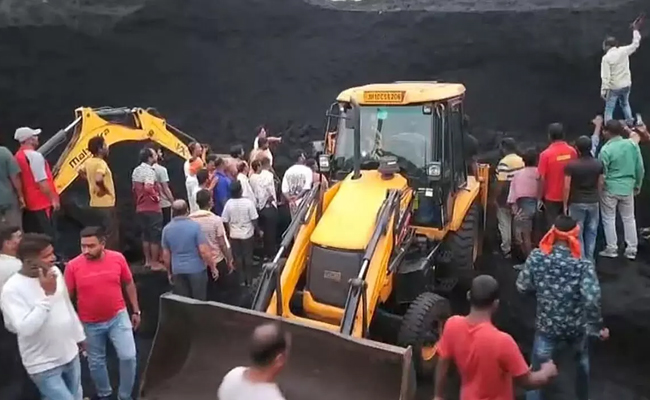
Dhanbad (Jharkhand) (PTI): At least four workers died after being buried under coal slurry in Jharkhand's Dhanbad district on Saturday, a police official said.
The incident took place at Moonidih coal washery in the command area of Bharat Coking Coal Limited (BCCL).
"Bodies of all four workers were dug out of debris during a rescue operation," Putki police station in-charge Waqar Hussain told PTI.
The incident took place when coal slurry was being loaded into trucks by workers, during which a large chunk of slurry fell and trapped several workers underneath, officials said.
The deceased have been identified as Manik Bauri, Dinesh Bauri, Deepak Bauri, and Hemlal Gope.
Meanwhile, the family members of the deceased and local villagers placed the bodies in front of the washery gate and began a protest.
They demanded compensation, jobs for dependents and action against those responsible for the incident.
Police and administration officials are trying to pacify the protesters, an official said.