Modi speaks to Trump; raises Imran Khan's provocative remarks against India
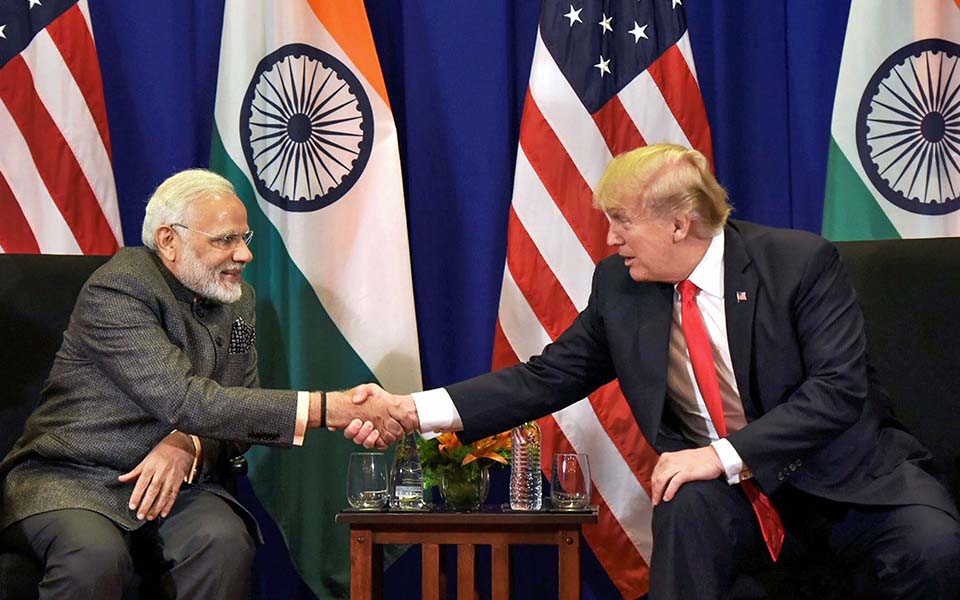
New Delhi, Aug 19: In the first highest-level interaction after India's announcement on Jammu and Kashmir, Prime Minister Narendra Modi on Monday held a telephonic conversation with US President Donald Trump, and conveyed that extreme rhetoric and incitement to anti-India violence by certain leaders in the region was not conducive to peace.
Modi's comments on extreme rhetoric by some regional leaders was an obvious reference to Pakistan Prime Minister Imran Khan, who has been making provocative comments against Modi government and Indian action in the last few days.
The 30-minute conversation between Modi and Trump covered bilateral and regional matters, and was marked by the "warmth and cordiality which characterises the relations between the two leaders", a Prime MInister's Office (PMO) release said.
"In the context of the regional situation, the prime minister stated that extreme rhetoric and incitement to anti-India violence by certain leaders in the region was not conducive to peace," it said.
The conversation between Modi and Trump took place two days after the US President asked Khan to resolve the Kashmir issue with India bilaterally during a telephonic conversation.
Continuing with his tirade against India over the Kashmir issue, Khan on Sunday had called the Indian government "fascist" and "supremacist", alleging that it poses a threat to Pakistan as well as to the minorities in India.
He also said the world must also seriously consider the safety and security of India's nuclear arsenal as it impacts not just the region but the world.
Earlier this month, India abrogated Article 370 in the Constitution to withdraw Jammu and Kashmir's special status and bifurcated it into two Union Territories, evoking strong reactions from Pakistan.
In his telephonic conversation, Modi also highlighted the importance of creating an environment free from terror and violence and eschewing cross-border terrorism without exception, the statement added.
The prime minister reiterated India's commitment to cooperate with anyone who followed this path, in fighting poverty, illiteracy and disease.
Noting that today marked the 100th year of the Independence of Afghanistan, Modi emphasised India's "longstanding and unwavering" commitment to work for "united, secure, democratic and truly independent Afghanistan".
During the conversation, Modi also referred to his meeting with Trump in Osaka on the margins of G-20 summit in June.
"Referring to their bilateral discussions in Osaka, the Prime Minister expressed the hope that the Commerce Minister of India and the US Trade Representative would meet at an early date to discuss bilateral trade prospects for mutual benefit," government said.
"The Prime Minister stated that he appreciated remaining in regular touch with President Trump," it added.
Let the Truth be known. If you read VB and like VB, please be a VB Supporter and Help us deliver the Truth to one and all.
Vijayanagara: One dead, 12 injured as trucks hits their vehicle from behind on NH 50
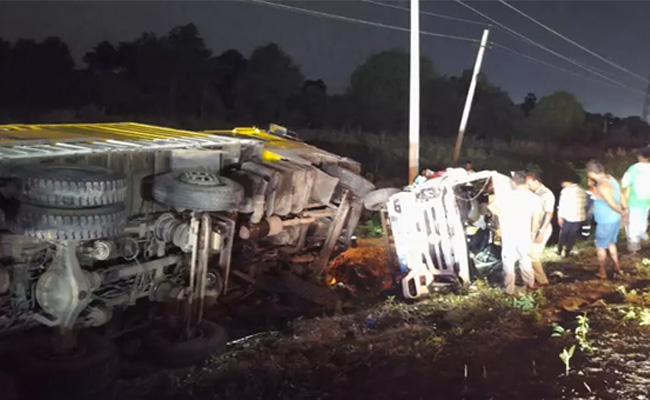
Vijayanagara: One man was killed and 12 others were injured after a truck hit vehicle they were traveling in on the National Highway 50 stretch on the outskirts of Koodligi in the district.
The accident victim, Madhu (27), is learned to have been an employee of Reliance Digital from Andhra Pradesh.
The vehicle was reportedly traveling from Bengaluru to Koodligi and the passengers are learned to have been seriously injured following the collision with the truck, which was found to have a Maharashtra registration.
Koodligi Deputy Superintendent of Police (DySP) Mallesh Dodmani and Circle Inspector Prahlad Channagiri arrived at the accident spot on being informed of the accident.
The police officers and locals rescued the injured passengers and got them shifted to the Koodligi Government Hospital. Some of the passengers were reportedly taken to the Ballari Trauma Care Centre for further treatment.
A case has been registered at the Koodligi Police Station and the officers are investigating the incident.