Mongolian President gifts horse to Defence Minister Rajnath Singh
Ulaanbaatar, Sep 7: Rajnath Singh, the first Indian Defence Minister to visit Mongolia, was gifted a majestic horse by President Ukhnaagiin Khurelsukh on Wednesday, seven years after Prime Minister Narendra Modi received a similar gift from the leadership of this country.
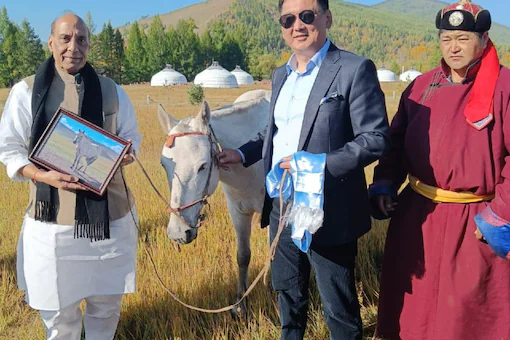
"A special gift from our special friends in Mongolia. I have named this magnificent beauty, Tejas'. Thank you, President Khurelsukh. Thank you Mongolia," Singh tweeted on Wednesday along with pictures of the white horse.
In one of the pictures, Singh is seen admiring the seven-year-old horse of Mongol breed while in another he is holding a framed picture of the equine gift.
An official source in Delhi said that the horse will not be brought to India. "It's a symbolic gift. The horse will remain in Mongolia," the source told PTI.
On Tuesday, Singh called on President Khurelsukh and reviewed the strategic bilateral ties.
"Excellent meeting with the President of Mongolia, H.E. U. Khurelsukh in Ulaanbaatar. Recalled my last meeting with him in 2018, when he was the Prime Minister of the country. We are fully committed to further deepening our multifaceted Strategic Partnership with Mongolia," Singh said in a tweet.
The Mongolian President expressed satisfaction with the expansion of relations and cooperation with India, Mongolia's important third neighbour while pointing out that the official visit of Prime Minister Narendra Modi to Mongolia in 2015, and the ongoing visit of the Defence Minister Singh are the important impetus for further development.
Khurelsukh also said that there is a full possibility of elevating the strategic partnership between the two countries to a comprehensive strategic partnership, Mongolia's Montsame national news agency reported.
In 2015, Prime Minister Modi received a special gift a brown racehorse from his then Mongolian counterpart Chimed Saikhanbileg during his historic visit to this country.
The horse was named Kanthaka'.
Mongolia is known as the land of the horse, according to the American Museum of Natural History (AMNH).
Mongolia is home to more than 3 million horses, making the horse population almost equal to the human population in the vast nation.
Even in the 21st century, Mongolia remains a horse-based culture and retains its pastoral traditions.
Meanwhile, Singh also visited the Gandan Monastery in Mongolia on Wednesday.
"Raksha Mantri Shri @rajnathsingh visited the Gandan Monastery in Mongolia today and interacted with the highest Buddhist monk of the country," the Defence Minister of India tweeted.
Defence Minister Singh is on a five-day visit to Mongolia and Japan from Monday with an aim to expand India's strategic and defence ties with the two countries in the backdrop of evolving regional security matrix and geo-political turmoil.
Singh's visit to Mongolia from September 5 to 7 is the first-ever tour to the East Asian country by an Indian defence minister.
Let the Truth be known. If you read VB and like VB, please be a VB Supporter and Help us deliver the Truth to one and all.
Bengaluru airport introduces AI-based system to enhance safety at vehicle-aircraft intersections
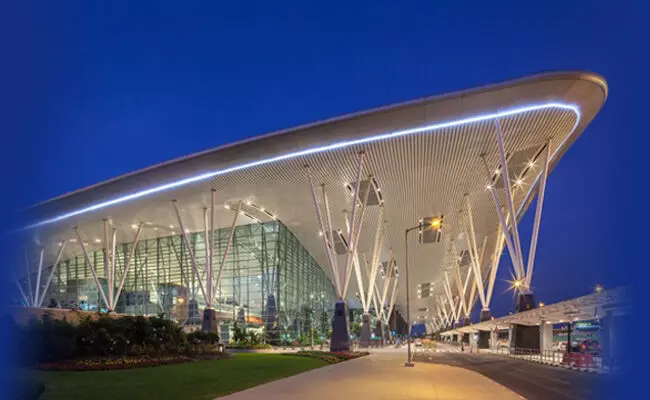
Bengaluru: Bangalore International Airport Limited (BIAL) has introduced an integrated smart airside safety system at Kempegowda International Airport to improve operational safety at key intersection zones.
According to The Hindu, the system has been designed to enhance safety at Cross Service Roads (CSRs), where aircraft and ground vehicle movements intersect.
According to BIAL, the system integrates AI-based computer vision, automation, and centralised monitoring to manage right-of-way movements and reduce the risk of human error.
“CRSs are among the most sensitive areas within airport operations, requiring precise and seamless coordination between aircraft and ground vehicles. Traditionally, right of way protection at these intersections relied on manual or semi-manual inset light activation, creating dependencies on human intervention, increasing the risk of delays and limiting operational visibility,” TH quoted BIAL as saying.
The new system uses real-time detection of vehicle movement, risk assessment, and automated signalling. AI-enabled cameras identify potential conflicts and trigger automated inset light signals to ensure aircraft priority. Normal operations resume once the area is confirmed clear.
“Based on these detections, the system triggers automated inset light activation to protect aircraft right‑of‑way and restores normal signalling once the intersection is confirmed clear. A centralised monitoring and analytics platform digitally logs all events, strengthening governance, compliance, and operational control,” BIAL said.
By embedding technology into operations, the system creates a data-driven separation layer between aircraft and ground vehicles, significantly reducing human error, especially during night and low-visibility conditions.
“Precision-led signal activation improves traffic flow, minimises unnecessary stoppage and enhances turnaround efficiency. It also establishes a scalable foundation for predictive safety analytics, enabling trend analysis, peak-hour optimisation, compliance mapping and risk forecasting to support continuous improvement and stronger airside governance,” BIAL said.