More than 200 dead after typhoon slams Philippines
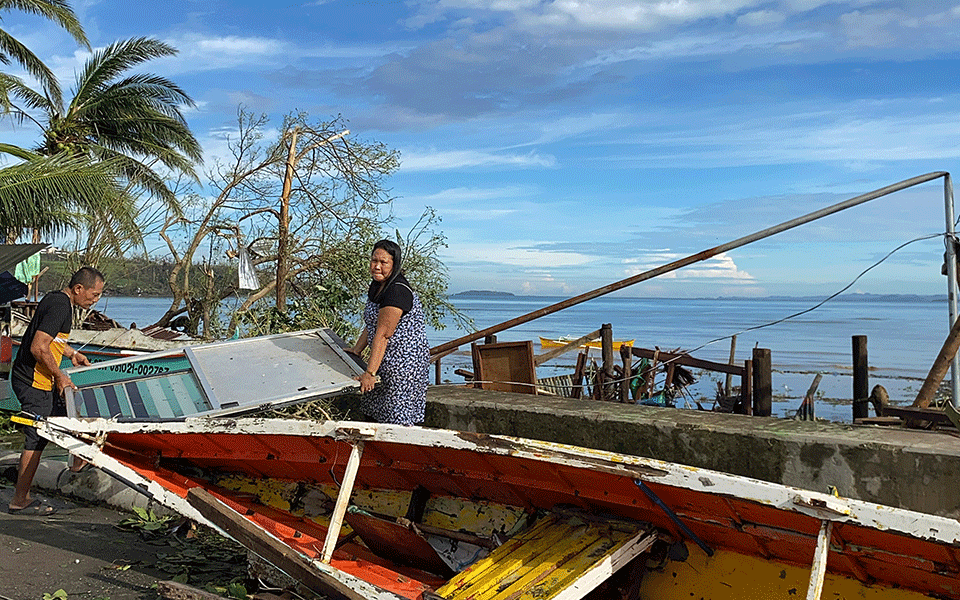
Manila (AP): The death toll rose to more than 200 following the strongest typhoon to batter the Philippines this year, with 52 people still missing and several central towns and provinces grappling with downed communications and power outages and pleading for food and water, officials said Monday.
At its strongest, the typhoon packed sustained winds of 195 kilometers (121 miles) per hour and gusts of up to 270 kph (168 mph) before it blew out Friday into the South China Sea.
At least 208 people were killed, 52 remained missing and 239 were injured, according to the national police. The toll was expected to increase because several towns and villages remained out of reach due to downed communications, power outages and clogged roads, although massive clean-up and repair efforts were underway with the improved weather.
Many of those who died were hit by falling trees or walls, drowned in flash floods or were buried alive in landslides. A 57-year-old man was found dead hanging from a tree branch in Negros Occidental province and a woman was blown away by the wind and died in the same hard-hit region, police said.
Governor Arlene Bag-ao of Dinagat Islands, which was among the southeastern provinces first hit by the typhoon, said Rai's ferocity in her island province of more than 130,000 was worse than that of Typhoon Haiyan, one of the most powerful and deadliest typhoons on record and which devastated the central Philippines in November 2013 but did not inflict any casualties in Dinagat.
If it was like being in a washing machine before, this time there was like a huge monster that smashed itself everywhere, grabbed anything like trees and tin roofs and then hurled them everywhere, Bag-ao told The Associated Press by telephone.
The wind was swirling north to south to east and west repeatedly for six hours. Some tin roof sheets were blown away then were tossed back.
At least 14 villagers died and more than 100 others were injured by flying tin roofs, debris and glass shards and were treated in makeshift surgery rooms in damaged hospitals in Dinagat, Bag-ao said. Many more would have died if thousands of residents had not been evacuated from high-risk villages before the typhoon arrived, she said.
Like several other typhoon-hit provinces, Dinagat remained without electricity and communications and many residents in the province, where the roofs of most houses and buildings were ripped off, needed construction materials, food and water.
Bag-ao and other provincial officials travelled to nearby regions that had cellphone signals to seek aid and coordinate recovery efforts with the national government.
More than 700,000 people were lashed by the typhoon in central island provinces, including more than 400,000 who had to be moved to emergency shelters.
Police, soldiers and the coast guard rescued thousands of residents including in the riverside town of Loboc in hard-hit Bohol province, where residents were trapped on roofs and trees to escape from rising floodwaters.
Emergency crews were scrambling to restore electricity and cellphone service in at least 227 cities and towns, officials said, adding that three regional airports were also damaged.
Bag-ao and other officials expressed concern that their provinces may run out of fuel, which was in high demand due to the use of temporary power generators, including those used for refrigerated warehouses where large amounts of coronavirus vaccine stocks were stored. Officials delivered vaccine shipments to many provinces for an intensified immunisation campaign, which was postponed last week due to the typhoon.
At the Vatican, Pope Francis expressed his closeness Sunday to the people of the Philippines, referencing the typhoon that destroyed many homes.
About 20 storms and typhoons annually batter the Philippines, which lies between the Pacific Ocean and the South China Sea. The Southeast Asian archipelago also lies along the seismically active Pacific Ring of Fire region, making it one of the world's most disaster-prone countries. (AP)
Let the Truth be known. If you read VB and like VB, please be a VB Supporter and Help us deliver the Truth to one and all.
Vartha Bharati–Sankalp predictions align closely with Karnataka bypoll results

Bengaluru: The Vartha Bharati–Sankalp election analysis has shown a high level of accuracy in predicting the outcome of the recent Karnataka Assembly by-elections held in May 2026, correctly calling winners in both constituencies and closely estimating vote share trends.
The by-elections were held in Bagalkot and Davanagere South, drawing significant political attention as both seats were seen as key tests for the ruling Congress and opposition BJP.
According to the analysis, Vartha Bharati–Sankalp had made three major projections ahead of the results the winning party, vote share percentages, and margin of victory.
In both constituencies, the platform accurately predicted that the Congress would emerge victorious. The outcome matched the projections, with Congress candidates winning in Bagalkot and Davanagere South.
In terms of vote share, the predictions were largely in line with the final results. In Bagalkot, the BJP’s vote share was forecast in the range of 40 to 46 per cent, while the actual figure stood at 42.9 per cent. The Congress vote share, however, exceeded expectations, with the party securing 55.4 per cent against a projected range of 43 to 48 per cent.
The margin of victory in Bagalkot turned out to be significantly higher than anticipated. While the projection had placed the margin between 2,000 and 3,500 votes, the final margin was around 22,332 votes.
In Davanagere South, the predictions also remained largely accurate. The Congress vote share was projected between 43 and 51 per cent, and the final figure stood at 43.9 per cent. The BJP was expected to secure between 42 and 50 per cent but ended with 40.3 per cent.
The analysis had also identified the role of SDPI as a potential spoiler in the constituency. While its vote share was estimated around 6 per cent, the party eventually secured around 12 per cent of the vote.
The margin of victory in Davanagere South was predicted to be between 1,500 and 2,600 votes. The actual margin was higher at around 5,708 votes, though the contest remained relatively close as anticipated.
Overall, the performance of Vartha Bharati–Sankalp stood out for correctly identifying the winning parties in both seats and maintaining close accuracy in vote share estimates, with only limited deviations in specific cases.