More than 200 scientists tell WHO coronavirus is airborne: report

New York: More than 200 scientists from 32 nations have written to the WHO, saying there is evidence that the coronavirus is airborne and even smaller particles can infect people, a significant departure from the UN health agency's claims so far that COVID-19 is spread primarily through coughs and sneezes.
A report in The New York Times says that clusters of infections are rising globally as people go back to bars, restaurants, offices, markets and casinos, a trend that increasingly confirms that the virus lingers in the air indoors, infecting those nearby.
In an open letter to the WHO, 239 scientists in 32 countries have outlined the evidence showing that smaller particles can infect people, and are calling for the agency to revise its recommendations, the report said, adding that the researchers plan to publish their letter in a scientific journal next week.
The World Health Organization (WHO) has long held that the coronavirus is spread primarily by large respiratory droplets when an infected person coughs or sneezes. In its latest update dated June 29 on the coronavirus, the WHO said airborne transmission of the virus was possible only after medical procedures that produce aerosols, or droplets smaller than 5 microns.
The guidance that the health agency has given to deal with the virus, such as wearing masks, maintaining social distance and frequent handwashing, since the pandemic first broke is based on its claim that the virus spreads through large droplets when an infected person coughs and sneezes.
If the airborne transmission is a significant factor in the pandemic, especially in crowded spaces with poor ventilation, the consequences for containment will be significant. Masks may be needed indoors, even in socially-distant settings. Health care workers may need N95 masks that filter out even the smallest respiratory droplets as they care for coronavirus patients, the NYT report said.
It said that ventilation systems in schools, nursing homes, residences and businesses may need to minimise recirculating air and add powerful new filters. Ultraviolet lights may be needed to kill viral particles floating in tiny droplets indoors, it said.
WHO's technical lead on infection control Dr Benedetta Allegranzi, however, said in the report that the evidence for the virus spreading by air was unconvincing. Especially in the last couple of months, we have been stating several times that we consider airborne transmission as possible but certainly not supported by solid or even clear evidence. There is a strong debate on this, she said.
Interviews with nearly 20 scientists, including a dozen WHO consultants and several members of the committee that crafted the guidance, and internal emails paint a picture of an organization that, despite good intentions, is out of step with science, the report said.
Whether carried aloft by large droplets that zoom through the air after a sneeze, or by much smaller exhaled droplets that may glide the length of a room, these experts said, the coronavirus is borne through the air and can infect people when inhaled, it said.
Experts pointed out that WHO's infection prevention and control committee is bound by a rigid and overly medicalized view of scientific evidence, is slow and risk-averse in updating its guidance and allows a few conservative voices to shout down dissent.
They'll die defending their view, one longstanding WHO consultant was quoted as saying in the report.
The WHO was relying on a dated definition of airborne transmission. The agency believes an airborne pathogen, like the measles virus, has to be highly infectious and to travel long distances, said Linsey Marr, an expert in airborne transmission of viruses at Virginia Tech.
WHO's chief scientist Dr Soumya Swaminathan said in the report that agency staff members were trying to evaluate new scientific evidence as fast as possible, but without sacrificing the quality of their review. She said the UN health agency will try to broaden the committees' expertise and communications to make sure everyone is heard. We take it seriously when journalists or scientists or anyone challenges us and say we can do better than this. We definitely want to do better, she said.
As the pandemic spread across the world, a lag by the global health agency in issuing critical guidelines was seen as hampering efforts to control the outbreak. It lagged behind most of its member nations in endorsing face coverings for the public. While many organisations, including The Centers for Disease Control and Prevention, have long since acknowledged the importance of transmission by people without symptoms, the WHO still maintains that asymptomatic transmission is rare.
The NYT report says that many experts said the WHO should embrace what some called a precautionary principle and others called needs and values the idea that even without definitive evidence, the agency should assume the worst of the virus, apply common sense and recommend the best protection possible.
There is no incontrovertible proof that SARS-CoV-2 travels or is transmitted significantly by aerosols, but there is absolutely no evidence that it's not, said Dr Trish Greenhalgh, a primary care doctor at the University of Oxford in Britain. So at the moment, we have to make a decision in the face of uncertainty, and my goodness, it's going to be a disastrous decision if we get it wrong. So why not just mask up for a few weeks, just in case, she said.
Let the Truth be known. If you read VB and like VB, please be a VB Supporter and Help us deliver the Truth to one and all.
CPI(M) rebel Kunhikrishnan hopes for 5,000-vote win in Payyanur
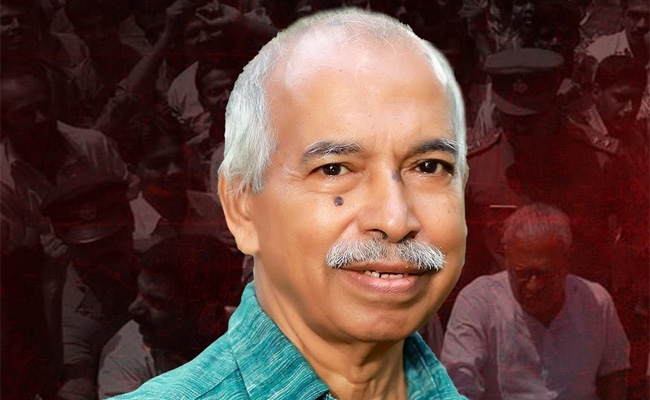
Kannur (Kerala) (PTI): CPI(M) rebel candidate V Kunhikrishnan, who contested as a UDF-backed Independent from Payyanur here, on Saturday said he was hoping to win the Assembly election by a margin of 5,000 votes.
Kunhikrishnan was expelled from the CPI(M) earlier this year after raising allegations of corruption in the party’s martyrs’ fund against sitting MLA T I Madhusoodanan.
Speaking to a TV channel, Kunhikrishnan said he had announced his candidature as a mark of protest and not with expectations of victory.
However, he said the situation had changed drastically, with a strong undercurrent within CPI(M) votes favouring him.
"The undercurrent in CPI(M) votes cannot be measured. Now people are giving a response indicating victory with a margin of at least 5,000 votes," he said.
Payyanur is considered a CPI(M) stronghold, and a defeat for Madhusoodanan there would be a major setback for the party.
On political violence in Payyanur, Kunhikrishnan said he had been facing it since filing his nomination.
"The people leading this violence should think about how long they can continue it. It is the police which has to take the initiative to stop this violence as part of maintaining law and order. But the police are not intervening at the required level," he said.
Regarding his political future, Kunhikrishnan said efforts were underway to strengthen Left groups, and discussions were being held across Kerala in that regard.
"After discussing with others, a decision will be taken," he said.
Kunhikrishnan is among six former CPI(M) leaders who either exited the party or were suspended before contesting for the UDF in the April 9 Assembly elections.
Elections to the 140-seat Kerala Assembly were held on April 9, and the counting of votes will be held on May 4.