More than 29 million hydroxychloroquine doses bought by US have come from India: Trump
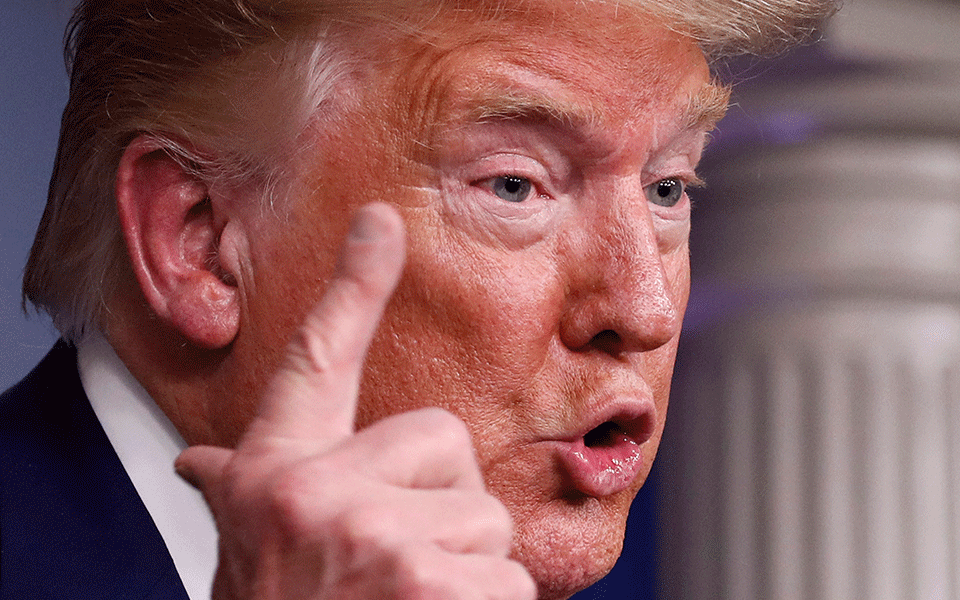
Washington: A sizeable chunk of the 29 million doses of hydroxychloroquine bought by the US to combat the coronavirus pandemic is from India, President Donald Trump has said as he acknowledged that Prime Minister Narendra Modi was "great" when he sought his help to allow the sale of the anti-malaria drug to treat the growing number of COVID-19 patients in America.
Trump and Prime Minister Modi spoke over the phone last week. During the call, Trump requested Modi to lift the hold on the American order of hydroxychloroquine, of which India is the major producer.
Hydroxychloroquine has been identified by the US Food and Drug Administration as a possible treatment for the COVID-19 and it is being tested on more than 1,500 coronavirus patients in New York. Anticipating that it will work, given initial positive results, Trump has bought more than 29 million doses of hydroxychloroquine for potential treatment of COVID-19 patients.
"I bought millions of doses (of hydroxychloroquine). More than 29 million. I spoke to Prime Minister Modi, a lot of it (hydroxychloroquine) comes out of India. I asked him if he would release it? He was Great. He was really good," Trump told Sean Hannity of the Fox News on Monday night.
"You know they put a stop because they wanted it for India, Trump said responding to a question on the usage of hydroxychloroquine.
India on Tuesday allowed the export of hydroxychloroquine to the US, which has emerged as the global hotspot of COVID-19.
By Tuesday night, nearly four lakh Americans tested positive for the novel coronavirus and the fatalities was more than 12,850. During the interview, Trump described hydroxychloroquine as a powerful malaria drug. The drug is being tested on hundreds of coronavirus patients in New York.
But there are a lot of good things coming from that, Trump said.
Lot of people are looking at it and saying, you know I don't hear bad stories, I hear good stories. And I don't hear anything where it is causing death, said the US President.
Hydroxychloroquine, an old and inexpensive drug used to treat malaria, is seen as a viable therapeutic solution by President Trump to coronavirus.
Last week Trump said he has sought help from Prime Minister Modi to allow the sale of hydroxychloroquine tablets ordered by the US to treat the growing number of coronavirus patients in his country, hours after India banned the export of the anti-malarial drug.
India has received similar requests from several other countries including its immediate neighbours Sri Lanka and Nepal. India has said that it is reviewing its export ban order.
Notably, India's decision to ban the exports of hydroxychloroquine is
Let the Truth be known. If you read VB and like VB, please be a VB Supporter and Help us deliver the Truth to one and all.
Man arrested with Rs 2.54-crore heroin in Mumbai
Mumbai (PTI): Police have arrested a man and seized over 500 grams of heroin worth Rs 2.54 crore in the illicit market from him in Mumbai, officials said on Friday.
The police's Anti-Narcotics Cell (ANC) made the drug seizure in Santacruz in the western suburbs. The operation was conducted by the Kandivali unit of the ANC on Thursday as part of a special crackdown against drug trafficking in the area, they said.
Acting on specific inputs, an ANC team conducted a raid in Santacruz (East) and intercepted a man. During a search, the team recovered 508 grams of high-grade heroin from his possession, an official said.
The seized contraband, a highly addictive, opioid drug derived from morphine, is estimated to be worth Rs 2.54 crore in the international market, he informed.
Following the seizure, a case was registered against the man under relevant sections of the Narcotic Drugs and Psychotropic Substances (NDPS) Act, 1985, and he was formally placed under arrest in the early hours of Friday.
The police are currently investigating the source of the drug and trying to identify the intended recipients of the consignment, he said.