More than 30 dolphins have died since oil spill in Russia: Experts
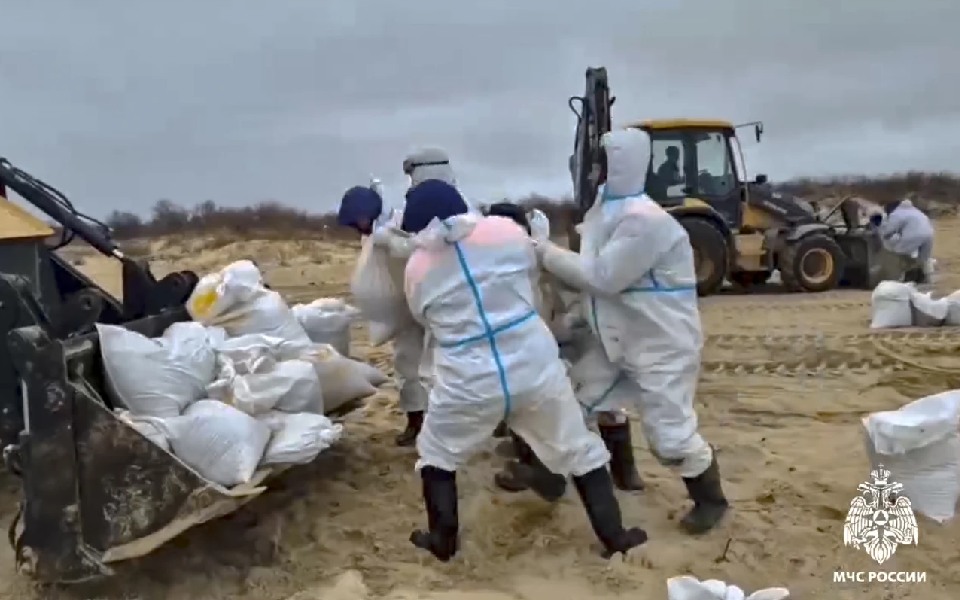
Washington, Jan 5: Thirty-two dolphins have died since fuel oil spilled out of two storm-stricken tankers three weeks ago in the Kerch Strait, which separates the Russia-occupied Crimean Peninsula from Russia's southern Krasnodar region, an animal rescue group said Sunday.
Russia's Delfa Dolphin Rescue and Research Center said the deaths are “most likely related to the fuel oil spill”.
The centre said on the messaging app Telegram that a total of 61 dead cetaceans — an order of aquatic mammals that includes whales and dolphins — had been recorded since the emergency, but the condition of the bodies suggested that the 29 others had died before the spill.
“Judging by the condition of the bodies, most likely the majority of these cetaceans died in the first 10 days after the disaster. And now the sea continues to wash them up,” the centre wrote, noting that most of the dead dolphins were from the endangered Azov species.
Russia's Emergencies Ministry said on Sunday that over 96,000 tons of contaminated sand and soil had been removed by officials and volunteers along the shoreline of the Krasnodar region's Anapa and Temryuk districts.
Russia-appointed officials in Moscow-occupied Crimea announced a regional emergency on Saturday after oil was detected on the shores of Sevastopol, the peninsula's largest city some 250 kilometers (155 miles) from the Kerch Strait.
On December 23, the ministry estimated that up to 200,000 tons in total may have been contaminated with mazut, a heavy, low-quality oil product.
Russian President Vladimir Putin has called the oil spill an “ecological disaster”.
The Kerch Strait is an important global shipping route, providing passage from the inland Sea of Azov to the Black Sea.
It has also been a key point of conflict between Russia and Ukraine after Moscow annexed the peninsula in 2014. In 2016, Ukraine took Moscow to the Permanent Court of Arbitration, where it accused Russia of trying to seize control of the area illegally. In 2021, Russia closed the strait for several months.
Mykhailo Podolyak, an adviser to the head of Ukrainian President Volodymyr Zelenskyy's office, described the oil spill last month as a “large-scale environmental disaster” and called for additional sanctions on Russian tankers.
Let the Truth be known. If you read VB and like VB, please be a VB Supporter and Help us deliver the Truth to one and all.
Punjab CM Mann meets President Murmu, seeks cancellation of membership of 6 RS members
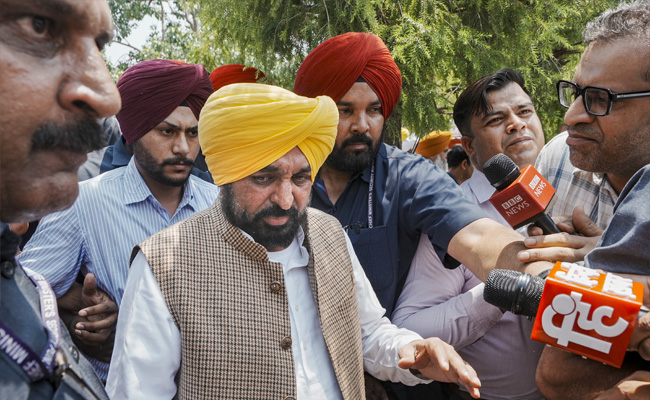
Chandigarh (PTI): Chief Minister Bhagwant Mann on Tuesday met President Droupadi Murmu, demanding the termination of the membership of six Rajya Sabha MPs from Punjab who defected to the BJP and also pressed for the introduction of a constitutional provision allowing for the recall of members.
Accompanied by party MLAs and ministers, Mann visited Rashtrapati Bhavan in Delhi.
This meeting followed a significant setback for the Aam Aadmi Party (AAP) on April 24, when seven of its 10 Rajya Sabha MPs -- Raghav Chadha, Ashok Mittal, Sandeep Pathak, Harbhajan Singh, Rajendra Gupta, Vikramjit Sahney and Swati Maliwal -- quit and merged with the BJP, alleging that the party had strayed from its principles, values and core morals. Six of the seven MPs who left AAP hailed from Punjab.
After he met with the President, Mann addressed the media here, describing the departure of the seven MPs as a "murder" of the Constitution. He stated, "Seven MPs merging with another party is completely unconstitutional. I spoke to Rashtrapati ji in detail."
Mann pointed out that he told the President that the BJP holds only two MLA seats (in Punjab), yet now has six MPs in the Rajya Sabha. He questioned, "How can this be possible? Isn't it a mockery of the Constitution?
"If they are such revolutionaries at heart, then they should have resigned from their six seats. The AAP could have sent someone else," Mann said, taking a swipe at them.
He emphasised the need for a recall provision in the Constitution, referencing MP Raghav Chadha's previous demands for such a measure when members fail to meet public expectations.
"Have you lived up to the expectations of the people?" Mann challenged the MPs during his statement.
Mann also presented a letter to the President, signed by all AAP MLAs. He differentiated between the terms 'elected' and 'selected,' stating, "They were 'selected.' Therefore, their membership should be cancelled."
The President assured Mann that she would consult constitutional experts before responding.
Earlier in the day, Mann, along with party MLAs, departed for Delhi from Chandigarh.
Speaking to reporters in Chandigarh, Mann affirmed that all AAP MLAs stand united with the party. "Only I have been given time for the meeting," Mann said.
"The President is the guardian of the Constitution. She is the constitutional head of the country," he added.
Later in a post on X in Hindi, Mann said, "Our struggle to protect Punjab's rights and interests continues. Today, along with all AAP MLAs, I have left to discuss Punjab's burning issues and present the state's strong voice before the President.
As your public servant, our government remains fully committed to Punjab's prosperity and the safeguarding of the rights of every section of society."
The MLAs and ministers gathered at the chief minister's residence in the morning before heading to Delhi, carrying placards that read 'Punjab Mann De Naal' and 'Punjab's Traitors.'
The legislators left for Delhi in buses.
Mann had previously sought an appointment with the President to meet with party MLAs and demand the "recall" of the Rajya Sabha MPs who defected to the BJP. However, only Mann was given a time slot for the meeting.