Mount Everest is now 86 cms taller! : Nepal & China after remeasurement
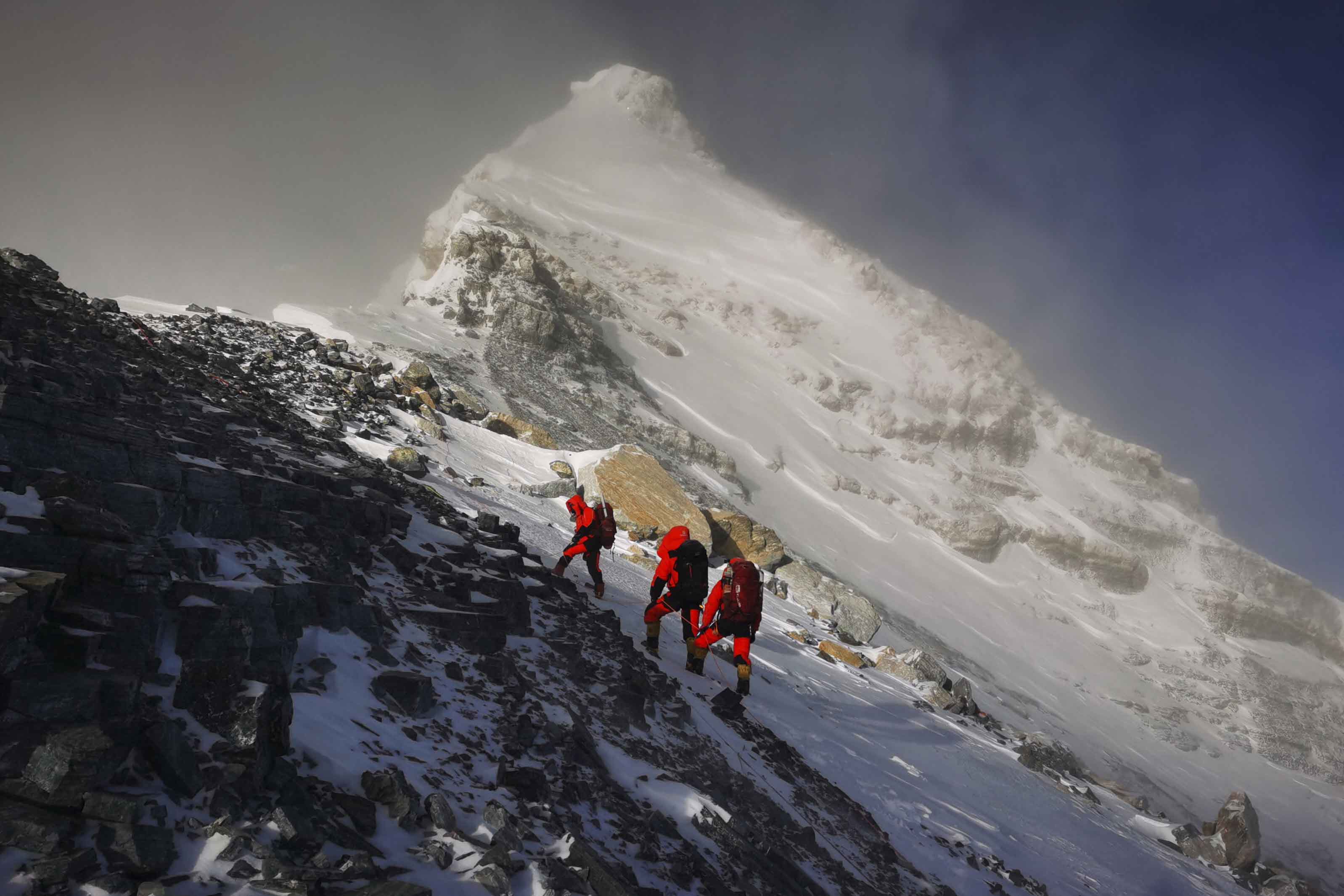
Kathmandu/Beijing, Dec 8: The world's highest peak is now taller by 86 centimetres, Nepal and China jointly announced on Tuesday after they remeasured Mt. Everest at 8,848.86 metres, over six decades after India conducted the previous measurement in 1954.
The revised height of Mt. Everest puts an end to the decades-long dispute between the two neighbours on the height of the world's tallest mountain that straddles their shared border.
The exact height of Mount Everest had been contested ever since a group of British surveyors in India declared the height of Peak XV, as it was initially called, to be 8,778 metres in 1847.
Mt. Everest stands on the border between China and Nepal and mountaineers climb it from both sides. Mt. Everest known as Sagarmatha in Nepal while in China it is called as Mt. Qomolangma, the Tibetan name for the world's highest peak.
The Nepal government decided to measure the exact height of the mountain as some geologists suggested that there might have been some changes due to various reasons, including the devastating earthquake of 2015. The 7.8 magnitude earthquake killed nearly 9,000 people in Nepal, and caused an avalanche which buried parts of the base camp at the mountain.
Mt. Everest's revised height was officially announced by Nepalese and Chinese foreign ministers at a special virtual event.
Nepal's Foreign Minister Pradeep Minister Gyawali and his Chinese counterpart Wang Yi attended the virtual event, and read out the letters written by their respective heads-of-the-state President Bidya Devi Bhandari and Chinese President Xi Jinping.
"This is a historic day. The new height of Mt Everest is 8,848.86 metres," Gyawali said while making the much-awaited announcement.
Speaking on the occasion, Gyawali and Wang expressed their satisfaction over the existing friendly and cooperative bilateral relations between the two countries.
Wang too announced the mountain's height to be 8,848.86 metres immediately afterwards.
The new height is 86 cms more than the previous measurement. According to the measurement done in 1954 by Survey of India, the height of Mount Everest is 8,848 metres.
The widely accepted height of 8,848 metres or 29,028 feet was determined by the Survey of India in 1954 from Bihar using the trigonometric method. It was the third survey by India, The Kathmandu Post reported.
A Chinese survey in 1975 obtained the figure of 29,029.24 feet (8,848.11 metres), and an Italian survey, using satellite surveying techniques, obtained a value of 29,108 feet (8,872 metres) in 1987, but questions arose about the methods used, the report said.
The joint survey is significant as China in 2018 differed with Nepal over the height of Mt. Everest and stuck to its calculations that the peak of the world's tallest mountain was four meters less than Kathmandu's measurement.
In 2018 China said it has not changed its measurement of the height of Mt. Qomolangma.
China recognises Mt. Qomolangma as the world's tallest, measuring 8,844.43 metres above sea level, the National Administration of Surveying, Mapping and Geo-information told the Xinhua News Agency in Feb 2018, in response to reports that China had agreed to accept Nepal's measurement of 8,848 metres.
The measurement was significant as China and Nepal settled their border dispute in 1961 with the boundary line passing through the summit of Mt. Everest.
The peak of Mt. Everest played a significant role in the settlement of the boundary between Nepal and China, after Beijing gave up its claims over the whole mountain as part of its territory after it took control of Tibet in 1950.
The dispute was finally settled in 1961 after the intervention of the ruling Communist Party of China founder Mao Zedong, who suggested that the boundary line should pass through the summit of the Mt. Everest, which was agreed by Nepal.
The latest survey puts both the countries on the same page about its height as Beijing seeks firm up its strategic ties with Nepal with huge investments in infrastructure projects, while enhancing its political influence over the Himalayan country.
President Xi said in his letter that China and Nepal reached a consensus last year on the joint announcement of the new height of the peak.
For more than a year, the two countries' survey teams have overcome all kinds of difficulties, solidly carried out their work, and finally reached a conclusion on the snow-covered height based on the International Height Reference System, he said.
Describing Mt. Qomolangma "an important symbol of the China-Nepal traditional friendship," Xi said it is agreed by both countries as the boundary peak and the "Peak of China-Nepal Friendship," the Xinhua report said.
He said the joint announcement of the new height of Mt. Qomolangma with his Nepali counterpart is of great significance in carrying forward the undertakings of the predecessors to the future, and showcasing the high level of the continuous development of China-Nepal relations.
China is willing to join hands with Nepal to actively promote the cooperation in ecological and environmental protection and scientific research, and better safeguard the precious wealth and home of both peoples, Xi said.
Let the Truth be known. If you read VB and like VB, please be a VB Supporter and Help us deliver the Truth to one and all.
Commission agent's licence suspended in Meerut for storing veggies in toilet
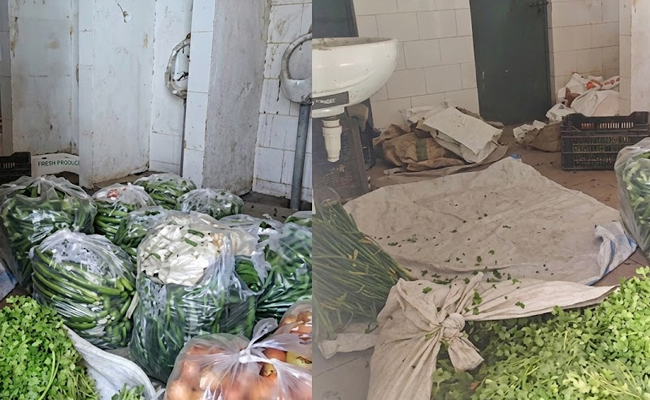
Meerut (UP) (PTI): The market administration in Meerut has suspended the licence of a commission agent or ‘arhtiya’ for storing vegetables inside a defunct toilet at the Mawana Naveen Sabzi Mandi in the city, officials said on Sunday.
The action followed after a video went viral showing vegetables, including tomato, ladyfinger, green chilli, coriander, mint and bottle gourd – packed in polythene bags inside an unused toilet on the market premises.
The secretary of the Mandi committee, Arjun Singh, told PTI that the toilet had been out of use for a long time due to being clogged.
“Abhay Kumar, the proprietor of Pradhan Trading Company, stored leftover vegetables there without permission. Within two hours of receiving information on May 15, a team from the Mandi committee reached the spot, seized about one quintal of vegetables, and buried them in a pit,” Singh said.
A notice was issued to Abhay Kumar, but since no satisfactory response was received, his licence has been suspended, he added.
According to officials, toilets in the market complex meant for use by farmers, commission agents and customers were allegedly being used as storerooms.
Following the incident, SDM Santosh Kumar Singh has sought an explanation from the Mandi committee secretary.
Strict action would be taken against those found guilty after an inquiry report is received, the SDM said.