MP: Congress claims national water award won with AI-images; administration rejects charge
Indore/Khandwa (PTI): The Congress has accused the Madhya Pradesh government of corruption, claiming that the Khandwa district administration won a national water conservation award using AI-generated images, a claim dismissed by authorities.
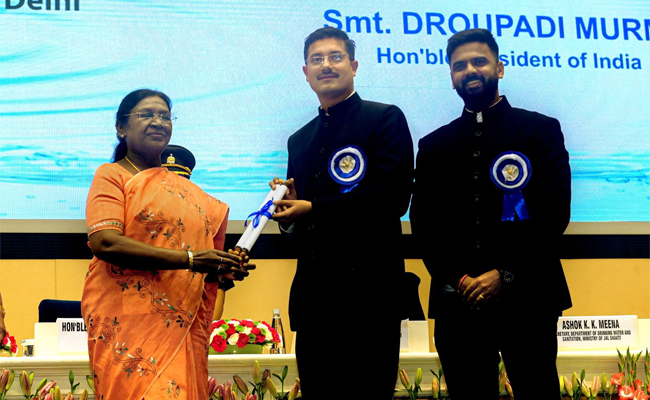
Khandwa district secured first place nationwide for outstanding work in water conservation under the Centre's 'Jal Sanchay, Jan Bhagidari' campaign. It received a Rs 2 crore award at the sixth National Water Awards ceremony held in New Delhi in November, officials said on Monday.
They said the Kaveshwar panchayat in Khandwa district also won the second prize in the best gram panchayat category at the ceremony.
MP Congress president Jitu Patwari, in a post on X, alleged, "Where the BJP government should teach our children the proper use of AI, it is itself indulging in corruption using AI. In Khandwa, officials of the BJP government turned two-foot-deep pits into wells using AI, and uploaded AI-generated images of various development works across the area on the portal."
Based on these images, they even took an award from the Honourable President, he alleged.
"When the ground reality came to light, fields and empty grounds were found there. Clearly, this was not water conservation, but a game of technology-created images. Under the BJP rule, corruption has also become smart," he added.
As the controversy over the allegations linked to the National Water Award escalated, the Khandwa administration held a press conference to clarify its position.
District Panchayat Chief Executive Officer (CEO) Nagarjun B Gowda said that uploading AI-generated images had no connection whatsoever with the National Water Award.
He said "verified images after thorough scrutiny" of 1,29,046 works carried out under the 'Jal Sanchay, Jan Bhagidari' campaign were uploaded on the campaign's JSJB portal.
Gowda said the Union Jal Shakti Ministry verified all these images and conducted random field inspections of one per cent of the total works.
"Prima facie, false news about water conservation works carried out in Khandwa district is being spread by some social media accounts," he added.
He said photographs related to water conservation are uploaded on another portal named 'Catch the Rain' only for educational and motivational purposes.
"The district administration has found that 21 images generated through AI were uploaded on the Catch the Rain portal. This was possibly done with malicious intent. The district administration is taking action against those who uploaded these images," the CEO added.
"The Catch the Rain portal is completely different from the Jal Sanchay, Jan Bhagidari campaign portal. Awards under the Jal Sanchay, Jan Bhagidari campaign are not considered based on images uploaded on the Catch the Rain portal," Gowda added.
More than 1.25 lakh water conservation works were carried out in Khandwa district under the 'Jal Sanchay, Jan Bhagidari' campaign, the highest in the country, he added.
Let the Truth be known. If you read VB and like VB, please be a VB Supporter and Help us deliver the Truth to one and all.
India should create strategic buffers to navigate 'most difficult' energy shock: CEA Nageswaran
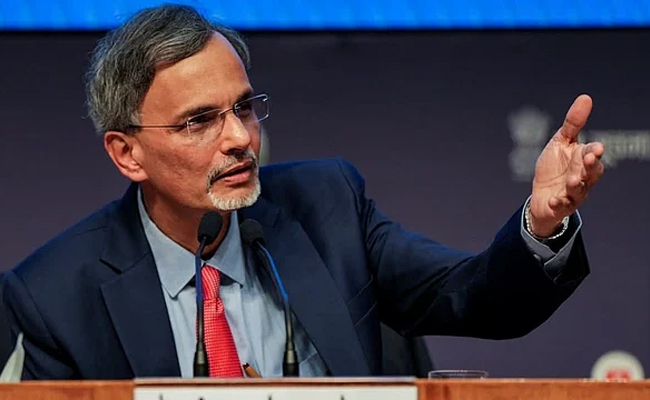
New Delhi (PTI): Chief Economic Advisor V Anantha Nageswaran on Saturday said India needs to create strategic buffers in the face of the "most difficult" energy shock that the country is facing amid the West Asia crisis.
Nageswaran also said the rising prices of fertiliser and petroleum products globally due to the crisis will make it challenging to achieve the 4.3 per cent fiscal deficit target for the current fiscal, while below normal monsoon and pass-through of higher energy prices could lead to "potential inflation spike".
He also said India has employment challenge emanating from AI, and there is a need to ensure that IT sector becomes more competitive and not lose jobs to AI, and instead create jobs that use AI within the IT sector or in other services.
Speaking at the ICPP Growth Conference organised by the Ashoka University, Nageswaran said the current account deficit (CAD) in the current fiscal could rise to over 2 per cent of GDP, from less than 1 per cent in FY'26.
"The ... priority for us is to create strategic buffers. This energy shock is the most difficult one compared to any other previous energy shock in terms of energy lost as a percentage of total global energy supply, not just oil, including gas.
"And we also need to use this occasion to think about other areas where we are vulnerable in terms of import dependence, nickel, tin, and copper. We need to build strategic buffers if we have to make a shot at manufacturing and becoming indispensable," Nageswaran said.
Since the beginning of the war in West Asia on February 28, crude oil prices soared to a four-year high of USD 126 per barrel on Thursday, from about USD 73 level before the war.
Stating that geopolitics will compel policymakers to be nimble and flexible and shed old model of thinking, Nageswaran said India is better prepared than many other countries to deal with the crisis because of the fiscal leeway that the country has due to lowering of fiscal deficit ratio to 4.4 per cent of GDP in FY'26.
Nageswaran said the West Asia conflict is more of a price shock than supply shock for India as the government is managing the supply side deftly.
"This particular conflict, which is going to be on a low simmer or a high flame situation, whatever it is, it is going to be there with us in some form or the other because the military conflict may be over, but the strategic conflict is well and truly alive. It will be so for some time," Nageswaran said.
He said the conflict has four channels of shock: price and supply shock, trade impact, sticky logistics costs and remittance shock.
India imports 60 per cent of its LPG usage and of that, 90 per cent flows through the now closed Strait of Hormuz.
Nageswaran said the pass-through of high global energy prices would have to be a "balancing act". He said some pass-through is already happening in commercial LPG, and the levy of export duty on diesel and ATF.
The government has cut excise duty on petrol and diesel to shield customers from the impact of the rise in petroleum prices. "We are coming around to arriving at a certain modus vivendi with respect to burden-sharing between the fiscal policy side, inflation, households and the oil marketing companies. So it has to be a balancing act," Nageswaran said.