Mukherjee believed deeply in importance of India, US tackling global challenges together: Biden
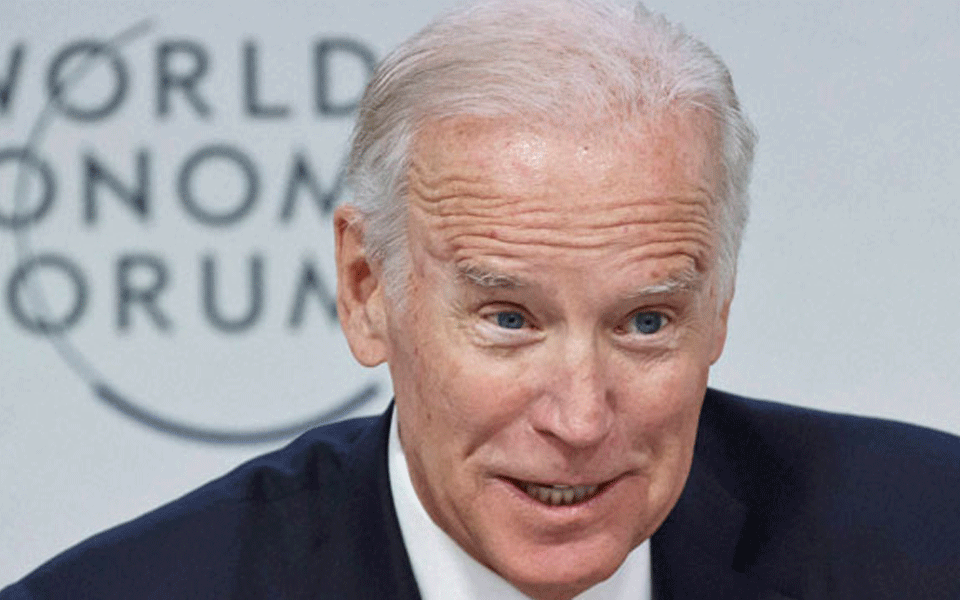
Washington: Pranab Mukherjee believed deeply in the importance of India and the US tackling global challenges together, Democratic presidential candidate Joe Biden has said, condoling the death of the former president.
Several other prominent US leaders and organisations also condoled Mukherjee's death, saying he will go down in history among India's most distinguished statesmen and scholars.
The 84-year-old veteran politician died after he suffered a septic shock on Sunday. He died of a cardiac arrest on Monday evening following a 21-day battle with multiple ailments.
"President Shri Pranab Mukherjee was a devout public servant who believed deeply in the importance of our two nations tackling global challenges together. Jill and I are saddened to hear of his passing - our prayers go out to his loved ones and the Indian people," Biden said on Monday.
As a Senator, in particular as member of the Senate Foreign Relations Committee and its chairman and later as the vice president of the United States, Biden had a strong friendship with Mukherjee, who was one of the most well-known Indian leaders in the US.
According to Deputy Secretary of State Stephen Biegun, a strong US-India partnership will be one of Mukherjee's many lasting legacies.
"He'll go down in history among India's most distinguished statesmen and scholars, and his many visits to Washington, everything he did for the relationship, played an instrumental role in expanding this US-India relationship, both in defence and external affairs when he was the minister," the top American diplomat said during the virtual India US Leadership Summit organised by the US India Strategic and Partnership Forum (USISPF) on Monday.
"Our thoughts and prayers are with his family and friends," the USISPF said.
Condoling Mukherjee's demise, the South and Central Asia Bureau of the State Department in a tweet said, "We stand with the people of India as they grieve the loss of a great leader who will be forever remembered in the annals of Indian history.
The US India Business Council said with Mukherjee's death, India lost an incredible statesman. He was a longtime supporter of the US-India partnership, it tweeted.
The New York Times described the former president as an "Indispensable Man of Indian Politics".
"His 50-year career set an everlasting example for the world's largest democracy," Congressman Pete Olson said.
In a statement, Indian Overseas Congress, USA, expresses its deep sorrow and sincere condolences on the demise of Mukherjee.
"He was a quintessential congressman, formidable leader and a great parliamentarian, said George Abraham, vice-chairman of the IOC, USA.
"NRIs across the globe will fondly remember his contribution to the country in various capacities as a political leader, minister of important portfolios, sharp troubleshooter and a statesman with an independent mindset who adorned the office of the presidency. We also pay tribute to the pivotal role he has played in passing the Indo-US civil nuclear treaty despite the coalition partners' threats," he said.
North America Telugu Society said Mukherjee leaves behind a rich legacy of his work, which will inspire generations to come.
He championed issues that lie at the heart of India's social, economic and developmental challenges -- literacy, healthcare, food security, energy security, rural and urban planning, economic empowerment, governance and administrative reforms, and national and regional security, it said.
Let the Truth be known. If you read VB and like VB, please be a VB Supporter and Help us deliver the Truth to one and all.
Manipur: Mortal remains of children killed in bomb attack handed over to family
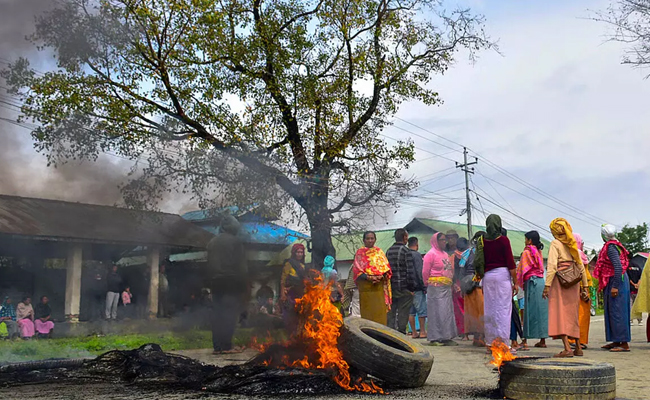
Imphal (PTI): The mortal remains of two children, who were killed in a bomb attack in Manipur's Bishnupur district in April, were handed over to family members on Saturday, officials said.
The bodies of the five-year-old boy and his six-month-old sister were kept in the morgue for 25 days, as the family members had refused to accept the mortal remains, demanding that the perpetrators be brought to book at the earliest.
On April 25, Chief Minister Y Khemchand Singh had appealed to the family members of the children to accept the bodies. Singh had also said that all efforts were underway to find the culprits.
The two children were killed in a bomb attack at Tronglaobi in Bishnupur district on April 7. Their bodies were kept in the morgue at the Regional Institute of Medical Sciences in Imphal.
The incident had triggered widespread violent protests in the five valley districts of Manipur, and the case was subsequently handed over to the NIA.
Hundreds of people lined up along the way to Tronglaobi to offer floral tributes, as the mortal remains were taken for the last rites in an open vehicle earlier in the day.